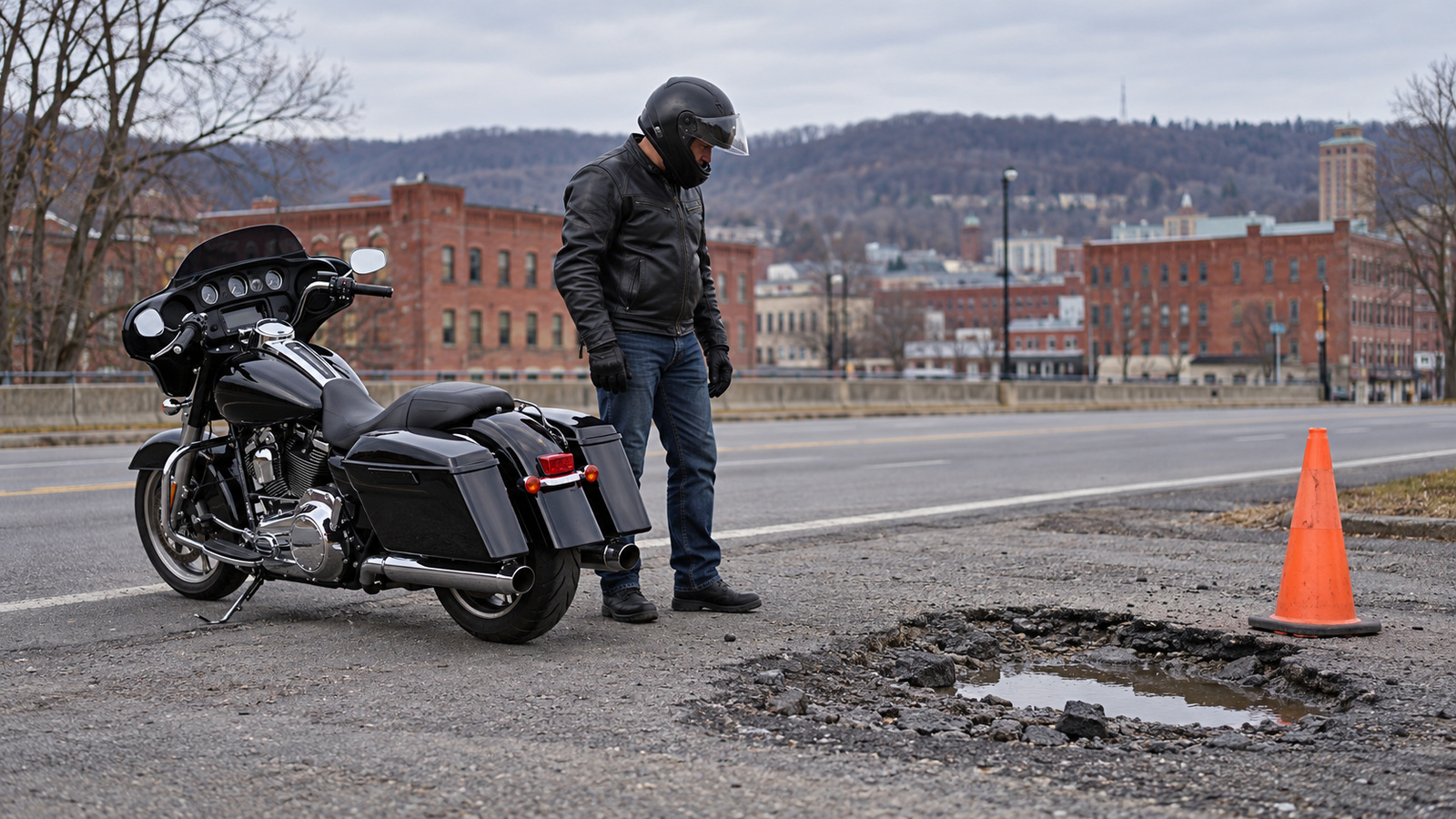
Pothole or Road Defect Crash in Binghamton: Who Is Responsible and What Deadlines Apply
A pothole that a car rolls through can be a serious problem for a motorcycle. Broken pavement, a sunken utility cut or an uneven road edge can also upset a rider's path. After a road defect crash in Binghamton, the questions go beyond how big the hole was. Who controlled that stretch of pavement? What notice existed before the crash? Which deadlines apply? Those answers can determine whether a claim is possible.
First, Identify Who Maintains That Exact Road Segment
A Binghamton mailing address does not establish that the city maintains the pavement. Responsibility may sit with a city, town, county or New York State. A contractor or utility may also have relevant duties after excavation or construction. The owner, maintenance arrangements and work history all deserve review.
Front Street, the Vestal Parkway, Route 26, Route 434 and neighborhood city streets pass through different settings. Record the precise location rather than deciding responsibility from the road's familiar name. Note the nearest intersection, direction of travel and lane. Photos of nearby landmarks and a saved map pin can help identify the segment. Do not assume that reporting the hole to one office reaches every potentially responsible party.
The 90-Day Notice Is Separate From a Lawsuit
For a typical negligence claim against a city, town or county, General Municipal Law 50-e generally requires a written notice of claim to be properly served within 90 days after the claim arises. This gives the public entity an opportunity to investigate. An ordinary repair request, phone call or social media post should not be assumed to meet that requirement.
General Municipal Law 50-i generally sets a separate one-year-and-90-day period to begin a municipal negligence lawsuit. Other prerequisites also apply. Serving a notice does not itself start the lawsuit. Exceptions and possible late-notice relief depend on the circumstances and court permission, so do not plan around an extension.
Prior Written Notice Means Notice Before the Crash
Many municipalities have local laws requiring prior written notice of particular road defects. This is a different issue from your notice of claim after an injury. Depending on the applicable law, the municipality may need to have received qualifying written notice of the defect before the crash. General awareness of rough pavement or a verbal complaint may not satisfy that law.
Local wording and records matter. Narrow exceptions can include a municipality's affirmative negligent creation of the hazard or a qualifying special use. Those exceptions are fact dependent. A poorly repaired patch does not automatically establish one. A Binghamton motorcycle accident lawyer can examine the governing rule, prior complaints, work orders and maintenance records rather than treating the hole's appearance as proof of legal responsibility.
New York State Claims Follow a Different Process
Negligence claims against New York State generally belong in the Court of Claims. Under Court of Claims Act 10, a negligence claim generally must be filed with the court and served on the Attorney General within 90 days of accrual, unless a qualifying notice of intention is timely served. A proper notice of intention generally extends that negligence claim's filing and service period to two years. Court of Claims Act 11 governs important content and service requirements.
Do not send a municipal form to a highway office and assume the state requirements are satisfied. Highway Law 58 also contains a seasonal restriction on state highway defect liability that can matter for winter crashes. Its application and any exceptions need individual review. The correct defendant, court and procedure must be identified promptly.
Save Evidence Before the Defect Changes
Get to safety and call 911 for injuries or immediate danger. Medical care comes before documenting pavement. If it is safe, photograph the defect from several angles, including a wide view showing its location in the lane. Close photographs with a familiar object for scale may help show size. Never enter moving traffic or lean over an unsafe hole to get a measurement.
Save the original files with their date information. Record when the pictures were taken, the exact location, weather and lighting. Keep witness contact details, any police report number, photos of the bike and gear, medical records and receipts. Preserve damaged items. A quick repair may change what later photographs show, but a repair alone does not establish liability. If someone else takes photos for you, keep their contact information too.
The General Three-Year Rule Does Not Replace Shorter Deadlines
Ordinary New York negligence injury claims generally have a three-year lawsuit limit under CPLR 214. That familiar rule does not excuse missing a municipal notice requirement or a Court of Claims deadline. Claims involving private contractors may raise different issues alongside a government claim. Getting advice early allows each potential claim to be assessed on its own timetable.
A Road Defect Claim Checklist
- Locate: Save the lane, travel direction, nearest intersection and map location.
- Document: Preserve safe wide and detailed photos, date information and witnesses.
- Identify: Check the owner, maintenance responsibility and recent work.
- Act: Review notice, service and lawsuit deadlines promptly.
Questions After a Southern Tier Road Defect Crash?
Call Tom Schimmerling and Schimmerling Injury Law at (607) 772-5291 for a free case review. Get help understanding responsibility, evidence and the deadlines that may apply to your situation.
Primary sources: General Municipal Law 50-e; General Municipal Law 50-i; Court of Claims Act 10; Court of Claims Act 11; Highway Law 58; New York appellate discussion of prior written notice and exceptions; CPLR 214.
General information, not legal advice for a particular claim. Applicable rules, exceptions and deadlines depend on the facts. No outcome is promised.

Tom Schimmerling and the Binghamton motorcycle injury attorneys at Schimmerling Injury Law represent riders hurt by negligent drivers. If you have questions after a crash, their team is here to help.