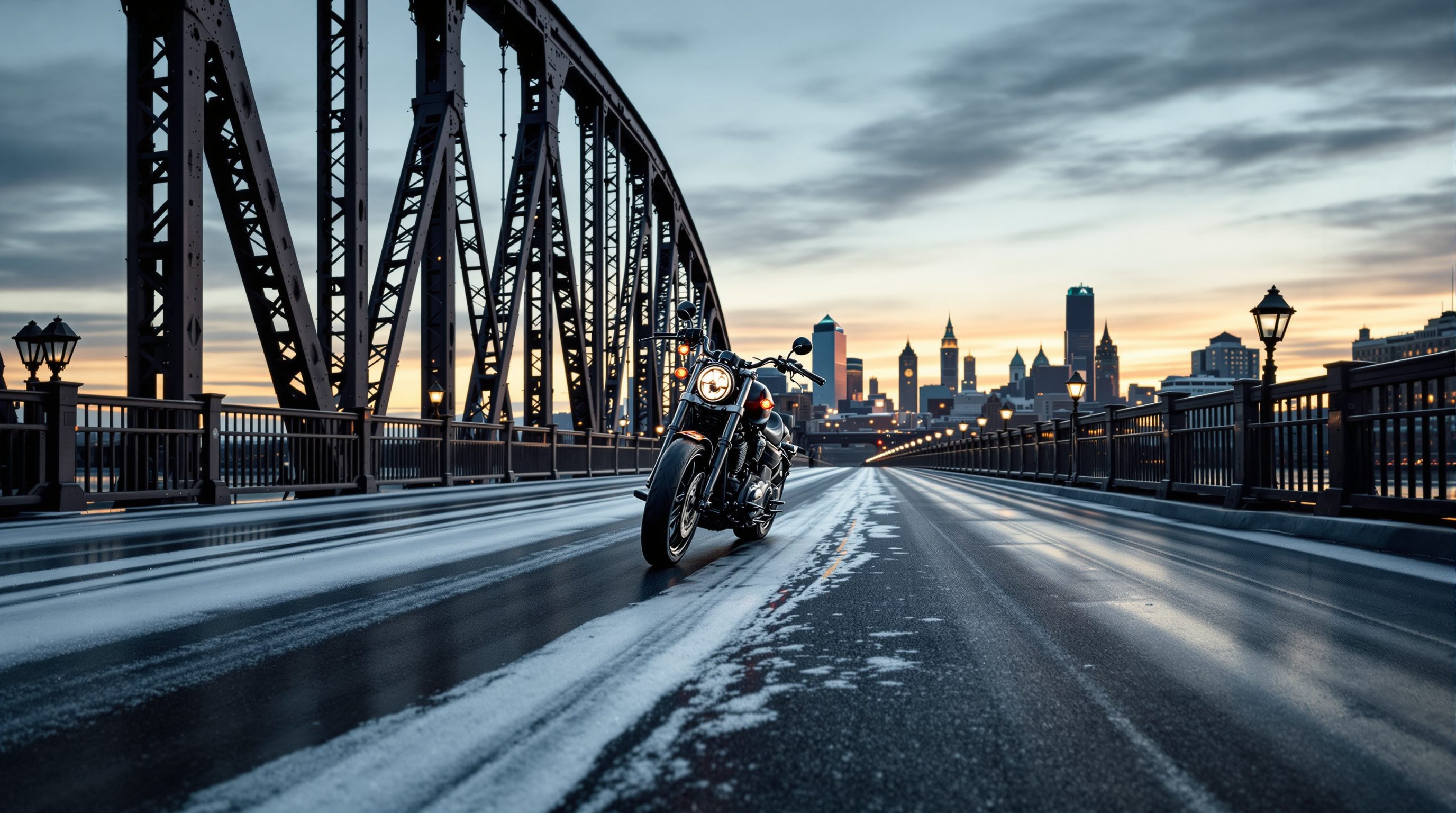
Black Ice and Bridge Decks: Winter Road Hazards in Louisville
Most Louisville riders park the bike for the winter. A stubborn few do not. If you are one of the die-hards who keeps commuting on two wheels through January, this one is for you, because winter throws a hazard at you that summer never does, and it is close to invisible until you are already on top of it. Black ice is thin, clear ice with no white sheen to warn you. It looks like wet asphalt, which is why it puts down riders who have handled rain and cold a thousand times, and in Louisville it forms first on the exact surfaces you cannot avoid: the Ohio River bridge decks and the elevated ramps where the interstates stack together.
Why Bridge Decks Freeze First
A normal road sits on the ground, and the earth underneath holds warmth that slows how fast the surface freezes. A bridge deck has no ground under it. Cold air moves above and below it at the same time, so the deck loses heat from both sides and drops below freezing long before the road on either end does. You can roll onto the Kennedy or Lincoln bridge on pavement that felt merely cold and wet and hit a deck that is frozen solid. The road warned you of nothing, because the road was fine. The bridge was not, and the stacked flyover ramps at Spaghetti Junction where I-64, I-65, and I-71 come together, plus the overpasses on the Watterson at I-264 and the Snyder at I-265, all behave the same way.
Steel Grate Decks, Salt, and Cold Tires
Some older bridges around the region use open steel-grate decks that are slick and squirmy even in July. Add a film of frost or freezing drizzle and you have one of the least forgiving surfaces a rider can cross, so do not brake, accelerate, or change lanes on the metal. Salt and the liquid brine crews spray before a storm leave the road gritty and greasy for days after the last flake, so a dry-looking road can still be slippery. And cold rubber makes it worse, because tires need heat to grip and are stiff for the first several miles on a freeze morning.
- ✓ Respect the first freeze. The first hard freeze catches even veterans off guard because the muscle memory is still set to summer. Slow down and reset your expectations.
- ✓ Read the bridges, not the road. The pavement leading up to a deck tells you nothing about the deck. Assume every river bridge and elevated ramp is frozen before the ground-level road is.
- ✓ Smooth inputs only. On ice, frost, steel, or salt film, sudden braking, throttle, or steering is what breaks traction. Keep every input gentle and gradual.
- ✓ Give yourself an out. Extra following distance and a clear escape path buy you the room to coast through a slick patch instead of grabbing the brakes on it.
When Winter Puts You Down
You can ride flawlessly and still go down when a car loses it on an iced deck and slides into you, or when a road was left in a genuinely dangerous state with no warning. Get medical care first, because the cold masks pain and hidden injuries surface days later, then document the ice, the frost, the untreated deck, and the spot while it is fresh. Do not let an adjuster turn the weather into your fault. Kentucky follows pure comparative negligence, so your recovery is reduced by your share of fault but never erased, and "it was icy out" does not hand a careless driver a free pass. Because motorcycles are excluded from Kentucky's no-fault Basic Reparation Benefits, your own uninsured and underinsured motorist coverage is the backstop that matters most when the other driver is broke or gone.

Led by Karl Truman, Karl Truman Law in Louisville fights for injured motorcyclists. Reach out to their motorcycle accident lawyers in Louisville anytime you need real answers.