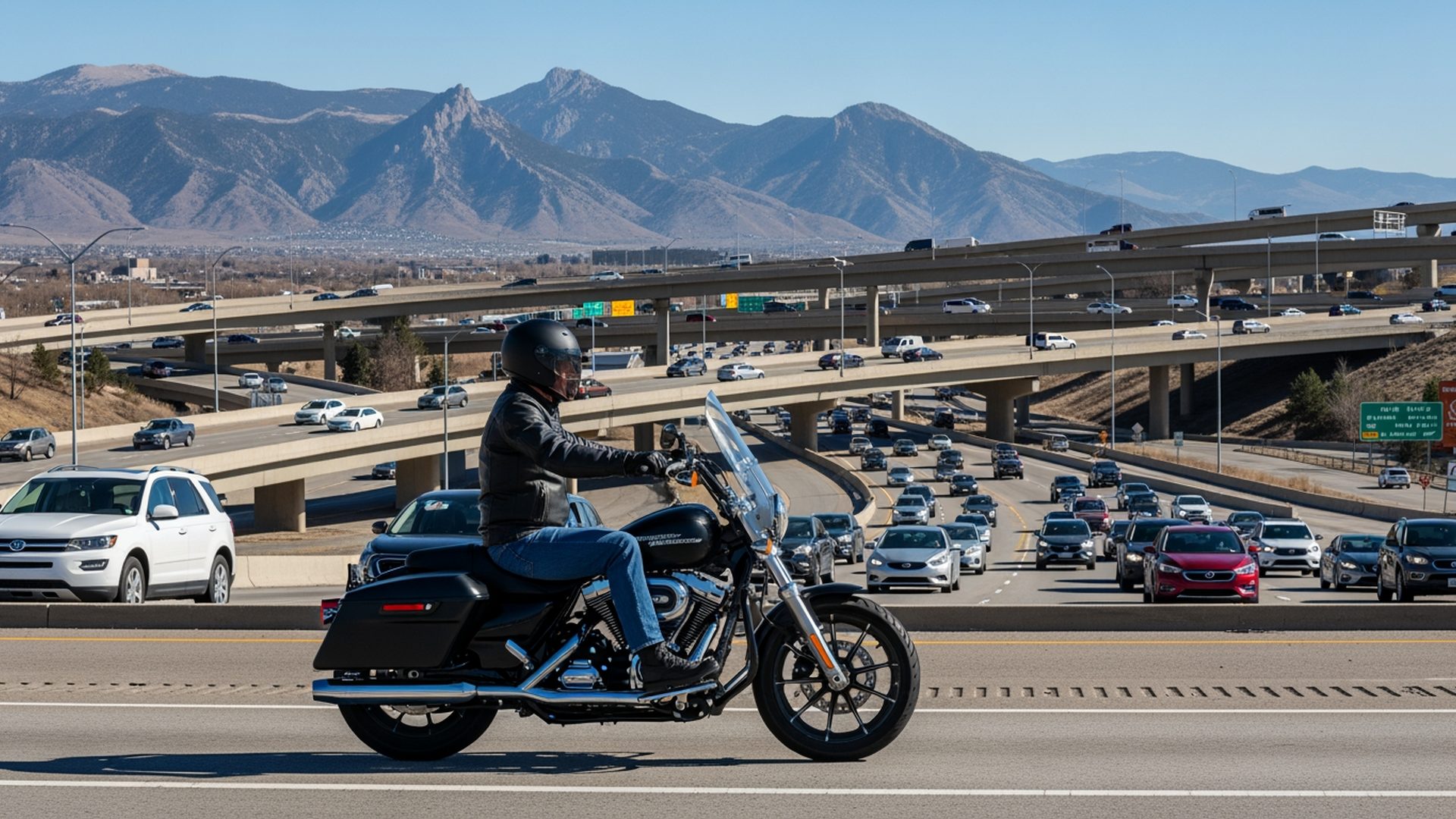
Denver's Most Dangerous Roads and Canyons for Motorcyclists
Every Front Range rider has a road they respect and a road they dread. Some of that is reputation, and some of it is hard-earned. The truth is that a handful of corridors, interchanges, and canyons around Denver concentrate the kind of traffic, speed, and driver behavior that turns a routine ride into a crash. Knowing which roads deserve extra caution, and why, is one of the cheapest safety upgrades you can give yourself.
I-25 and I-70: the corridors that punish inattention
I-25 is the spine of the Front Range and the busiest, most unforgiving road most Denver riders touch every week. Heavy commuter volume, constant lane changes, and stop-and-go through the core mean a driver can drift into your lane without ever registering a motorcycle. Merges from the interchanges pile fast-moving traffic into tight gaps, and the driver who never checks a blind spot is the one who puts a rider down. Ride I-25 assuming you are invisible, stay out of the blind-spot pockets beside cars, and watch your mirrors as hard as the road ahead, because the rear-end hit at a slowdown is one of the most common crashes on this corridor. I-70 west of Denver is a different animal. It climbs fast, the weather changes without warning, and it mixes exhausted commuters, loaded semis fighting the grade, and out-of-state drivers who have never seen mountain switchbacks. Add tunnels, steep runaway grades, and sudden slowdowns near the ski-season chokepoints and you have a corridor that punishes inattention hard.
- ✓ Sudden traffic walls. The interstate backs up on the grade with almost no warning, especially near the ski-season chokepoints.
- ✓ Weather that flips in miles. Dry pavement can turn to rain, hail, or snow above treeline in the space of a few switchbacks.
- ✓ Wind gusts through the canyon cuts. A hard gust funneling out of a side canyon can shove a bike across a lane.
- ✓ Truck spray and debris. The wet downhill runs on I-70 throw water and road grit right where you need traction.
- ✓ Distracted tourist drivers. Out-of-town drivers watching the scenery instead of the road are a constant on the scenic stretches.
The canyon two-lanes and the Lariat Loop
The roads that make Colorado worth riding are also the ones that punish a mistake. Deer Creek Canyon, Golden Gate Canyon, the run up Guanella Pass, and the climb to Mount Blue Sky pack blind corners, narrow shoulders, and sheer drop-offs into a few miles of pavement. There is no forgiveness on a canyon two-lane. A corner entered too hot, a patch of gravel in the apex, or an oncoming car crossing the center line leaves you almost no room to recover. Ride the canyons within your sightlines, not your ego, set up wide so you can see through a blind bend, and expect gravel, rockfall, and cold shade in the turns the sun never reaches. The Lariat Loop up Lookout Mountain is one of the most popular rides right out of Golden, and that popularity is exactly what makes it risky. On a nice weekend it fills with cyclists, sightseers, hikers crossing to overlooks, and cars stopping short for the views, so treat it as a shared road and keep your speed where you can stop for a cyclist or a stopped car around the next switchback.
The Peak to Peak and the danger they all share
The Peak to Peak is a rider's classic, but its long, fast, scenic stretches invite trouble. Wildlife is a constant along the timberline, weather can turn on the high sections, and the mix of fast local traffic and slow leaf-peepers creates dangerous closing speeds. A driver braking hard for an elk, or an out-of-towner drifting across the line to look at the view, is a real hazard on this highway, so watch the tree line at dawn and dusk and keep a buffer behind the car ahead. Different roads, same core danger: a driver who never saw the motorcycle. Left turns across your path, lane changes into your space, and cars pulling out from a side road cause a huge share of rider crashes, and none of them are your fault when they happen. The best riders reduce the odds with lane position, speed, and gear, but you cannot control the driver who is not looking for you.
When one of these roads puts you in a claim
When a driver hits you on any of these corridors, Colorado law shapes what comes next. The state follows modified comparative negligence with a 50 percent bar, so if you are found 50 percent or more at fault you recover nothing, and if you are partly at fault but under that line, your recovery is reduced by your share. Colorado minimum liability coverage is just 25/50/15, which is often not enough for a serious injury, and uninsured and underinsured motorist coverage is your real backstop against a driver with little or no insurance. The deadline to file a Colorado motor-vehicle injury claim is generally three years from the crash date, longer than most states but not a reason to sit on your rights. Insurers know a motorcycle crash is easy to spin against the rider, and after a crash on any of these roads they often argue you were going too fast or riding recklessly, which is exactly why the details of how it happened matter so much.

Scott O'Sullivan and the Denver motorcycle accident attorneys at Rider Justice represent riders hurt by negligent drivers. If you have questions after a crash, their team is here to help.