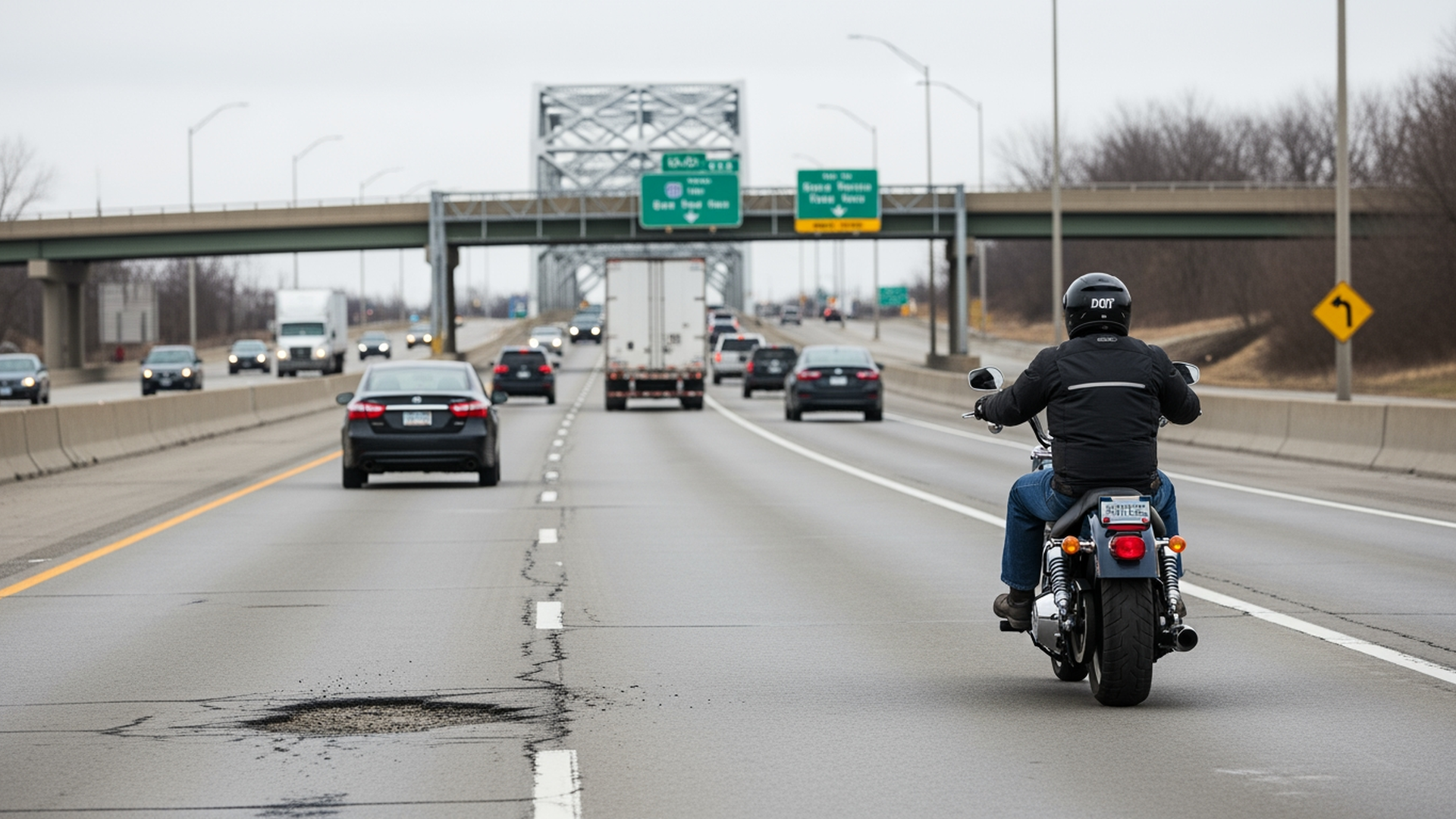
The Most Dangerous Roads for Buffalo Motorcyclists, and How to Ride Them
Every Buffalo rider has a road they respect and a road they dread. Some of that is reputation and some of it is hard-earned. The truth is that a handful of corridors around Western New York concentrate the kind of traffic, speed, pavement, and driver behavior that turns a routine ride into a crash. This is not about naming a road so you avoid it forever, most of these you cannot avoid, they are how you get around the region. It is about knowing which ones demand your full attention and exactly what makes each one dangerous, so you can stack the deck in your favor before you ever throw a leg over the bike.
The I-90 Thruway and the I-190
These two carry the heaviest fast-moving traffic in the region, and they punish a motorcycle in the same ways. The danger is not any single curve, it is the volume, the speed, the constant merging, and the pavement. The Thruway runs fast and open, and long-haul trucks throw wind blasts and carry blind spots big enough to swallow a bike whole. The I-190 threads through the city and out to Grand Island and Niagara Falls with short merges, tight interchanges like the split near downtown, and a surface that never stops being worked on. Add drivers cutting across lanes to reach an exit at the last second, and potholes and pavement seams lurking in a lane, and you have the recipe for the crashes riders fear most.
Ride them with distance as your friend. Stay out of truck blind spots, keep your following distance long, and do not linger alongside a big rig where the driver cannot see you and the wind can shove you around. Position yourself early for your exit so you are never the one diving across lanes at an interchange, scan the pavement a few car lengths ahead for the pothole or seam you do not want to hit mid-merge, and watch your mirror as hard as the road ahead, because the rear-end at the back of a sudden stop is one of the worst hits a rider can take.
The Grand Island bridges and the wind off the water
The two Grand Island bridges on the I-190 are their own animal. They are high, they are exposed, and the wind coming off the Niagara River can hit a motorcycle like a wall, shoving you toward the next lane right where there is nowhere to go and no shoulder to use. The metal expansion joints and the grated sections get slick the instant they are wet, and traffic tends to bunch up on the approaches and stop short. A crosswind gust on a bridge deck is one of the few things that can move a bike a foot sideways before you even react.
- ✓ Brace for the crosswind before the deck. Loosen your grip, keep your speed steady, and expect the push the moment you clear the shelter of the approach. A tense, locked-arm rider gets thrown further.
- ✓ Cross the joints and grates upright. The steel expansion joints and any grated decking get glassy when wet. Meet them straight, steady on the throttle, no sudden inputs.
- ✓ Leave a buffer lane if you can. A gust that nudges you toward an occupied lane is far worse than one that nudges you toward an empty one. Give yourself room on the windward side.
- ✓ Expect the bunch-up on the approach. Traffic stacks up before and after the bridges. Cover your brakes and do not close the gap on the car ahead going onto the span.
The 33 Kensington and the 198 Scajaquada
The 33 Kensington Expressway and the 198 Scajaquada are short, fast, sunken city expressways that were never built for the way they get used now. The 33 runs in its trench with tight ramps, walls close on both sides, and no room to maneuver when traffic stops short. The 198 is a narrow, curving, low-speed-limit corridor that drivers routinely treat like a highway, with sharp on-ramps and merges that appear fast. The risk on both is the same: high closing speeds in a tight space with drivers jockeying hard, and merge points that give a motorcycle almost no time to be seen or to react.
Ride them out of the blind-spot pockets, keep your following distance long enough to absorb a sudden stop, and treat every on-ramp as a car about to cross into your lane without looking. On the 198 especially, do not match the pace of the driver who is treating it like the Thruway. Ride your own margin.
Route 5, the Skyway, and the lakeshore
Route 5 along Lake Erie and the Skyway are some of the best views a Buffalo rider gets, and they carry their own hazards. The Skyway is a tall, exposed, curving span with brutal crosswinds coming straight off the lake, a surface that suffers in the freeze-thaw, and long sightlines that tempt speed right where the wind is worst. Route 5 running south along the water blends fast traffic with lake-effect weather that can roll in off the lake with little warning, and glare off the water at the wrong time of day. The wind and the weather are what make this stretch deceptive, because the view says relax and the conditions say pay attention.
Treat the Skyway like the Grand Island bridges: brace for the gusts, keep your speed sensible, and cross any wet joints upright. On Route 5, watch the sky over the lake as hard as the road, because a beautiful ride south can turn into a cold, wet one on the way back.
The pothole-beaten arterials
Off the expressways, Buffalo's own streets are a hazard the whole region knows by heart. The freeze-thaw cycle chews the pavement apart every winter and leaves the arterials cratered with potholes, frost heaves, sunken utility cuts, and steel plates by spring. A pothole a car rolls over is a genuine threat to a motorcycle, capable of tucking a front wheel or launching a rider. The danger is not just the hole itself, it is that riders swerve to avoid one and put themselves into a lane they never checked, or into oncoming traffic. Layer in the left-turn crash, the number one killer of motorcyclists, at the endless signalized intersections on Main, Delaware, Elmwood, and the rest, and the city grid demands as much attention as any highway.
- ✓ Read the pavement several car lengths ahead. Spot the pothole or the plate early enough to adjust your line smoothly, not swerve at the last second into a lane you did not check.
- ✓ Expect the left turn at every light. Cover your brakes near intersections and watch the front wheels of any car waiting to turn, because the wheels move before the car does.
- ✓ Ride out of the blind-spot pockets. On a busy arterial, the lane change into a rider nobody saw is a top crash. If you cannot see a driver's mirrors, assume they cannot see you.
- ✓ Give parked cars room. Leave space for an opening door or a driver pulling out, and buy yourself an escape path at every light.
What New York law means when one of these roads bites
You can ride every one of these corridors perfectly and still get hit by a driver who was not paying attention. When that happens, New York law shapes what comes next, and it treats riders differently than drivers. New York is a no-fault state, but its no-fault law specifically does not cover motorcyclists. A car occupant taps PIP for their own bills regardless of fault. A rider cannot, which means recovering after a crash usually depends on proving the other driver was at fault. That is why the insurance company will work so hard to pin a sliver of blame on the rider, and why the details of how the crash actually happened matter so much.
- ✓ No-fault excludes motorcycles. New York's PIP system does not pay a rider's own injuries, so fault becomes the whole fight after a crash.
- ✓ Pure comparative negligence. New York reduces your recovery by your share of fault but never bars it entirely, so a partly-blamed rider still has a claim worth protecting.
- ✓ Minimum liability is 25/50/10. Often not enough for a serious injury, which is why the uninsured-motorist coverage required in New York is a rider's real backstop against the uninsured and hit-and-run drivers on our roads.
- ✓ Three years to file. The statute of limitations on a New York injury claim is generally three years, and it is shorter when a public entity like the NFTA or a county is involved, so the clock does not wait.
Rick Nicotra and the Buffalo motorcycle accident attorneys at The Nicotra Law Firm represent riders hurt by negligent drivers. If you have questions after a crash, their team is here to help.