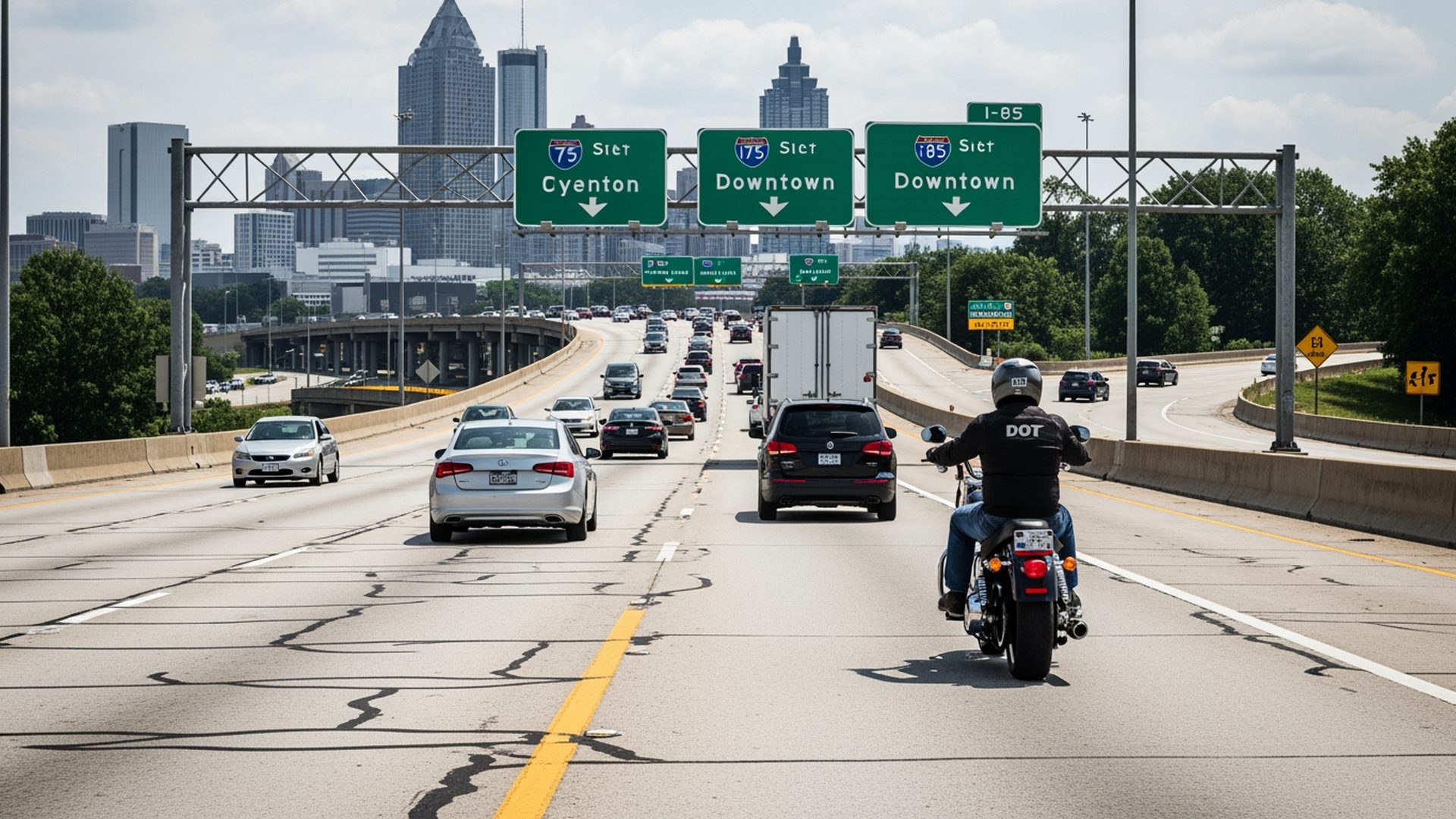
The Most Dangerous Roads for Atlanta Motorcyclists, and How to Ride Them
Every Atlanta rider has a road they respect and a road they dread. Some of that is reputation and some of it is hard-earned. The truth is that a handful of corridors around the metro concentrate the kind of traffic, speed, and driver behavior that turns a routine ride into a crash, and Atlanta has some of the worst congestion in the country to pack them into. This is not about naming a road so you avoid it forever, because most of these you cannot avoid, they are how you get around the city. It is about knowing which ones demand your full attention and exactly what makes each one dangerous, so you can stack the deck in your favor before you ever throw a leg over the bike.
The Downtown Connector, where I-75 and I-85 collide
For a couple of miles through the heart of the city, I-75 and I-85 merge into one massive stretch of pavement that carries some of the heaviest traffic in the Southeast. The danger on the Connector is not any single curve, it is the sheer volume and the constant weaving. Drivers cut clear across multiple lanes to reach an exit or to catch the I-75 or I-85 split at the last second, and they read their mirrors for a car-sized gap that a motorcycle disappears into. Add long-haul trucks that throw wind blasts and carry blind spots big enough to swallow a bike, stop-and-go that slams from a crawl to a surge and back, and pavement beaten up by that much traffic, and you have the recipe for the crashes riders fear most. Ride the Connector with distance as your friend. Position yourself early for your exit so you are never the one diving across lanes, stay out of truck blind spots, keep your following distance long, and watch your mirror as hard as the road ahead, because the rear-end at the back of a sudden stop is one of the worst hits a rider can take.
I-285, the Perimeter
The Perimeter rings the whole metro, and riders know it as a place where traffic moves fast and tempers run hot. Speeds climb well above the limit between the interchanges, and then a wreck or a merge stacks everything into a dead stop with no warning. The west side and the top-end stretch through Sandy Springs and Dunwoody are notorious for aggressive lane changes, drivers riding bumpers, and semis running three and four abreast. The closing speed on a rider who did not read the brake lights ahead is brutal, and the lane change into a motorcycle nobody saw is one of the most common ways riders go down here.
- ✓ Ride out of the blind-spot pockets. On a road this fast and this busy, if you cannot see a driver's mirrors, assume they cannot see you. Ride the open gaps in traffic, not alongside a car or a truck.
- ✓ Leave real following distance. A car cutting into the gap in front of you should not put you into its bumper. Space is what buys you time when the Perimeter goes from 75 to zero.
- ✓ Scan several cars ahead. Read the brake lights three and four vehicles up so you see the slowdown before it reaches you, and get your braking done in a straight line before you arrive.
- ✓ Do not linger next to the semis. Wind blast and enormous blind spots make riding beside a big rig one of the worst places to be. Get past it or drop back, but do not sit in the danger zone.
Spaghetti Junction, where I-85 meets I-285
The Tom Moreland Interchange on the northeast side, better known as Spaghetti Junction, is exactly what the nickname promises. Stacked ramps, tight curves, short merge zones, and cars crossing several lanes in a hurry to make a connection they nearly missed. It is one of the busiest and most complex interchanges in the region, and the danger is the churn. Drivers focused on finding the right ramp are not looking for a motorcycle, the merge zones give everyone less time to sort it out, and the elevated curves carry seams, patches, and debris that get slick when wet. Ride it knowing exactly which ramp you need before you get there so you are never the one crossing lanes late, cover your brakes through the merges, and read the pavement ahead on the curves so you meet a seam or a patch upright, not mid-lean.
GA-400 and I-20
GA-400 running north toward Alpharetta and the suburbs blends the worst of two worlds. It carries near-highway speeds but stacks up into some of the worst stop-and-go in the metro without warning, and the toll-era habit of drivers flying between exits has never fully gone away. Aggressive lane-changers, drivers riding the shoulder, and a mix of commuters who know the road cold and out-of-town drivers who do not add a layer of unpredictability. I-20, running east and west through the city, brings its own problems: high speeds, heavy truck traffic, rough patched pavement, and interchanges where merging traffic crosses lanes hard. On both roads, keep your speed matched to the sightlines and the flow ahead, not just the car in front of you, treat any tapping brake lights as a full stop coming, and give yourself room to brake in a straight line before you reach it.
The common threads, and the metro merge
Different as these roads are, the crashes on them rhyme. The metro merge, where a driver changes lanes or joins the freeway without ever seeing the motorcycle, shows up on every one of them. So does the sudden stop at the back of Atlanta's famous congestion, and the aggressive driver who treats a gap you are occupying as an invitation. Ride all of them the same way underneath the specifics.
- ✓ Assume you are invisible until proven otherwise. A driver looking your way is not the same as a driver who has seen you. Position yourself so a lane change or a merge into your space is not a crash.
- ✓ Buy space, front and back. Following distance and a cushion behind you are what turn a sudden Atlanta stop into a non-event instead of a rear-end.
- ✓ Have an escape route. On every one of these corridors, know where you would go if the lane ahead stopped dead or a car crossed into it. An out beats hard braking every time.
- ✓ Make yourself bright. A headlight on, reflective gear, and a lane position that keeps you out of the wash of traffic all help a distracted metro driver register you before it matters.
What Georgia law means when one of these roads bites
You can ride every one of these corridors perfectly and still get hit by a driver who was not paying attention. When that happens, Georgia law shapes what comes next. Georgia is an at-fault state that uses modified comparative negligence with a hard cutoff: your recovery is reduced by your share of the blame, and if you are found 50 percent or more at fault you recover nothing at all. That is why the insurance company will work so hard to pin a sliver of blame on the rider after a freeway crash, arguing you were splitting a gap, riding too fast, or somewhere you should not have been. How the crash actually happened, and how it gets documented, decides everything.
- ✓ The 50 percent bar is the whole fight. Georgia cuts your recovery by your share of fault and ends it entirely at 50 percent, so keeping blame off the rider is what protects the claim.
- ✓ Minimum liability is only 25/50/25. Often not enough for a serious freeway-crash injury, which is why the uninsured and underinsured-motorist coverage a Georgia insurer must offer is a rider's real backstop in a metro full of uninsured drivers.
- ✓ Universal helmet law. Every rider and passenger in Georgia must wear a DOT-approved helmet, no exceptions.
- ✓ Two years to file. The statute of limitations on a Georgia injury claim is generally two years, so the clock on even a clear-cut crash does not wait.

Michael Moebes and the Atlanta motorcycle accident attorneys at Moebes Law represent riders hurt by negligent drivers. If you have questions after a crash, their team is here to help.