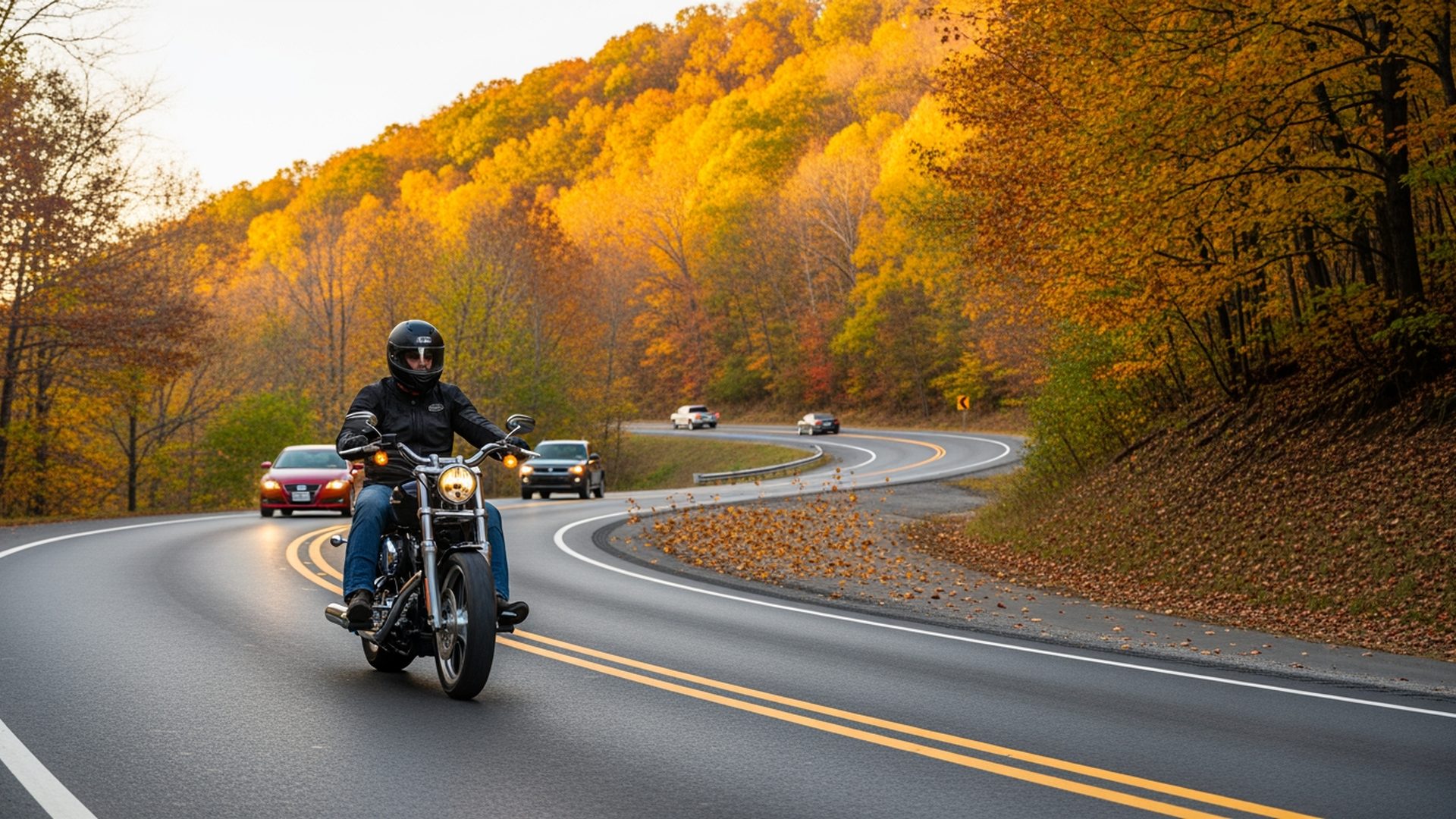
Fall Riding Hazards in North Georgia: What Bites Atlanta Riders in October and November
Ask most Atlanta riders and they will tell you fall is the payoff. The summer humidity finally breaks, the afternoon storms back off, and a run up to the North Georgia mountains with the hardwoods turning is the reason you own the bike. The Richard Russell Scenic Highway on GA-348, Wolf Pen Gap on GA-180 out of Suches, Blood Mountain on US-19/129, the climbs toward Brasstown Bald and Tallulah Gorge, the wine-country roads around Dahlonega and Helen. Peak color pulls riders up there by the thousands. It also pulls up everyone else. Fall is the best riding of the year in North Georgia and one of the most deceptive, because the same cool mornings and blazing ridgelines hide traction traps, wildlife, and traffic that simply are not there in July. Knowing what October and November throw at you is half the fight.
Peak color brings a wall of leaf-peeper traffic
The reason to ride GA-348 and Blood Mountain in mid to late October is the reason everyone else is up there too. Peak foliage turns the North Georgia two-lanes into a slow parade of out-of-town cars, RVs, and rental SUVs, and a lot of those drivers are looking everywhere except the road. They brake for a photo, drift over the center line to gawk at the ridge, stop dead at an overlook that has no shoulder, and pull out of a scenic turnout without ever checking for a motorcycle. The roads you love for their flow become stop-and-go, and the danger is the driver ahead who lifts off the throttle for a view you cannot see coming. Treat every blind switchback like there is a stopped car just past it, keep your following distance long behind anything with out-of-state plates, and do not let a clear stretch tempt you into a pass you cannot complete before the next curve.
The deer rut is the number one fall hazard in the mountains
North Georgia is thick with whitetail, and the crash spike lands squarely in the fall. October and November are the rut, when bucks are chasing does and both are on the move at all hours, crossing roads they normally avoid. For a car a deer strike is a bad morning. For a rider it can be the whole ballgame. The ranch roads and pasture edges around Suches, the wooded climbs on US-19/129 near Neel Gap and Blood Mountain, and the valley two-lanes around Helen and Dahlonega are exactly where deer live and where they cross. They move most at dawn and dusk, the same low-light hours a cool mountain ride is most tempting, and they travel in groups, so the one that just bolted across your lane is often not the last. Scan the tree line and the shoulders, not just the pavement, and back your speed down on any wooded stretch at first and last light so you actually have room to react.
- ✓ Treat shaded switchbacks as wet. The tight corners on GA-348, Wolf Pen Gap, and the Blood Mountain climbs sit under heavy canopy and stay damp long after the open road has dried, and they collect a slick mat of fallen leaves.
- ✓ Watch for washed gravel and runoff. Fall rain drags gravel, sand, and leaf litter across the mountain roads at the outside of curves and the bottoms of grades. It is invisible until you are on it, so brake upright and early, not mid-lean.
- ✓ Respect cold tires for the first few miles. Rubber needs heat to grip, and on a 40-degree mountain morning your tires are stiff and cold. Take it easy until they warm before you push a corner.
- ✓ Check your tire pressure more often. Pressure drops about a pound for every ten-degree fall in temperature, and an underinflated tire handles worse right when the roads are least forgiving.
- ✓ Wear your helmet and dress for the ridge. Georgia law requires a DOT helmet for every rider and passenger, and the mountains run ten to fifteen degrees cooler than Atlanta, so cold hands and a chilled body slow your reactions on the exact roads that demand them most.
Valley fog, early sunsets, and the first cold snaps
Fall does not just change the road surface, it changes the air and the light. Cool nights and warm days leave the North Georgia valleys and river bottoms socked in with fog at dawn, and you can drop out of clear sky into a gray wall in the space of a single downhill curve near Helen or the Chattahoochee headwaters. Visibility collapses for you and for every driver around you. Then the days shorten, and after the clocks fall back in early November sunset lands in the late afternoon, so a ride that started in daylight finishes in the dark on a mountain road with no streetlights. The low fall sun also sits right at the horizon during the morning and evening hours, blasting straight down the east-west stretches and blinding drivers who never register a motorcycle in the glare. Add the season's first cold snaps that leave shaded bridge decks and low spots frosty before the rest of the road, and you have a stack of hazards that all land on the same ride. Assume the valley you are dropping into is foggy, that at sunrise and sunset half the drivers around you are squinting into a wall of light, and give yourself extra space and an escape route at every intersection and overlook.
Why a fall crash hits Georgia riders harder
Here is the part too many riders learn after the crash instead of before it. Georgia is an at-fault state, and it uses modified comparative negligence with a hard cutoff. Your recovery gets reduced by your share of the blame, and if you are found 50 percent or more at fault you recover nothing at all. That makes every fall crash a fight over how it gets documented, because the insurance company's whole playbook is to push that number up. They will argue you were riding too fast for a wet corner, that you should have seen the deer, that a mountain road in October is no place for a motorcycle. Do not let "it was slippery out" get twisted into "the rider caused it." Wet leaves, fog, and low sun do not hand a careless or inattentive driver a free pass, and they do not automatically make a crash your fault.
- ✓ The 50 percent bar is the whole ballgame. Georgia reduces your recovery by your share of fault and cuts it off entirely at 50 percent, so keeping the blame off the rider is what protects the claim.
- ✓ Universal helmet law. Every rider and passenger in Georgia must wear a DOT-approved helmet, no exceptions, so keep yours on and make it work for you.
- ✓ Minimum liability is only 25/50/25. Often not enough for a serious mountain-crash injury, which is why the uninsured and underinsured-motorist coverage a Georgia insurer must offer is a rider's real backstop against the state's many uninsured drivers.
- ✓ Two years to file. The statute of limitations on a Georgia personal injury claim is generally two years, and waiting can quietly end a valid case.
If a fall-condition crash does happen, protect yourself and get medical care first, because hidden injuries have a way of surfacing days later. Then document the conditions while they are fresh: photograph the leaves, the fog, the low sun, the washed gravel, the deer, and the exact spot it happened, and get names and numbers from anyone who saw it. In a state where fault decides everything and a 50 percent finding ends the case, those details are not a formality, they are the difference between a full claim and a fight.

Led by Michael Moebes, Moebes Law in Atlanta fights for injured motorcyclists. Reach out to their motorcycle accident lawyers in Atlanta anytime you need real answers.