Lane Splitting in California: Legal, and How to Do It Without Handing the Insurer Your Claim
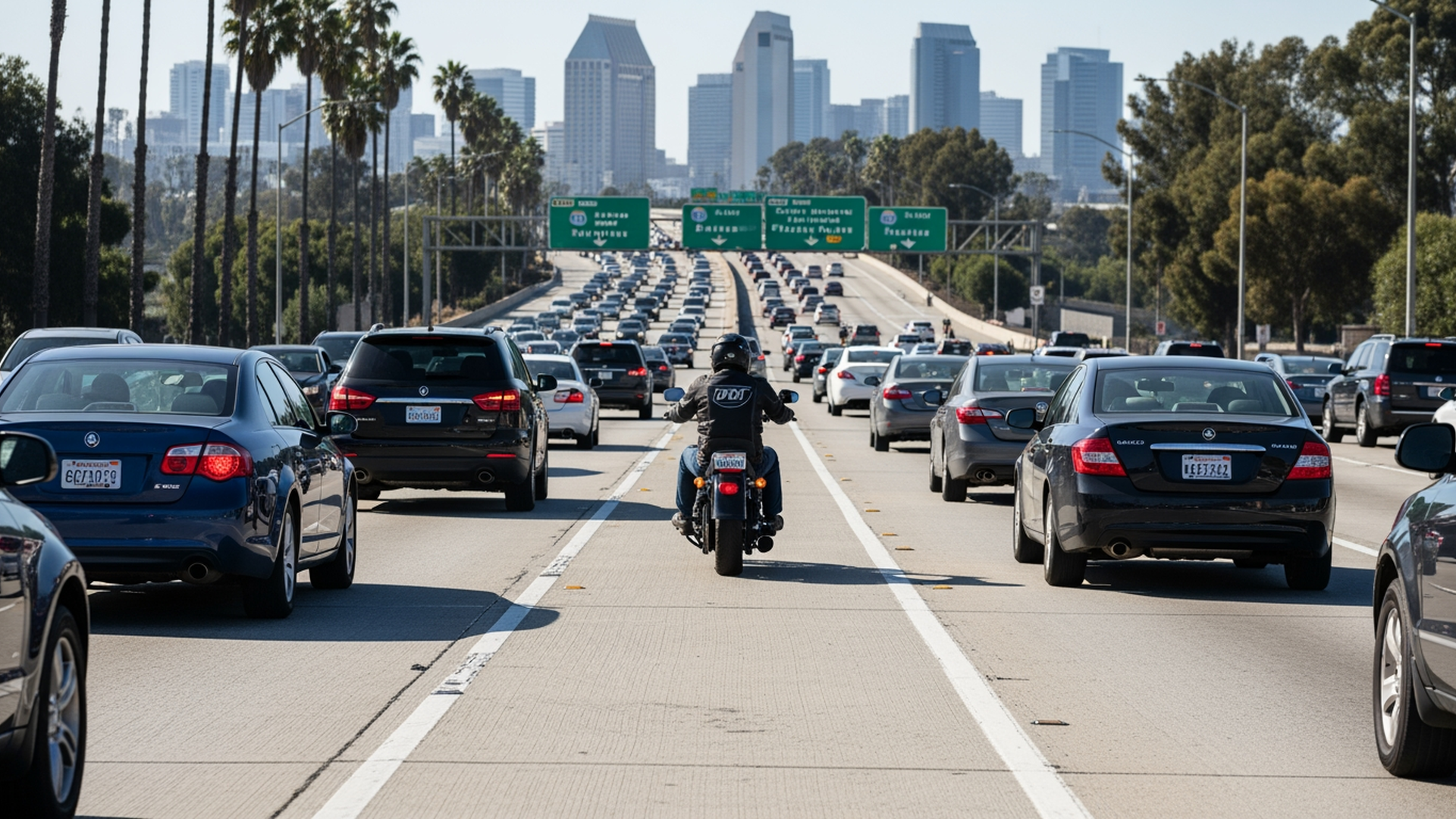
You are stuck on the 5 south of the merge, the traffic has not moved in three minutes, the engine heat is baking through your jeans, and there is a clean gap opening up between the stopped cars. In most of the country a rider who takes that gap is doing something the law does not allow. In California, you are not. California is the single state in the union that has written lane splitting into its vehicle code, which means a San Diego rider splitting lanes on the I-5, the 805, or the 15 is exercising a legal right, not committing a violation. That distinction matters enormously the day a driver drifts into you while you are doing it, because the insurance company is going to try to tell you otherwise.
What Vehicle Code 21658.1 actually says
California defines lane splitting right in the statute. Vehicle Code section 21658.1 describes it as riding a two-wheeled motorcycle between rows of stopped or moving vehicles in the same lane, including on divided and undivided streets, roads, and highways. In plain terms, the legislature looked at the thing riders were already doing and chose to name it and allow it rather than ban it. That is the opposite of what nearly every other state has done. The same law directs the California Highway Patrol to develop educational guidelines for doing it safely, which is why the CHP, not a court, is the agency that publishes what safe splitting looks like. The takeaway for a San Diego rider is simple. You do not have to pretend you were not splitting. You were allowed to.
The CHP safety guidelines, in the language of the road
The Highway Patrol's guidance is not a mystery, and it is built on the physics of what actually gets riders hurt. It comes down to speed, the difference in speed between you and the cars, and where you position yourself. The bigger the gap between your pace and the traffic's pace, the less time a driver has to react and the less time you have to react to a door, a mirror, or a car nosing into the gap. Ride within it.
- ✓ Keep your speed reasonable. Splitting is for slowed or stopped traffic, not for blasting past freeway flow. The faster you go, the harder every hazard hits and the worse it looks later.
- ✓ Keep the speed difference low. The danger is not your speed alone, it is how much faster you are moving than the cars beside you. A small differential gives everyone time to react. A big one does not.
- ✓ Stay out of blind spots. Do not linger beside a car where the driver cannot see you. Move through, do not park in the danger zone, and never split next to a big rig.
- ✓ Split the far-left lanes when you can. The gap between the two leftmost lanes tends to be widest and the traffic there more predictable than weaving through the middle of a packed freeway.
- ✓ Read the whole picture. Watch for cars changing lanes, drivers on phones, and the sudden surge when traffic breaks loose. Cover your brakes and be ready to abandon the gap.
Why doing it safely protects your claim, not just your neck
Here is the part a lot of riders miss. In California, splitting safely does double duty. It keeps you upright, and it protects your legal position if a driver still hits you. California follows pure comparative negligence, which means your recovery is reduced by your share of the fault but is never barred outright, even if you are found mostly to blame. That is more rider-friendly than the states that cut you off entirely at 50 or 51 percent. But pure comparative still means the insurer fights over every percentage point of blame, because every point it can pin on you comes straight out of your recovery. A rider who was splitting at a sane speed, in a reasonable position, gives the adjuster very little to work with. A rider who was screaming through stopped traffic hands them a story. The way you ride the gap is the same evidence that later decides how the fault gets divided.
How an insurer blames a splitting rider even though it is legal
Do not expect the other driver's insurance company to volunteer that lane splitting is legal in California. Their whole job after a crash is to move blame off their driver and onto you, and a rider between lanes is the easiest target they will ever get. Expect to hear that you came out of nowhere, that you were going too fast, that the driver never had a chance to see you. None of that changes the fact that the maneuver is authorized by statute. What it does is turn your claim into a fight over your fault percentage, and under pure comparative negligence that fight decides how much of your recovery survives.
- ✓ Legal does not mean blameless in their eyes. The insurer will treat splitting as fault even though the law authorizes it, so the details of how you split become the evidence that protects you.
- ✓ Pure comparative negligence is your backstop. Even if some blame lands on you, California never zeroes out your claim the way half the country does. It only reduces it, which is why every point matters.
- ✓ Document the gap. Photos of lane positions, traffic conditions, and sightlines, plus any independent witness, are what counter the came-out-of-nowhere story.
- ✓ Do not narrate the crash to their adjuster. An offhand "I was flying up the gap" can become the centerpiece of their fault argument. Get advice before you give a recorded statement.

Led by Maxwell Agha, Banker's Hill Law Firm in San Diego fights for injured motorcyclists. Reach out to their motorcycle accident lawyers in San Diego anytime you need real answers.