What to Do After a Motorcycle Accident in NYC: A Rider's Step-by-Step
The minutes and days after a motorcycle crash decide far more than most city riders realize. On a bike you are exposed, the injuries run worse, and New York has a trap built into its insurance law that catches riders off guard. What you do in the first hour on the FDR or the BQE, and in the first weeks after, can make or break your claim.
The One Fact Every New York Rider Has to Understand
New York is a no-fault state, which means most car occupants can tap their own Personal Injury Protection to cover medical bills and lost wages no matter who caused the crash. Motorcyclists are specifically left out. The no-fault law does not cover riders, so a car driver walks away with a built-in cushion and you do not. That is not a small technicality. It means your medical bills and lost income are not handled quietly in the background. They ride entirely on your ability to prove the other driver was at fault and to reach the coverage that actually applies, including the uninsured and underinsured motorist coverage on your own policy. Everything below is about protecting that case from the first minute.
First: Get Safe and Get Checked
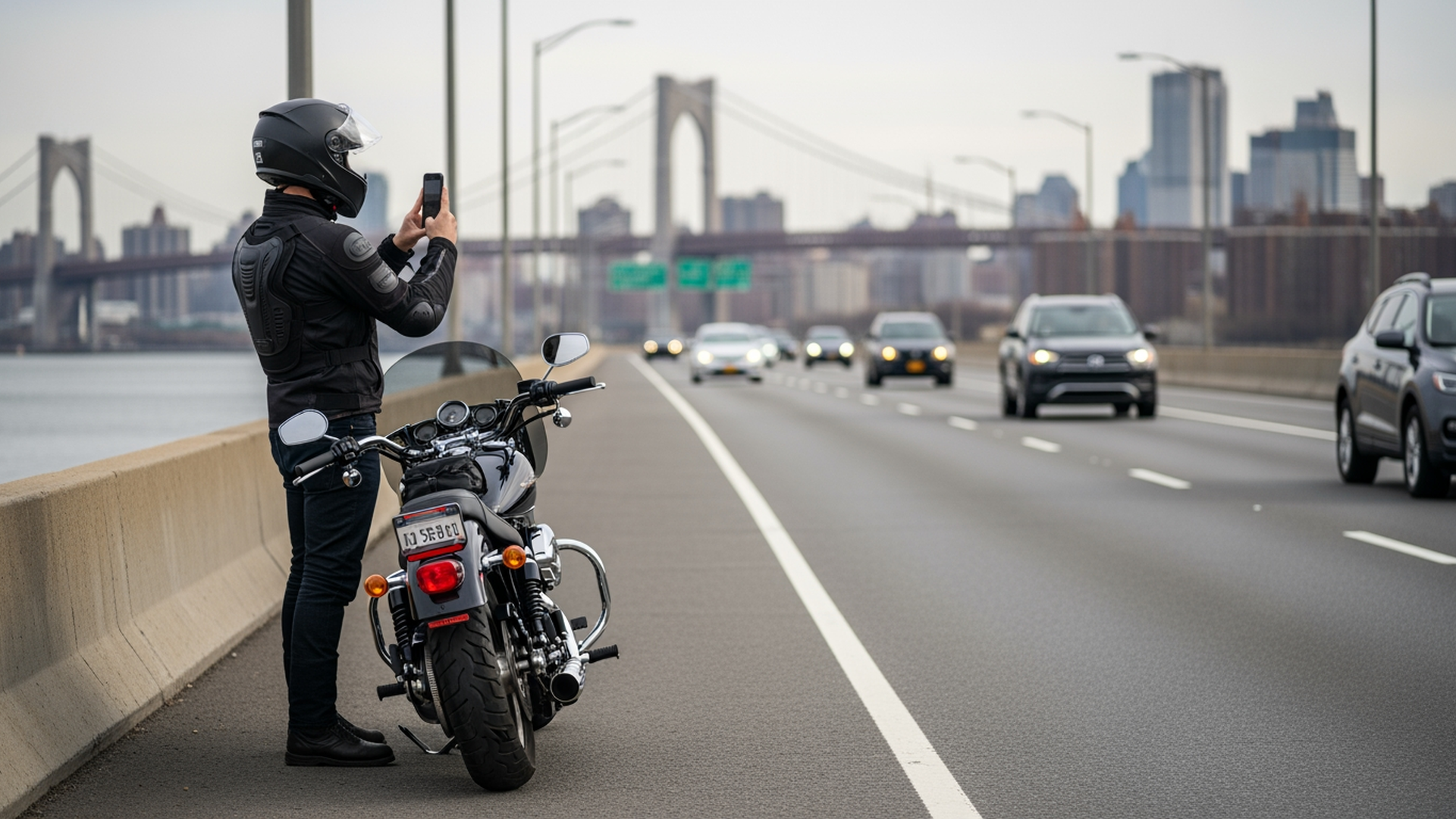
Before anything else, your health comes first. A motorcycle crash hides injuries behind adrenaline, and riders regularly wave off an ambulance only to wake up the next morning barely able to move. A downed rider on the FDR, the BQE, or the Cross Bronx is in real danger from the next wave of cars, taxis, and for-hire vehicles, so if you can move without making an injury worse, get yourself and your bike clear of the live lanes and onto the shoulder. If you feel numbness, sharp neck or back pain, or you cannot move a limb, stay put and wait for help. A heavy bike is not worth a spinal injury. Keep your helmet on until medical help checks you, then call 911 so police and paramedics are on the way. Say yes to the ambulance or get to a New York emergency room the same day, because refusing care hurts your body and hands the insurer an argument that you were never really hurt.
Second: Build Your Own Record, Then Watch Every Word
If you are physically able, the scene is a source of evidence that disappears fast, and your phone is all you need. Photograph both vehicles, the damage, your bike's resting position, the road surface, potholes or steel plates, skid marks, debris, and the traffic signals in both wide shots and close-ups. Get the other driver's name, phone, insurance company, policy number, and plate. In dense city traffic the vehicle that hit you may be a yellow cab, a black-car for-hire vehicle, or a delivery rider on an e-bike or moped, so note the medallion or TLC plate, the company, and any markings. Find any neutral witness and get names and numbers before everyone drives off. Note the time, the weather, your lane, and anything the other driver says at the scene.
Then guard your words. New York uses pure comparative negligence, which means your recovery is reduced by your share of fault but never barred entirely. That sounds forgiving, and it is better than the rule in many states, but insurers still fight hard to pin as much blame on the rider as they can, because every percentage point they shift is money out of your pocket. A casual "I'm sorry" or "I never saw him" can be twisted into an admission. Stick to the facts with the officer, do not guess about fault, and do not apologize on the record. You do not have to accept blame to be polite.
Third: Preserve the Evidence and Handle the Adjuster With Care
A New York police accident report is a foundational document, so give your account clearly and ask the responding officer how to obtain the report and case number later. If the crash involves a City, MTA, or other public vehicle, special short deadlines and a Notice of Claim can apply, which is one more reason to get advice quickly. Meanwhile the clock is running on the evidence itself. Camera footage from businesses, buildings, and bridge and tunnel approaches is often overwritten within days, skid marks fade, and witnesses move and forget. Within a day or two an adjuster will likely call sounding friendly, but remember who signs that person's paycheck. Their job is to close your file for as little as possible, and they are especially aggressive with motorcycle claims because they know a hurt rider has no no-fault cushion and needs the money.
- ✓ Do not give a recorded statement. The other driver's insurer will ask for one. It exists to catch you saying something they can use to pin fault on you, and you are not required to provide it.
- ✓ Do not accept a fast, early offer. The first check almost always lands before you know the full extent of your injuries, and once you sign, the claim is usually over even if you need surgery next month.
- ✓ Do not sign a blanket medical release. A broad authorization lets the insurer dig through your entire history hunting for a pre-existing condition to blame.
- ✓ Open your own UM claim carefully. Because there is no no-fault for you, the uninsured and underinsured motorist coverage on your policy may be your real source of recovery, so notify your insurer but do not let its adjuster run the case.
- ✓ Keep records of everything. Bills, treatment, missed work, and how the injuries affect your daily life all build the real value of your claim.
The Short Version for City Riders
A crash on the LIE, the Major Deegan, or a bridge approach is chaotic and painful, and nobody thinks clearly in the moment. That is exactly why these steps are worth knowing before you ever need them. Get medical care the same day even if you feel fine. Document the scene if you safely can. Guard your words so a comparative fault argument cannot be built on them. Decline the recorded statement and the quick offer. And get the specifics of your crash reviewed while the evidence is still fresh and the three-year deadline is still comfortably ahead. In a state where no-fault leaves riders out in the cold, the record you build now is the case you keep later.

Have questions after a wreck? Mary Ellen O'Connor and the motorcycle accident lawyers in New York at O'Connor Law (nyworkerslaw.com) review rider claims and explain your options.