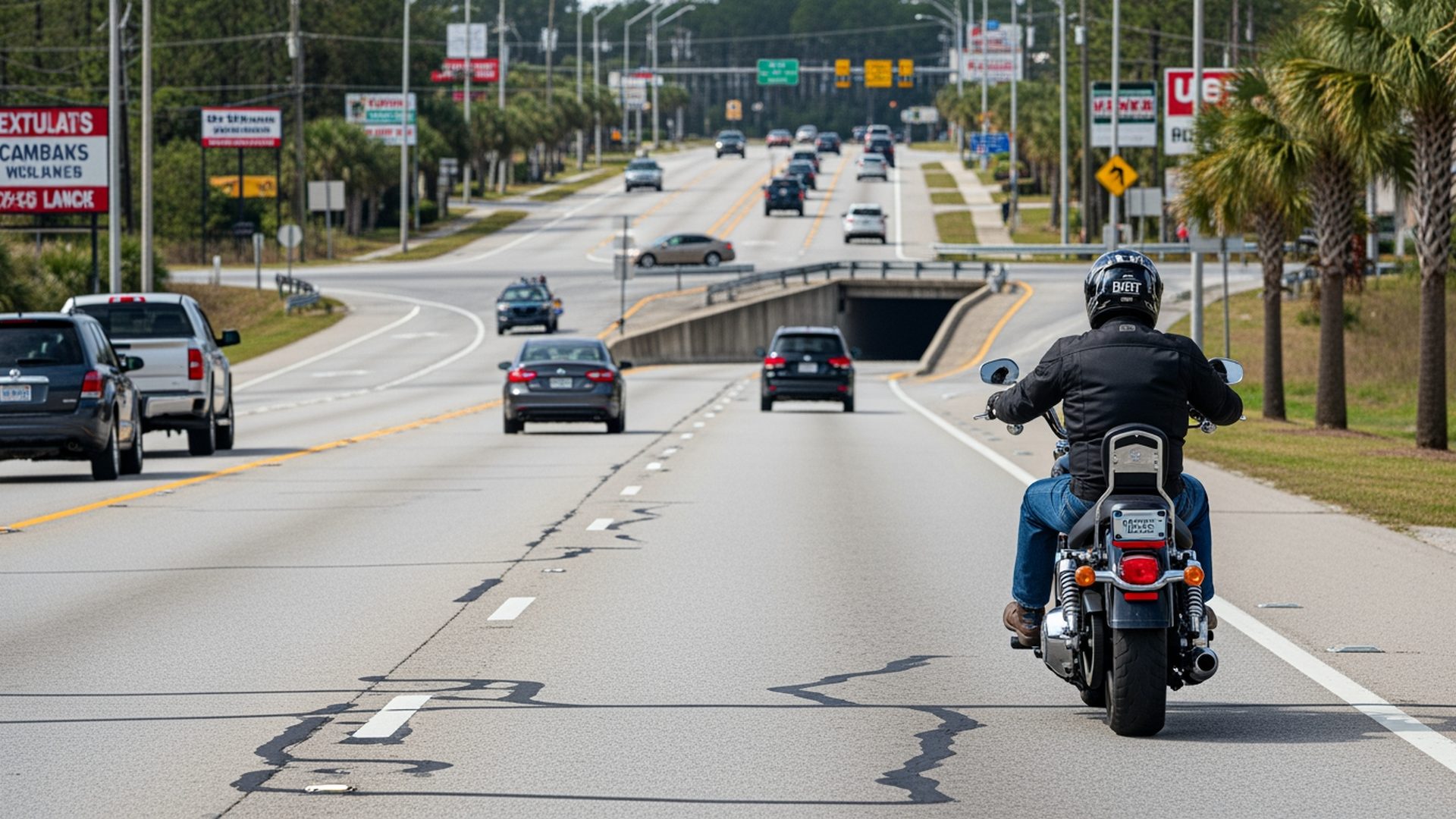
The Most Dangerous Roads for Myrtle Beach Motorcyclists, and How to Ride Them
Every Grand Strand rider has a road they respect and a road they dread. Some of that is reputation and some of it is hard-earned. The truth is that a handful of corridors around Myrtle Beach concentrate the kind of traffic, turning movements, and out-of-town driver behavior that turns a routine ride into a crash. This is not about naming a road so you avoid it forever, most of these you cannot avoid, they are how you get around the Strand. It is about knowing which ones demand your full attention and exactly what makes each one dangerous, so you can stack the deck in your favor before you ever throw a leg over the bike.
US-17 Kings Highway and the 17 Bypass
US-17 is the spine of the Grand Strand, and it carries the risk to match. Kings Highway runs right through the heart of Myrtle Beach, lined with motels, restaurants, and shops, which means an unbroken wall of driveways, curb cuts, and cars turning in and out across the traffic. The 17 Bypass moves faster but adds its own trap, the constant left turns across median cuts and busy intersections where a driver waiting to turn has to judge the speed of everything coming, including a single motorcycle they may never register. This is where the classic left-turn crash lives, the one where an oncoming driver turns across your lane because they misjudged your speed or looked right through you. Add tourists who do not know which lane they need and brake or swerve at the last second, and both halves of US-17 stay unpredictable all day.
Ride US-17 expecting the turn. Cover your brakes as you approach every median cut and intersection, watch the front wheels of any car waiting to turn because the wheels move before the car does, and set a lane position where a turning driver has the best chance of seeing you. Leave room for the car that stops short to read a sign, stay out of the blind-spot pockets alongside larger vehicles, and never assume a driver looking your way has actually seen you coming.
Ocean Boulevard and the oceanfront strip
Ocean Boulevard is a different kind of danger. The speeds are low, but the chaos is high. The oceanfront strip is packed with pedestrians stepping off the curb, cars circling for parking, rideshare and taxi pickups stopping without warning, and drivers watching the beach and the crowds instead of the road. Blown sand drifts across the pavement near the dunes. During the Fall Bike Rally the whole boulevard crawls bumper to bumper with bikes and cars mixed together. The risk here is not speed, it is the sheer number of things that can cross your path in a single block, any one of which can put a rider down.
- ✓ Expect the sudden stop and the U-turn. On Ocean Boulevard a car will stop dead for a parking spot or swing across the lane without a signal. Keep space and cover your brakes.
- ✓ Watch the curb and the crosswalks. Pedestrians step out from between parked cars, and a rideshare pickup pulls to the curb with no warning. Give the curb line a wide berth.
- ✓ Scan for drifting sand. Wind off the beach lays a slick film of sand across the boulevard, worst right where you turn. Meet it upright and easy on the throttle.
- ✓ Assume drivers are looking at the beach. On the strip, plenty of drivers are watching everything except the road. Ride like none of them have seen you.
The SC-31 and SC-22 interchanges and the fast bypasses
The SC-31 Carolina Bays Parkway and the SC-22 Conway Bypass are the fast way around the Strand, and they blend near-highway speeds with heavy merge points where the two connect and where they tie back into US-17 and US-501. The danger on these roads is the closing speed and the merge churn. Traffic runs quick, then stacks up at an interchange or a ramp with little warning, and a driver reading a mirror for a car-sized gap misses a motorcycle entirely. Aggressive lane changers and out-of-town drivers hunting for the right exit add to it. On the open stretches, deer cross from the wooded shoulders at dawn and dusk.
Ride these bypasses with distance as your friend. Stay out of blind spots, keep a long following distance so a car cutting into your gap does not put you into its bumper, and position yourself early for your exit so you are never the one diving across lanes at the last second. Scan several vehicles ahead so you see a slowdown before it reaches you, and watch the treeline on the rural stretches.
US-501 to Conway and the inland arterials
US-501 is the main artery between Myrtle Beach and Conway, and it carries a punishing mix of traffic. Commuters who know the road cold share it with tourists who do not, big-box shopping traffic turns in and out of the commercial stretches, and the road runs fast enough between the lights that a sudden stop catches riders out. The stop-and-go near the retail corridors, the constant turning traffic, and the closing speed when a light backs up traffic without warning are the recipe for the rear-end and left-turn crashes riders fear most. Farther out toward Conway and on the rural connectors off SC-9, the hazard shifts to two-lane roads, deer, and drivers passing where they should not.
On US-501 and the inland arterials, keep your speed matched to the sightlines and the flow ahead, not just the car in front of you. Treat any tapping brake lights as a full stop coming, give yourself room to brake in a straight line, and stay ready for the car that turns across the highway into a shopping lot without ever seeing your headlight.
What South Carolina law means when one of these roads bites
You can ride every one of these corridors perfectly and still get hit by a driver who was not paying attention. When that happens, South Carolina law shapes what comes next. The state follows modified comparative negligence with a 51 percent bar, which means your recovery is reduced by your share of fault and disappears entirely if you are found 51 percent or more at fault. That is why the insurance company will work so hard to pin even a sliver of extra blame on the rider, and why the details of how the crash actually happened matter so much.
- ✓ The 51 percent bar decides everything. Reduced recovery below that line, nothing at or above it, so keeping your share of fault down is the whole game after a crash.
- ✓ Helmets are required only under 21. Adults 21 and over may ride without one in South Carolina, but insurers still try to use a no-helmet choice against an injured rider. Wear one anyway.
- ✓ Minimum liability is 25/50/25. Often not enough for a serious injury, which is why the uninsured-motorist coverage South Carolina requires is a rider's real backstop against the many uninsured and out-of-state tourist drivers on the Strand.
- ✓ Three years to file. The statute of limitations on a South Carolina injury claim is generally three years, so the clock does not wait on a valid case.

Justin Lovely and the Myrtle Beach motorcycle accident attorneys at The Lovely Law Firm represent riders hurt by negligent drivers. If you have questions after a crash, their team is here to help.