Fall Riding Hazards on the Grand Strand: What Bites Myrtle Beach Riders in October and November
Ask most Grand Strand riders and they will tell you fall is the payoff. The August heat and humidity finally break, the summer tourist crush thins out on a weekday, and a run down US-17 through Murrells Inlet toward Pawleys Island and Georgetown, or a back-road loop past Brookgreen Gardens, is the reason you bought the bike. It is also the season that puts more good riders on the ground than the calm days of summer. The tail end of hurricane season, sudden coastal storms, blowing sand, the crowds of the Fall Bike Rally, deer on the inland roads, and shorter days all stack up in the same few weeks. In South Carolina, the way the fault rules treat motorcyclists makes a fall crash even more punishing than it looks. Knowing what October and November throw at you on the coast is half the fight.
Hurricane season is not over, and the coast knows it
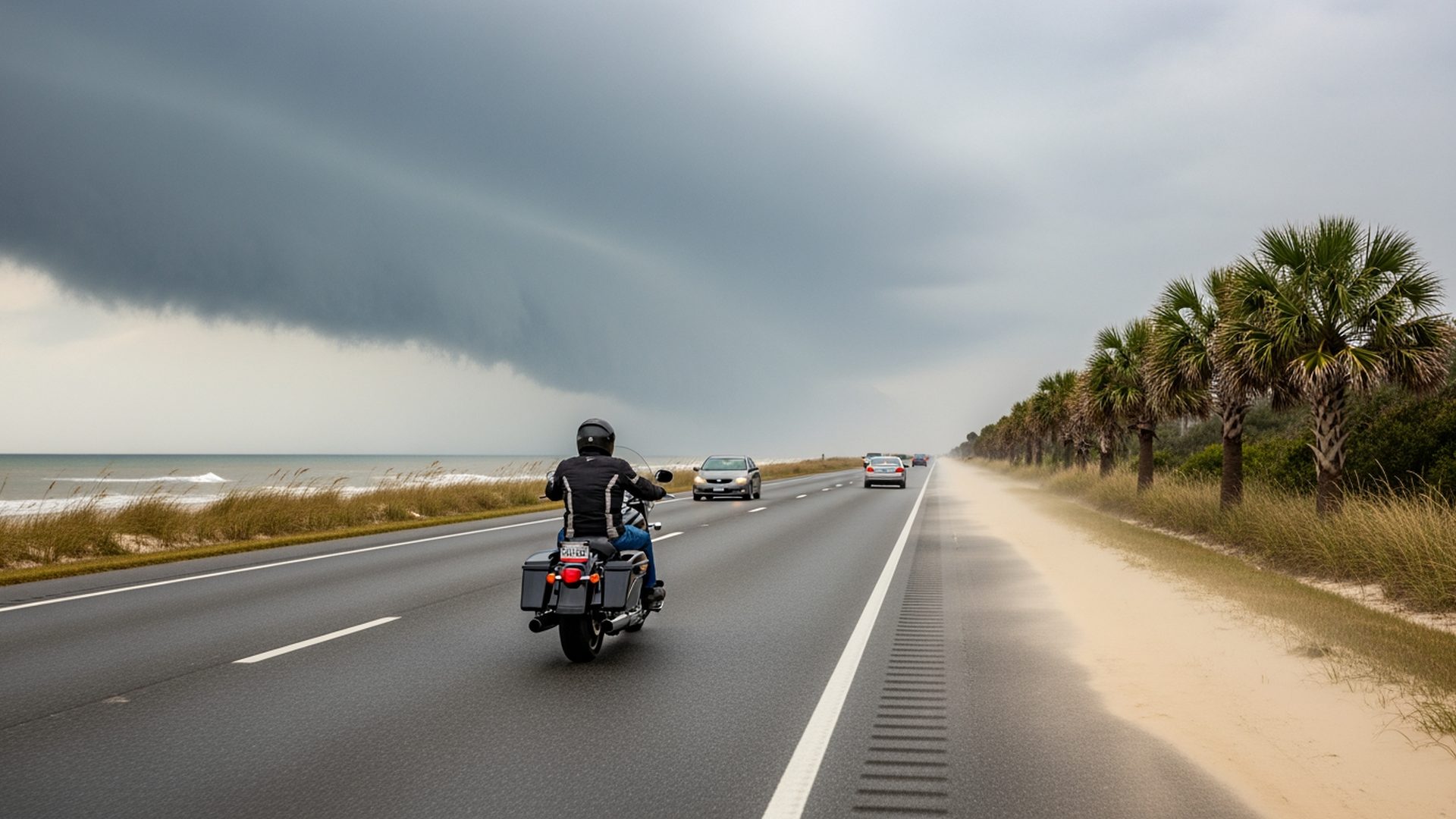
The Atlantic hurricane season runs into late November, and some of the wettest, windiest days of the year hit the Grand Strand in the fall. You do not need a named storm to get in trouble. A band of tropical rain rolling in off the ocean can drop visibility to nothing and flood the low spots on US-17 and the 17 Bypass in minutes, and a gusting crosswind off the water shoves a bike around every time you clear the tree line or cross a bridge. Standing water pools where you least expect it, on the shoulders, in the ruts of the older pavement, and at the bottom of the causeways heading toward the inlets. If a storm is building offshore, check the sky before you throw a leg over the bike, and if the wind is already bending the palmettos, that ride down to Georgetown can wait.
Blowing sand and the greasy first rain
Two coastal hazards catch riders off guard more than any storm. The first is sand. Wind coming off the beach carries a fine layer of it across Ocean Boulevard, the connector avenues near the oceanfront, and the stretches of US-17 that run close to the dunes and the inlets. A patch of dry sand on the pavement acts like ball bearings under your tires, and it collects worst in exactly the places you lean, the curves and the turns. The second is the first rain after a dry spell. Weeks of oil, rubber, and grime bake into the road surface, and the first rain lifts all of it into a slick film before it washes away. That first ten or fifteen minutes of a fall shower is some of the most treacherous riding you will do all year.
- ✓ Treat blown sand like ice. Scan for the light-colored drift across Ocean Boulevard and the oceanfront connectors, and get your speed and lean off before you reach it, not on top of it.
- ✓ Respect the first rain. When a dry spell finally breaks, back off hard for the first several miles until the road film washes clear. That opening stretch is slicker than steady rain.
- ✓ Watch the bridges and causeways. The spans over the Waccamaw and the Intracoastal, and the causeways to the inlets, get gusty and glassy the moment they are wet. Cross them upright with steady throttle and no sudden inputs.
- ✓ Do your braking early and upright. On a wet or sandy fall road, get your speed down in a straight line so you are not asking a low-grip surface for traction mid-corner.
- ✓ Check your tires more often. Cooler fall air drops your tire pressure, and worn tread that got you through a dry summer will not hold on a slick coastal road.
The Fall Bike Rally and the crowds it brings
Myrtle Beach is a rally town, and the Fall Bike Rally packs the Grand Strand with motorcycles and the traffic that follows them. The riding energy is great, but the roads get dense, slow, and unpredictable. Ocean Boulevard and the oceanfront strip crawl bumper to bumper, US-17 and the 17 Bypass stack up with out-of-town drivers who do not know the exits, and every parking lot and side street becomes a spot where a car pulls out across a lane of bikes. During rally weeks, more riders on the road also means more chances for a distracted or unfamiliar driver to misjudge one of them. Ride the rally like everyone around you is looking at the crowd instead of the road, keep extra space, and stay out of the tight gaps where a car turning across the strip cannot see you coming.
Deer on the inland roads and early sunsets
Head off the coast onto the Horry and Georgetown backroads, the two-lanes through the Francis Marion and the Swamp Fox country, US-501 toward Conway, and the rural stretches off SC-9, and the hazard changes to deer. Fall is the rut, when deer are on the move at all hours and crossing roads they normally avoid, and they move most at dawn and dusk. For a car a deer strike is a bad night. For a rider it can be the whole ballgame. They also travel in groups, so the one that just bolted across your lane is often not the last. On top of that, the days are getting short. Sunset slides into the late afternoon, and the clocks falling back in early November pushes it earlier still, so a ride that started in daylight ends in the dark. You are harder to see right when a driver "just didn't see the motorcycle" gets easier to say. Scan the treeline as hard as the pavement on the inland roads at first and last light, run your headlight, and keep reflective gear on for the ride home.
Why a fall crash hits South Carolina riders harder
Here is the part too many Grand Strand riders learn after the crash instead of before it. South Carolina follows modified comparative negligence with a 51 percent bar. That means your recovery is reduced by your share of fault, and if you are found 51 percent or more at fault, you get nothing at all. How the crash is documented drives that number, and the insurance company will fight hard to push your share up, arguing you were riding too fast for a wet road, should have seen the sand, or had no business out in rally traffic. Do not let "it was slick out" or "it was the rally" get twisted into "the rider caused it." Wet leaves, blown sand, and low sun do not hand a careless driver a free pass.
- ✓ The 51 percent bar is the whole fight. Cross that line and your claim is gone, which is exactly why insurers work so hard to hang extra blame on a rider after a fall crash.
- ✓ Helmets are required only under 21. In South Carolina only riders and passengers under 21 must wear a helmet, but a no-helmet choice is still something an insurer will try to use against an adult rider. Gear up anyway, for your head and for your claim.
- ✓ Uninsured-motorist coverage is your backstop. South Carolina requires UM coverage, and on a coast full of uninsured and out-of-state tourist drivers it may be what pays after a crash the other driver cannot.
- ✓ Three years to file. The statute of limitations on a South Carolina personal injury claim is generally three years, so a valid fall-crash case can quietly slip away if you wait too long.
If a fall-condition crash does happen, get medical care first, because hidden injuries have a way of surfacing days later. Then document the conditions while they are fresh: photograph the standing water, the sand drift, the wet bridge deck, the deer, and the exact spot it happened. In a state where crossing 51 percent fault ends your case, those details are not a formality, they are the difference between a full claim and a fight.

Led by Justin Lovely, The Lovely Law Firm in Myrtle Beach fights for injured motorcyclists. Reach out to their motorcycle accident lawyers in Myrtle Beach anytime you need real answers.