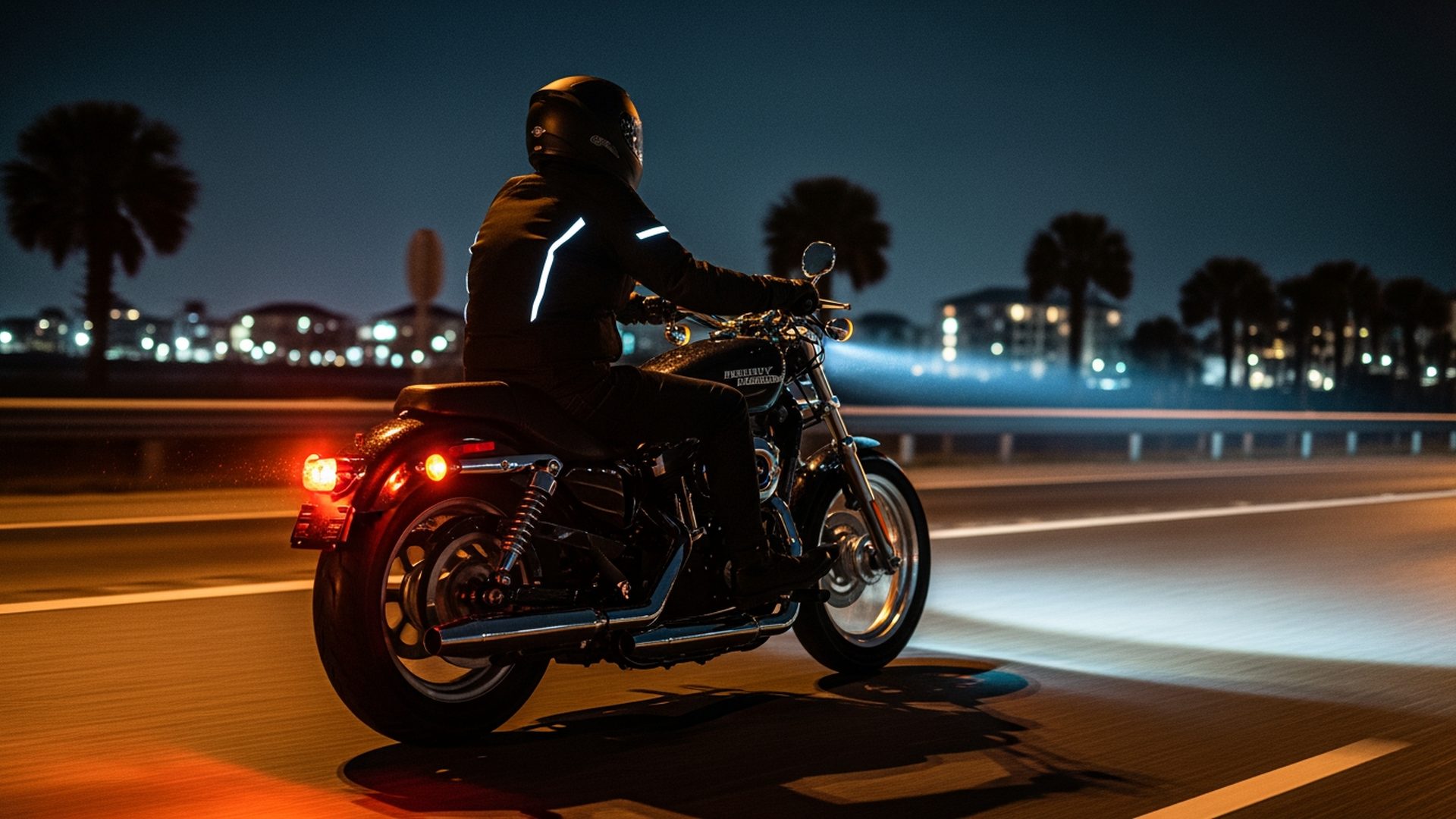
Night Riding on the Gulf Coast: Staying Visible on Highway 59 and the Beach Express
By November, the ride home is a night ride whether you planned it or not. The clocks fall back, sunset lands in the late afternoon, and a big share of Gulf Coast riding shifts into the dark. Night riding is not reckless by itself, but it strips away your biggest advantage on the road, which is being seen. On a motorcycle, visibility is survival, and after dark you have to work for it.
Why the dark is harder on a motorcycle
A car at night reads as a wide, obvious pair of headlights and a set of taillights. A motorcycle reads as a single light that a tired or distracted driver can mistake for something far away, or miss entirely. Depth perception fails at night, and a driver judging the gap before a left turn onto Highway 59 can badly misjudge how close and how fast you are coming. That is the core problem behind most night crashes involving riders. Not that you were invisible, but that a driver saw one small light and made the wrong call. Everything else is about closing that gap.
Own your visibility, do not assume it
You cannot control whether a driver is paying attention, but you can control how hard you are to miss. The riders who make it home are usually the ones who stack the deck in their favor with gear and lighting, not the ones who trust drivers to look twice. Build your night setup around being seen.
- ✓ Reflective gear on the parts that move. Strips on your jacket, helmet, and boots catch headlights and read as a human, not a road sign, and movement draws the eye.
- ✓ A clean, aimed headlight. A grimy or misaligned headlight throws away half its output, so wipe the lens and check the aim.
- ✓ Auxiliary lights that widen your footprint. A pair of lights spreads your signature so you stop looking like a single distant point.
- ✓ A working, bright brake light. The driver behind you in beach-town stop-and-go needs the clearest possible warning when you slow.
- ✓ A clear, clean face shield. Scratches and salt haze turn oncoming headlights into starbursts and cost you the detail you need to read the road.
Highway 59 and the Beach Express after dark
Highway 59 keeps its heavy traffic and constant turn-lane activity at night, but now every driver is working with reduced vision and more of them are tired or impaired. The left turn across your lane, the car easing out of a shopping entrance near the outlets, the driver who never registered your single headlight, all of it gets harder to avoid because the window to spot you is shorter. The Baldwin Beach Express and Foley Beach Express bring their own trap after dark. Long, fast, and lightly lit in stretches, they give you less margin and less light to work with, and the toll points and interchanges create sudden slowdowns. Keep your following distance longer than it feels like you need, ride out of the blind-spot pockets, and let a merging car see your headlight well before the gap closes. Glare from oncoming and trailing traffic washes out detail on both roads, so slow to a speed where your own headlight actually reaches far enough for you to react.
The rural roads and Fort Morgan go truly dark
Get off the main corridors and the lights disappear. Fort Morgan Road out the peninsula, the county two-lanes north and east of Foley, and the back roads through the pines have little or no lighting, which means your headlight is the whole show. A curve you can read easily by day becomes a guess at night, and blown sand or a downed limb can be on you before your beam picks it up. This is also prime territory and prime hours for deer, which move most at dawn and dusk and travel in groups. On an unlit two-lane, a deer at the edge of your headlight gives you almost no time. Ride these roads slower at night than you would in daylight, keep your high beam on when no one is oncoming, and treat the edge of your light as the edge of what you can safely handle. If you cannot stop within the distance your headlight lights up, you are riding too fast for the dark. Fatigue works against you too, so break up a long night ride and know when to call it rather than push through the last exhausted miles.
When a driver never saw you
Do everything right and a driver can still turn left across your path, change lanes into you on the Beach Express, or pull out from a side road because they registered your headlight too late or not at all. When that happens, "I never saw the motorcycle" is not a defense. It is an admission that the driver failed to look for you. Alabama, though, makes this harder than almost anywhere else. The state follows pure contributory negligence, which means if you are found even one percent at fault, you can be barred from recovering anything at all. After a night crash, insurers love to argue the rider was hard to see, as if that shifts the blame off their driver and onto you. Alabama also requires a helmet for every rider and passenger, sets minimum liability coverage at just 25/50/25, and generally gives you only two years from the crash date to file, while uninsured and underinsured motorist coverage stays your backstop against a driver with little or no insurance. Whether your lights and gear met the moment, and how the crash actually unfolded, become central questions, which is exactly why the details matter.
Have questions after a wreck? Noel Leonard and the Foley / South AL motorcycle injury attorneys at Noel B. Leonard Attorney (attorney-leonard.com) review rider claims and explain your options.