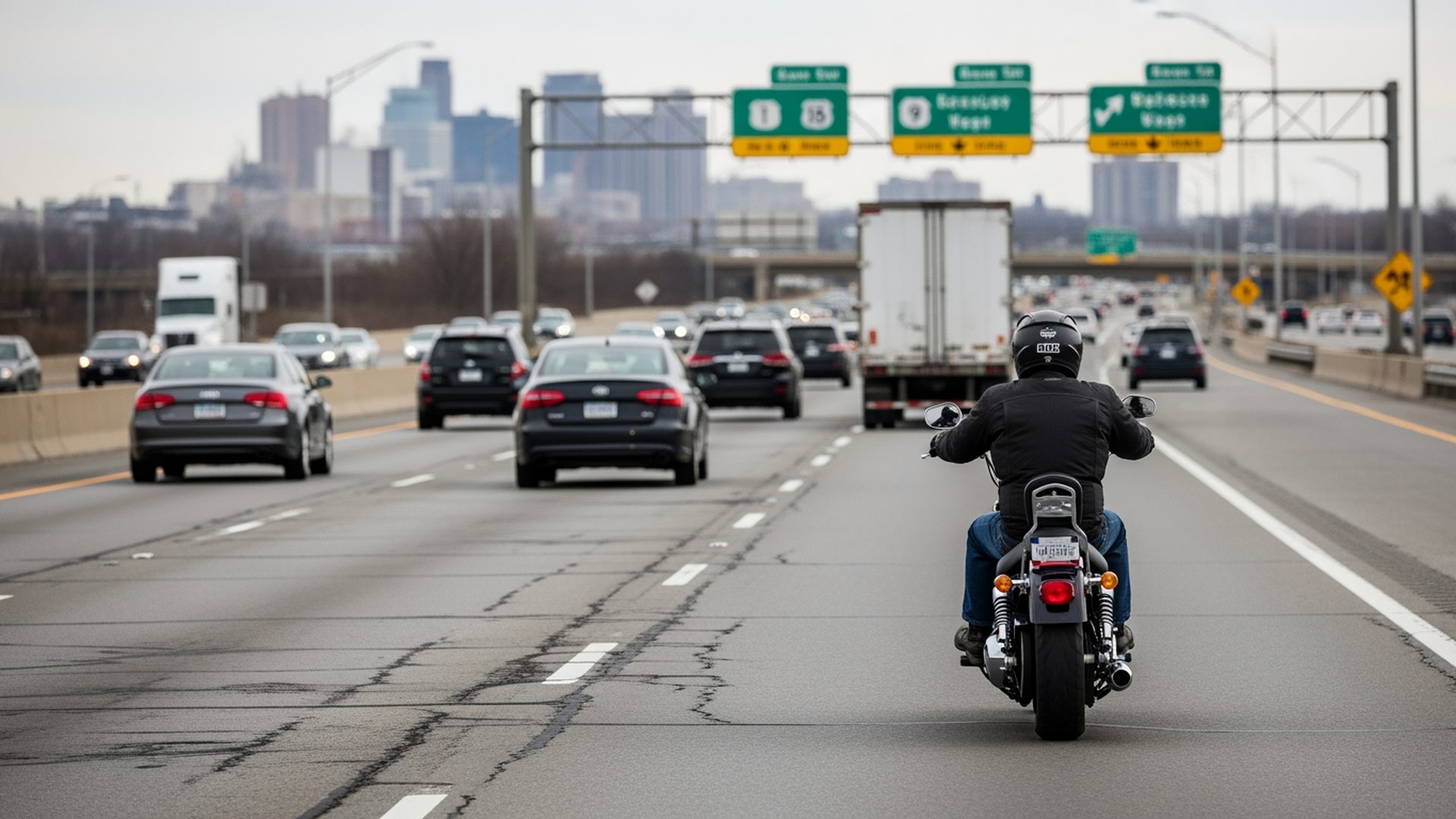
The Most Dangerous Roads for New Jersey Motorcyclists, and How to Ride Them
Every Jersey rider has a road they respect and a road they dread. Some of that is reputation and some of it is hard-earned. The truth is that a handful of corridors around the state concentrate the kind of traffic, speed, and driver behavior that turns a routine ride into a crash. This is not about naming a road so you avoid it forever, most of these you cannot avoid, they are how you get around New Jersey. It is about knowing which ones demand your full attention and exactly what makes each one dangerous, so you can stack the deck in your favor before you ever throw a leg over the bike.
The Turnpike and the Garden State Parkway
These two carry some of the heaviest, fastest traffic in the country, and they punish a motorcycle in the same ways. The danger is not any single curve, it is the volume, the constant merging, and the closing speeds. The Turnpike runs wide and fast with a dedicated truck-and-bus roadway in the north, and the split between the car lanes and the truck lanes creates merge points where drivers cross late to reach an interchange. The Parkway threads from the shore to the north with tight on-ramps, short merges, and toll-plaza churn where everyone jockeys for a lane at once. Add long-haul trucks that throw wind blasts and carry blind spots big enough to swallow a motorcycle, and potholes and steel plates lurking in a lane, and you have the recipe for the crashes riders fear most.
Ride them with distance as your friend. Stay out of truck blind spots, keep your following distance long, and do not linger alongside a big rig where the driver cannot see you and the wind can shove you around. Position yourself early for your exit so you are never the one diving across lanes at the last second, scan the pavement a few car lengths ahead for the pothole or plate you do not want to hit mid-merge, and watch your mirror as hard as the road ahead, because the rear-end at the back of a sudden stop is one of the worst hits a rider can take.
Route 1 and 9 and the Pulaski Skyway
The Route 1 and 9 corridor through the northeast and the Pulaski Skyway that carries it over the Meadowlands are a category of their own. The Skyway is a narrow, aging, high deck with no real shoulder, tight lanes, and no room to recover if traffic stops short or a driver drifts. Below and around it, Route 1 and 9 runs through dense industrial traffic, truck routes, and a stack of intersections and jughandles where cars cross your path constantly. The surface is beat up, the merges are short, and the trucks are everywhere. That combination of no escape room on the Skyway and relentless cross traffic below it is what makes the corridor so unforgiving for a rider.
- ✓ Ride out of the blind-spot pockets. On corridors this busy, the lane change into a rider nobody saw is the most common crash. If you cannot see a driver's mirrors, assume they cannot see you.
- ✓ Leave real following distance. A car cutting into the gap in front of you should not put you into its bumper. Space is what buys you time on a deck with no shoulder like the Skyway.
- ✓ Expect the last-second merge and the sudden stop. Around the truck routes and toll plazas, plan for a driver to cross into your lane late and cover your brakes.
- ✓ Read the pavement early. These older roads are full of seams, patches, and steel plates that get slick when wet. Spot them ahead so you meet them upright, not mid-lean.
Route 22, Route 46, and the jughandle arterials
Off the highways, the big surface arterials are their own hazard, and New Jersey's jughandles make them uniquely tricky. Route 22 and Route 46 are walls of intersections, strip-mall curb cuts, abrupt lane drops, and turning traffic, and each of those is a spot where a car can cross your path. Because so many of these roads use jughandles instead of standard left turns, drivers ride to the right ramp and then swing left across all lanes to turn or make a U-turn, which puts cars cutting across your line in places you would not expect on a normal road. The signature crash here is the left-turn or crossing collision, where a driver turns across your lane because they misjudged your speed or never registered a single headlight in the visual clutter. Left-turn crashes are the number one killer of motorcyclists nationwide, and a Route 22 or Route 46 jughandle gives a turning driver a fresh chance to make that mistake every few hundred feet.
Ride these arterials expecting the turn. Cover your brakes near every intersection and jughandle, watch the front wheels of any car waiting to cross, because the wheels move before the car does, and set a lane position where a turning driver has the best chance of seeing you coming. Give parked and merging cars room, buy yourself an escape path at every light, and never assume a driver looking right at you has actually seen you.
The I-80, I-280, and I-287 interchanges
The north Jersey interstate web blends the worst of two worlds. I-80, I-280, and I-287 carry near-highway speeds but tangle together in interchanges where lanes split, weave, and merge in a short distance, and traffic stacks up into some of the worst stop-and-go congestion in the region without warning. Traffic slams from 65 to zero in a heartbeat, and the closing speed on a rider who did not read the brake lights ahead is brutal. Aggressive lane-changers cutting across two lanes to catch a ramp, drivers riding the shoulder, and the mix of local commuters who know the weave cold and out-of-town drivers who do not add another layer of unpredictability.
On these roads, keep your speed matched to the sightlines and the flow ahead, not just the car in front of you. Scan several vehicles up so you see the slowdown before it reaches you, know your exit and get into the right lane early so you are not diving across the weave, treat any tapping brake lights as a full stop coming, and give yourself room to brake in a straight line before you reach it.
What New Jersey law means when one of these roads bites
You can ride every one of these corridors perfectly and still get hit by a driver who was not paying attention. When that happens, New Jersey law shapes what comes next, and it treats riders differently than drivers. New Jersey is a no-fault state, but its no-fault law specifically does not cover motorcyclists. A car occupant taps PIP for their own bills regardless of fault. A rider cannot, which means recovering after a crash usually depends on proving the other driver was at fault. That is why the insurance company will work so hard to pin a sliver of blame on the rider, and why the details of how the crash actually happened matter so much.
- ✓ No-fault excludes motorcycles. New Jersey's PIP system does not pay a rider's own injuries, so fault becomes the whole fight after a crash.
- ✓ But riders keep full tort rights. Because they are outside the no-fault system, riders are not bound by the limitation-on-lawsuit threshold that restricts car occupants, so an injured rider keeps the full right to sue for pain and suffering.
- ✓ Modified comparative negligence. New Jersey reduces your recovery by your share of fault and bars it only if you are more than 50 percent to blame, so a partly-blamed rider still has a claim worth protecting.
- ✓ UM/UIM is your backstop. With no PIP on the bike and a lot of minimally insured drivers on these roads, uninsured and underinsured motorist coverage is a rider's real lifeline after a serious crash or a hit-and-run.
- ✓ Two years to file. The statute of limitations on a New Jersey injury claim is generally two years, and the notice deadline is far shorter when a public entity is involved, so the clock does not wait.

Lawrence LeBrocq and the New Jersey (New Brunswick) motorcycle accident attorneys at Garces, Grabler & LeBrocq represent riders hurt by negligent drivers. If you have questions after a crash, their team is here to help.