Fall Riding Hazards in New Jersey: What Bites Riders in October and November
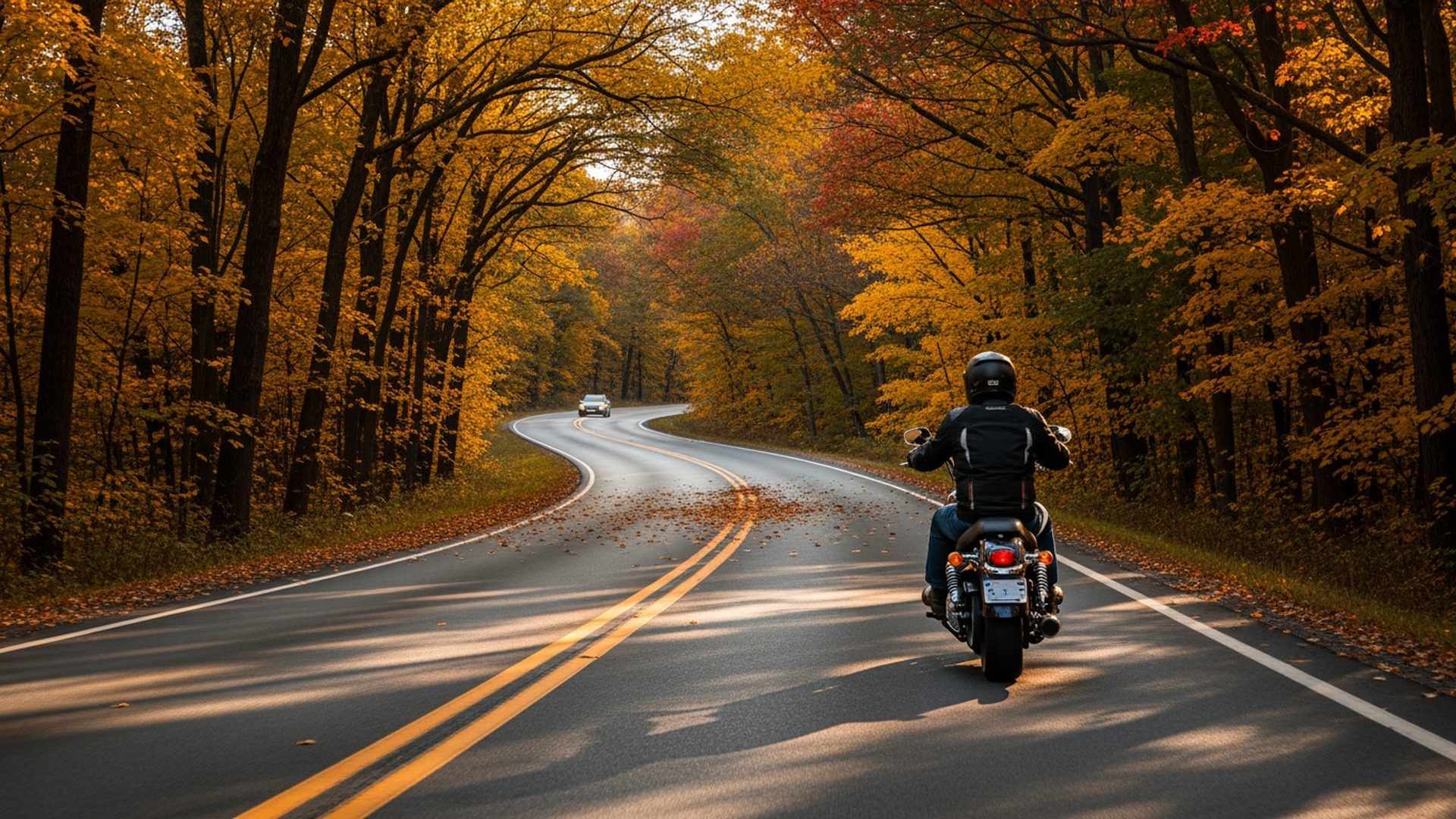
Ask most Jersey riders and they will tell you fall is the payoff. The summer humidity finally breaks, the shore traffic thins out, and a run up Old Mine Road along the Delaware Water Gap, a loop through the Sourland Mountains, or a climb toward High Point with the hardwoods turning gold is the reason you bought the bike. It is also the season that puts more good riders on the ground than any other. The same cool mornings and colorful roads hide traction traps and wildlife that simply do not exist in July, and in New Jersey the way the insurance rules treat motorcyclists makes a fall crash even more punishing than it looks. Knowing what October and November throw at you is half the fight.
The deer rut is the number one fall hazard on the backroads
New Jersey is one of the most crowded deer-strike states in the country, and the crash spike lands squarely in the fall. October and November are the rut, when bucks are chasing does and both are on the move at all hours, crossing roads they normally avoid. For a car a deer strike is a bad morning. For a rider it can be the whole ballgame. The wooded two-lanes riders love are exactly where deer live: the northwest corner around the Water Gap, Old Mine Road, and the ridges of Sussex and Warren counties, the Sourland Mountains and the Hunterdon backroads, and the quieter central and Pine Barrens routes past the reservoirs and state forests.
Deer move most at dawn and dusk, the same low-light hours a cool fall morning or evening ride is most tempting. They also travel in groups, so the one that just bolted across your lane is often not the last. Scan the shoulders and the treeline, not just the pavement, and back your speed down on any tree-lined road at first and last light so you actually have room to react.
Wet leaves are grease, and they hide in the curves
A dry leaf is nothing. A wet, matted layer of leaves is close to riding on ice. It hides the road surface underneath, covers painted lines and potholes, and tears grip away the instant you lean or brake on top of it. Leaves pile up worst in exactly the places you least want to lose traction: the shaded sweepers on Old Mine Road and the Water Gap that never see full sun, the tree-walled turns through the Sourlands and the Hunterdon hills, and the off-ramps where they collect against the curb. A backroad corner you have railed a hundred times in summer can be a different animal in November when it stays damp under the canopy all day.
- ✓ Treat shaded curves as wet. Corners under heavy tree cover on the northwest and central backroads hold moisture and leaves long after the open road has dried.
- ✓ Do your braking upright and early. Get your speed off before the leaves, not on top of them, so you are not asking a leaf-covered surface for grip mid-lean.
- ✓ Respect the metal grate bridges and expansion joints. The steel-grid decks and expansion joints on the older river crossings and the Water Gap bridges get glassy the moment they are wet or cold. Cross them upright with steady throttle and no sudden inputs.
- ✓ Respect cold tires for the first few miles. Rubber needs heat to grip, and on a 40-degree morning your tires are stiff and cold. Take it easy until they warm up before you push a corner.
- ✓ Check your tire pressure more often. Pressure drops about a pound for every ten-degree fall in temperature, and an underinflated tire handles worse right when the roads are least forgiving.
Early sunsets, the first cold rain, and morning frost
Fall does not just change the road surface, it changes the light and the weather. As the days shorten, the evening commute slides into dusk, and the clocks falling back in early November pushes sunset into the late afternoon. You are harder to see, and a driver who "just didn't see the motorcycle" has even more cover for that excuse, so reflective gear and running your headlight stop being optional. Then there is the low sun, sitting right in drivers' eyes at rush hour and blasting straight down the east-west arterials like Route 22 and Route 46. A driver blinded by that glare may never register you until it is too late. Add the season's first real cold rain, which lifts a summer's worth of oil and rubber off the Turnpike, the Parkway, and Route 1 and 9 and leaves them greasy for the first twenty minutes, plus the first frosts that settle on shaded overpasses and low spots at dawn before the rest of the road, and you have a stack of hazards that all land on the same ride. Assume that at sunrise and sunset half the drivers around you are squinting into a wall of light, give yourself extra space and an escape route at every intersection, and treat that first fall rain as the most slippery pavement of the year.
Why a fall crash hits New Jersey riders harder
Here is the part too many Jersey riders learn after the crash instead of before it. New Jersey is a no-fault state, but its no-fault law specifically does not cover motorcyclists. A car occupant can tap no-fault PIP for their own medical bills no matter who caused the wreck. A rider cannot. That means after a fall crash your own bills do not just get paid automatically, and recovering them usually depends on proving the other driver was at fault. That is exactly why the insurance company will fight so hard to hang blame on you, arguing you were riding too fast for a wet corner or should have seen the deer. Do not let "it was slippery out" get twisted into "the rider caused it." Wet leaves, low sun, and a cold rain do not hand a careless driver a free pass.
- ✓ No-fault excludes motorcycles. New Jersey's PIP system does not pay a motorcyclist's own injuries, so recovering after a fall crash usually means proving the other driver was at fault.
- ✓ The flip side is full tort rights. Because riders are outside the no-fault system, they are not bound by the limitation-on-lawsuit threshold that restricts car occupants, so an injured rider keeps the full right to sue for pain and suffering.
- ✓ Modified comparative negligence. New Jersey reduces your recovery by your share of fault and bars it only if you are more than 50 percent to blame, so a partly-blamed rider still has a claim worth protecting.
- ✓ Universal helmet law. Every rider and passenger in New Jersey must wear a DOT-approved helmet, no exceptions, so keep yours on and make it work for you.
- ✓ Two years to file. The statute of limitations on a New Jersey injury claim is generally two years, and the notice deadline is far shorter when a public entity is involved, so waiting can quietly end a valid case.
If a fall-condition crash does happen, protect yourself and get medical care first, because hidden injuries have a way of surfacing days later. Then document the conditions while they are fresh: photograph the leaves, the low sun, the wet bridge grate, the deer, and the exact spot it happened. In a state where no-fault leaves riders out and fault decides everything, those details are not a formality, they are the difference between a full claim and a fight.

Led by Lawrence LeBrocq, Garces, Grabler & LeBrocq in New Jersey (New Brunswick) fights for injured motorcyclists. Reach out to their motorcycle accident lawyers in New Jersey (New Brunswick) anytime you need real answers.