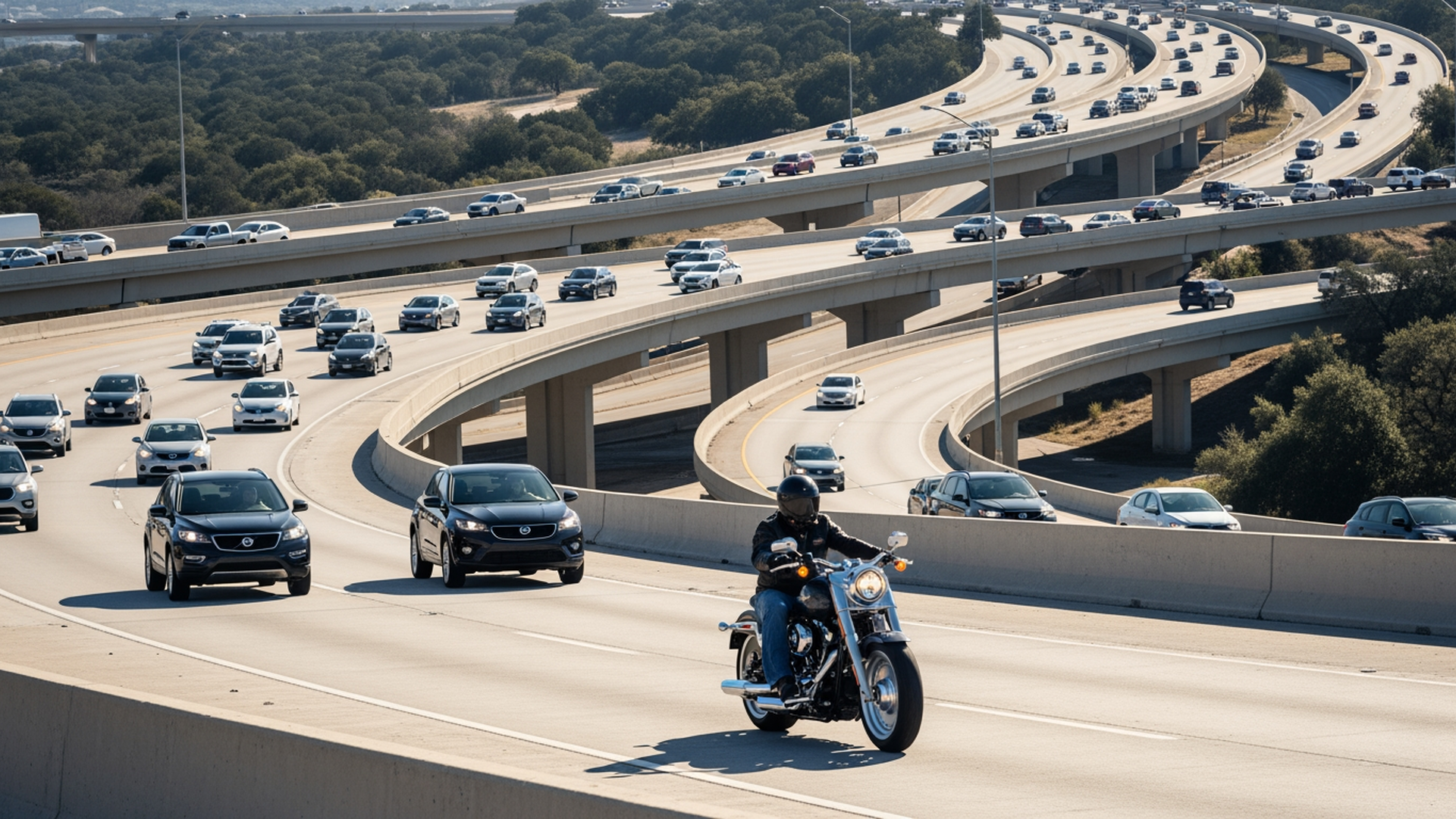
Austin's Most Dangerous Roads and Interchanges for Motorcyclists
Every Austin rider has a road they respect and a road they dread. A handful of corridors and interchanges around the city concentrate the kind of traffic, speed, and driver behavior that turns a routine commute into a crash. Knowing which roads deserve extra caution, and why, is one of the cheapest safety upgrades you can give yourself.
I-35 through the core is the big one
If you ride in Austin, I-35 is unavoidable, and it is the corridor where the odds stack hardest against a motorcycle. The upper and lower decks downtown, the constant lane changes, the short merges, and the stop-and-go that appears out of nowhere all create the exact conditions where riders get hurt: cars changing lanes without looking and traffic that slams from highway speed to a standstill.
The rear-end and the blind lane change are the two crashes I-35 produces most. A rider filtering through slowing traffic or riding a driver's blind spot is one distracted glance away from being hit. Give yourself an escape lane, stay out of the pockets where a car cannot see you, and never assume the driver merging onto the deck has checked for a motorcycle.
MoPac and its merges
MoPac, or Loop 1, moves fast when it moves at all, and its trouble spots are the merges. The on-ramps feed traffic in at speed, the express-lane dividers narrow your options, and the transitions to and from Highway 183 and the RM 2222 area put cars and bikes into the same tight space at the same time. A merge is where a driver is looking for a gap in traffic and not looking for a motorcycle already in it.
The defensive play on MoPac is positioning. Ride where a merging driver's mirrors can actually find you, adjust your speed early to open or close a gap on your terms, and treat every on-ramp as a place where someone is about to move into your lane.
The 183 and 290 corridors
Highway 183 through the north and northwest side and US-290 out to the west both carry heavy, fast traffic with frequent access points, signals, and turning movements. The classic and most dangerous crash on roads like these is the left-turn collision, where an oncoming driver turns across your path at an intersection because they never registered the single headlight coming toward them.
Intersections are where riders and drivers meet at angles, and they are where the "I never saw the motorcycle" crash happens most. Cover your brakes approaching any intersection, watch the front wheel of a car waiting to turn because it moves before the car does, and be ready for the driver who is looking for a gap in car traffic, not for you.
The Hill Country two-lanes
The roads that make Austin a great place to ride are also the ones that punish a mistake hardest. RM 360, RR 2222, the Devil's Backbone on RR 32, Hamilton Pool Road, and Lime Creek Road pack blind curves, elevation changes, and no shoulder to speak of into miles of scenery. Add weekend tourists, cyclists, and the occasional deer, and the margin for error shrinks fast. The danger here is different from the highway. It is the corner you entered too hot, the car drifting over the center line in a blind curve, the gravel or wet leaves you did not see until you were on them. Ride your own pace, not the pace of the rider ahead, and set up wide so you can see through a corner before you commit to it.
Different roads, the same handful of failures
Across Austin, the crashes that hurt riders tend to come from a short list of situations you can learn to anticipate. The common thread is that most involve another driver who failed to see or yield to a motorcycle, and that fact matters when it comes time to sort out fault.
- ✓ Left-turn collisions at intersections. An oncoming driver turns across your path on 183, 290, or a busy arterial.
- ✓ Blind-spot lane changes. On I-35 and MoPac, a driver merges into a rider they never saw.
- ✓ Rear-end hits in stop-and-go. A following driver does not react to sudden braking on the deck.
- ✓ Cars pulling out from side roads. Drivers enter busy arterials like Bee Cave Road or Anderson Mill without yielding.
- ✓ Over-speed and mid-corner surprises. Gravel, wet leaves, or oncoming traffic over the line on the Hill Country two-lanes.
When a crash was not your fault
Getting hit on one of these roads is not proof you did anything wrong, but the other driver's insurance company will often act like it is. Texas follows a modified comparative negligence rule with a 51 percent bar. If you are found more than 50 percent responsible, you recover nothing. If you are partly responsible but at or below that line, your recovery is reduced by your percentage of fault. That is why insurers push so hard to pin blame on the rider after a motorcycle crash. The location and mechanics of the crash carry real weight. A left-turn collision at a 183 intersection, a merge on MoPac, a rear-end on I-35, each tells a story about who failed to yield, and building that story with the evidence is where a claim is won or lost. Keep the Texas basics in mind: minimum liability coverage of 30/60/25 often does not cover a serious injury, uninsured and underinsured motorist coverage is your backstop when the driver who hit you has little or no insurance, and the two-year statute of limitations means the clock is running from day one.
Glen Larson and the Austin motorcycle accident attorneys at Biker Wolf Pack represent riders hurt by negligent drivers. If you have questions after a crash, their team is here to help.