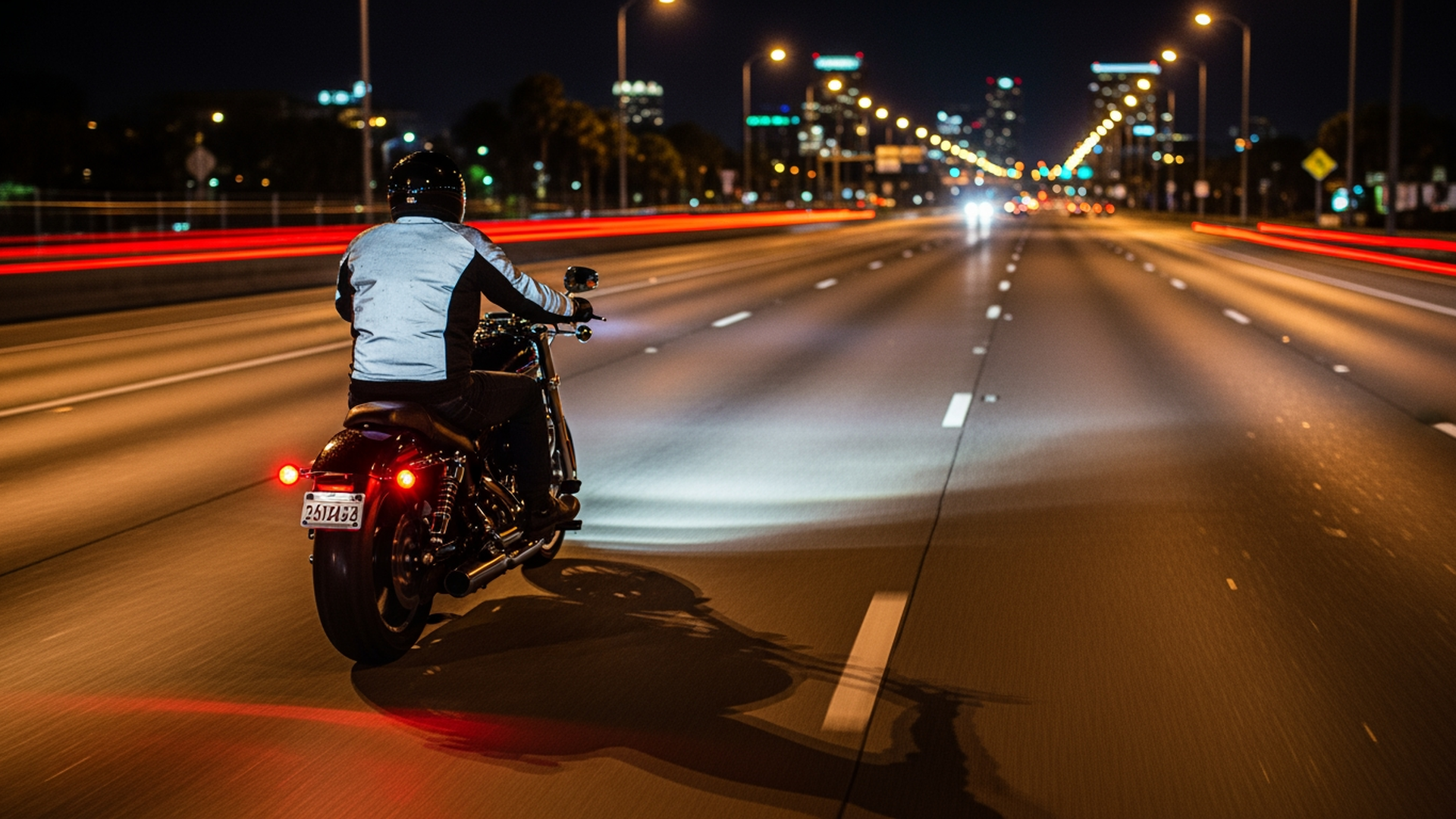
Night Riding on US-19 and I-275: Staying Visible in Tampa Bay Traffic
By November the sun is down before most people finish work, which means a lot of Tampa Bay riding now happens in the dark. US-19 and I-275 are two of the busiest corridors in the region, and both change character after sunset. The traffic is faster, the lighting is uneven, and the single biggest threat to a rider, a driver who simply does not see you, gets far worse at night.
Why night riding is a different animal on these roads
US-19 is a wide, high-speed arterial packed with intersections, driveways, and left-turn lanes. Every one of those is a spot where a driver might cross your path without ever registering your headlight. I-275 is the opposite kind of danger: highway speeds, quick lane changes, and drivers who check a mirror for a car-sized gap and miss a motorcycle entirely. Add darkness, glare from oncoming headlights, and the flat sameness of a single headlight in a sea of taillights, and a rider can become nearly invisible to a distracted or tired driver. The core problem at night is that a motorcycle gives a driver very little to lock onto: one light, low to the ground, with no width to judge distance or speed. Your job is to give them more.
Make yourself impossible to miss
Visibility at night comes from stacking small advantages until you stand out from the traffic around you. A reflective vest or jacket catches headlights from angles your taillight never will, and retroreflective material on the helmet and around the ankles, which move, draws the eye even faster. Make sure your headlight is properly aimed and consider auxiliary lights, because two points of light read as a vehicle far better than one. Keep your visor and lenses clean so every oncoming headlight does not turn into a starburst that hides the road. Flat black looks great in daylight and disappears after dark, so reserve the visibility gear for night runs even if it is not your usual style.
Ride the gaps, not the pack
Being seen is half of it. The other half is positioning yourself so that when a driver misses you, it does not matter. Stay out of blind spots on I-275, because if you cannot see a driver's mirrors, they cannot see you. Buy space at US-19 intersections, cover your brakes, and set up an escape path for the left-turning driver who never sees your light. Back off your speed to match how far your headlight actually reaches, since outriding your light is how riders meet a stalled car or debris with no time to react. Assume every driver at a light or a driveway is looking for a car-sized gap and will pull out into yours.
What Florida law means if a driver hits you at night
Do everything right and a driver can still turn across your path claiming they never saw you. Florida is a no-fault PIP state, but PIP does not cover motorcyclists. The personal injury protection that automatically pays a car driver's medical bills does not extend to your bike. On top of that, Florida does not require drivers to carry bodily injury liability coverage, so the driver who pulls out of a dark US-19 side street may have no insurance to pay for your injuries at all. This is exactly why uninsured and underinsured motorist coverage is a Florida rider's real lifeline. Expect the insurance company to lean on the darkness and argue the rider was hard to see or moving too fast for conditions, shifting blame onto you under the comparative negligence rule.
- ✓ PIP does not cover motorcycles. Your own health insurance and UM/UIM coverage carry the load.
- ✓ The driver may carry no injury coverage. Florida does not require bodily injury liability, so UM/UIM is what protects you.
- ✓ Fault is shared, not all-or-nothing. Florida's 51 percent bar lets you recover if you were partly at fault, but not if you were more than half responsible.
- ✓ The clock is two years. Florida's 2023 tort reform shortened the deadline for most injury claims from four years to two.
Have questions after a wreck? Jason Melton and the Spring Hill motorcycle injury attorneys at Whittel & Melton (thefllawfirm.com) review rider claims and explain your options.