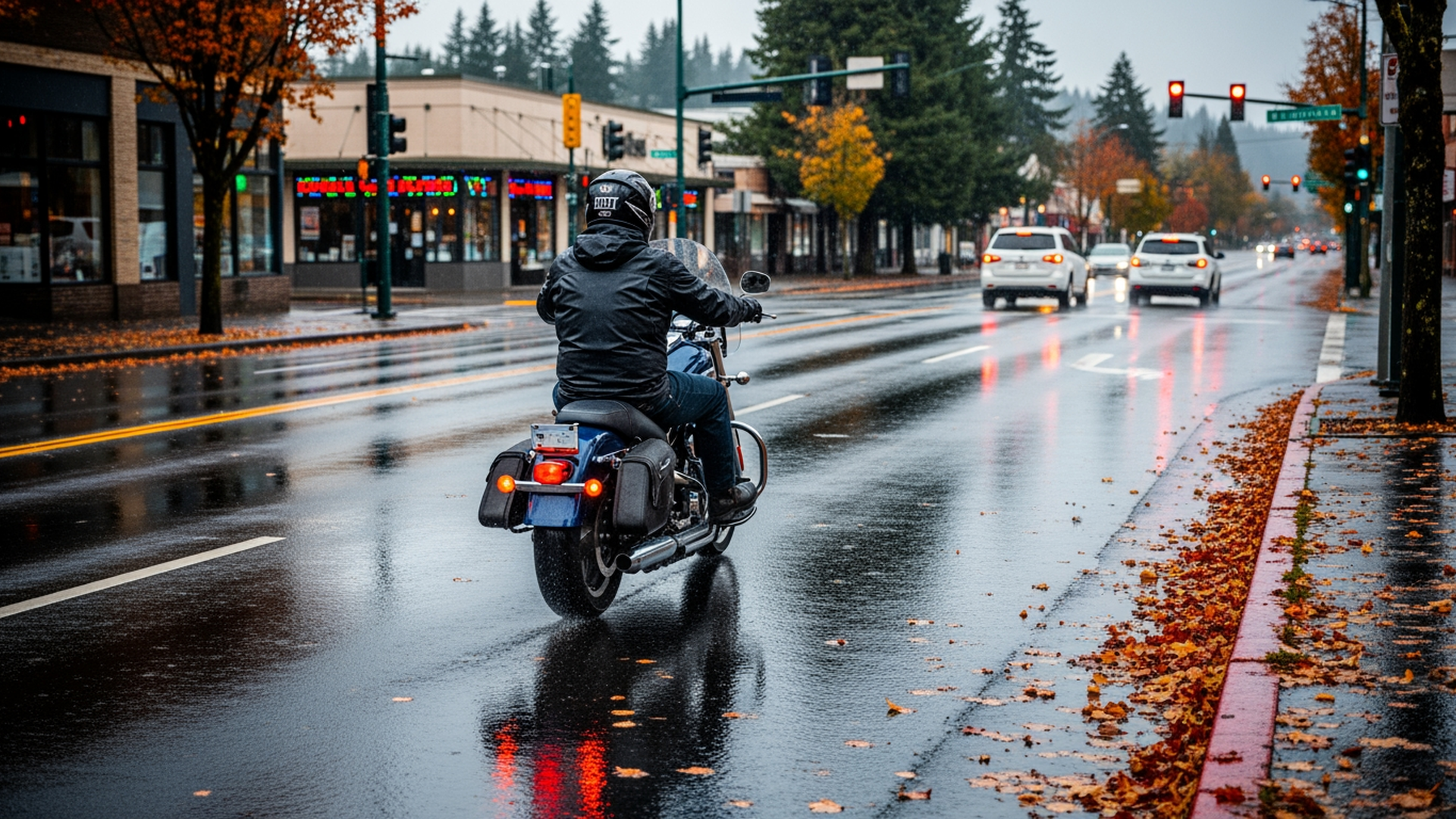
Wet-Season Riding Hazards in Oregon: How Portland Riders Survive the Return of the Rain
Every Portland rider knows the feeling. The long dry summer finally breaks, the first real storm rolls in off the coast, and suddenly the ride that felt effortless in August is a completely different animal. Wet season is Portland's defining hazard on two wheels. It is not one danger but a stack of them: oil that floats up on the first rain after a dry spell, wet leaves buried in the backroad curves and out along the Gorge, painted lines and metal grates that turn to grease, fog that fills the valleys at dawn, and dark, cold evenings that shrink your window to react. None of it should keep you off the bike. All of it should change how you ride. Here is what the return of the rain really throws at you, and how to handle it.
The first rain is the most dangerous day of the year
The single slickest moment of the whole season is the first good rain after a long dry spell. All summer, oil, rubber, and grime build up on the pavement and bake in. When the first storm hits, that film floats up before enough water arrives to wash it away, and for a few hours the road is coated in a slippery slurry that grip cannot cut through. It is worst at the places you most need traction: intersections where cars idle and drip, the approaches to lights on Powell and Sandy, freeway on-ramps, and any well-traveled stretch that has not seen water in weeks. Treat the first rain of fall, and the first rain after any dry break, as if the road were iced. Give yourself extra room, brake sooner and softer, and stay off aggressive throttle until the road has had a real soaking.
Wet leaves, paint, and metal: three kinds of grease
Once the rain settles in, three surfaces stop behaving. Wet leaves are the first. A dry leaf is nothing, but a wet, matted layer is close to riding on ice, and it hides the pavement, the paint, and the potholes underneath. Leaves pile up worst exactly where you least want them: shaded curves that never dry out, the tree-lined side streets of older Portland neighborhoods, and the sweepers out along the Historic Columbia River Highway and the Gorge, where the canopy keeps the road damp all day. The second is paint. Crosswalks, stop bars, arrows, and lane lines turn glossy and slick when wet, and Portland's streets are covered in them. The third is metal. The steel bridge decks and grates over the Willamette, manhole covers, railroad crossings, and above all the MAX light-rail and streetcar tracks that thread through downtown all go greasy in the rain.
- ✓ Cross tracks and metal as straight up as you can. The downtown streetcar and MAX rails, bridge grates, and crossings are slickest when wet and grab a tire that hits them at an angle. Cross close to a right angle, upright, off the brakes, with steady throttle.
- ✓ Do your braking upright and early. Get your speed off before the leaves, the paint, or the corner, not on top of them, so you are never asking a slick surface for grip mid-lean.
- ✓ Avoid the paint where you can. Try not to put a tire down on a crosswalk, stop bar, or lane line while braking or turning in the wet. A dry-looking line is still slick under rain.
- ✓ Treat shaded Gorge and backroad curves as wet all day. Corners under heavy tree cover along the Columbia River Highway and the coast-range roads hold water and leaves long after the open road has dried out.
- ✓ Respect cold, hard tires for the first few miles. Rubber needs heat to grip, and on a 40-degree morning your tires are stiff. Ease into it, and check your pressures more often, since they drop about a pound for every ten-degree fall in temperature.
Fog, early dark, and cold hands
The wet season also steals your light and your comfort. Fog settles into the low ground on cool mornings, filling the valleys, the river bottoms, and the ramps and lowlands around the metro, dropping your visibility and every driver's at the same time. Then the clocks fall back in early November and sunset slides into the late afternoon, so the ride home becomes a night ride whether you planned it or not. You are harder to see in the gloom, and a driver who "just didn't see the motorcycle" has more cover for it. Add cold hands that go numb and clumsy on the controls, and rain running down your visor, and your reaction time quietly gets worse right when the roads are least forgiving. Reflective gear, a clean and aimed headlight, a clear visor, and warm, waterproof gloves stop being luxuries once the rain is back. Slow to a speed where your own headlight actually reaches far enough to react to what it finds.
Why a wet-season crash hits Oregon riders harder
Here is the part too many Portland riders learn after a wreck instead of before it. Oregon follows modified comparative negligence with a 51 percent bar. Your recovery is reduced by your share of fault, and if you are found more than 50 percent at fault, you are barred from recovering anything at all. That is exactly why the insurance company will fight so hard to pin a slice of blame on the weather and on you after a rainy-day crash, arguing you were going too fast for a wet corner or should have expected the slick tracks. Do not let "it was raining out" get twisted into "the rider caused it." A careless driver who turns across your path does not get a free pass because the pavement was wet.
- ✓ PIP does not follow the motorcycle. Oregon requires Personal Injury Protection on auto policies, but motorcycles are exempt, so most riders have no PIP on the bike for their own medical bills unless they bought it separately. Carry strong health coverage and UM/UIM.
- ✓ The 51 percent bar cuts both ways. Fault below that line only reduces your recovery, so how the crash is documented matters enormously in the rain.
- ✓ Universal helmet law. Every rider and passenger in Oregon must wear a DOT-approved helmet, so keep yours on and make it work for you.
- ✓ Two years to file. The statute of limitations on an Oregon personal injury claim is generally two years, and claims against public bodies carry a much shorter notice deadline, so do not wait.
If a wet-season crash does happen, get medical care first, because hidden injuries have a way of surfacing days later. Then document the conditions while they are fresh: photograph the leaves, the wet tracks or grate, the standing water, the fog, and the exact spot it happened. In a state with a 51 percent bar, those details are not a formality, they are the difference between a claim and nothing.

Led by Dave Eltringham, ELG Injury Lawyers in Portland fights for injured motorcyclists. Reach out to their motorcycle accident lawyers in Portland anytime you need real answers.