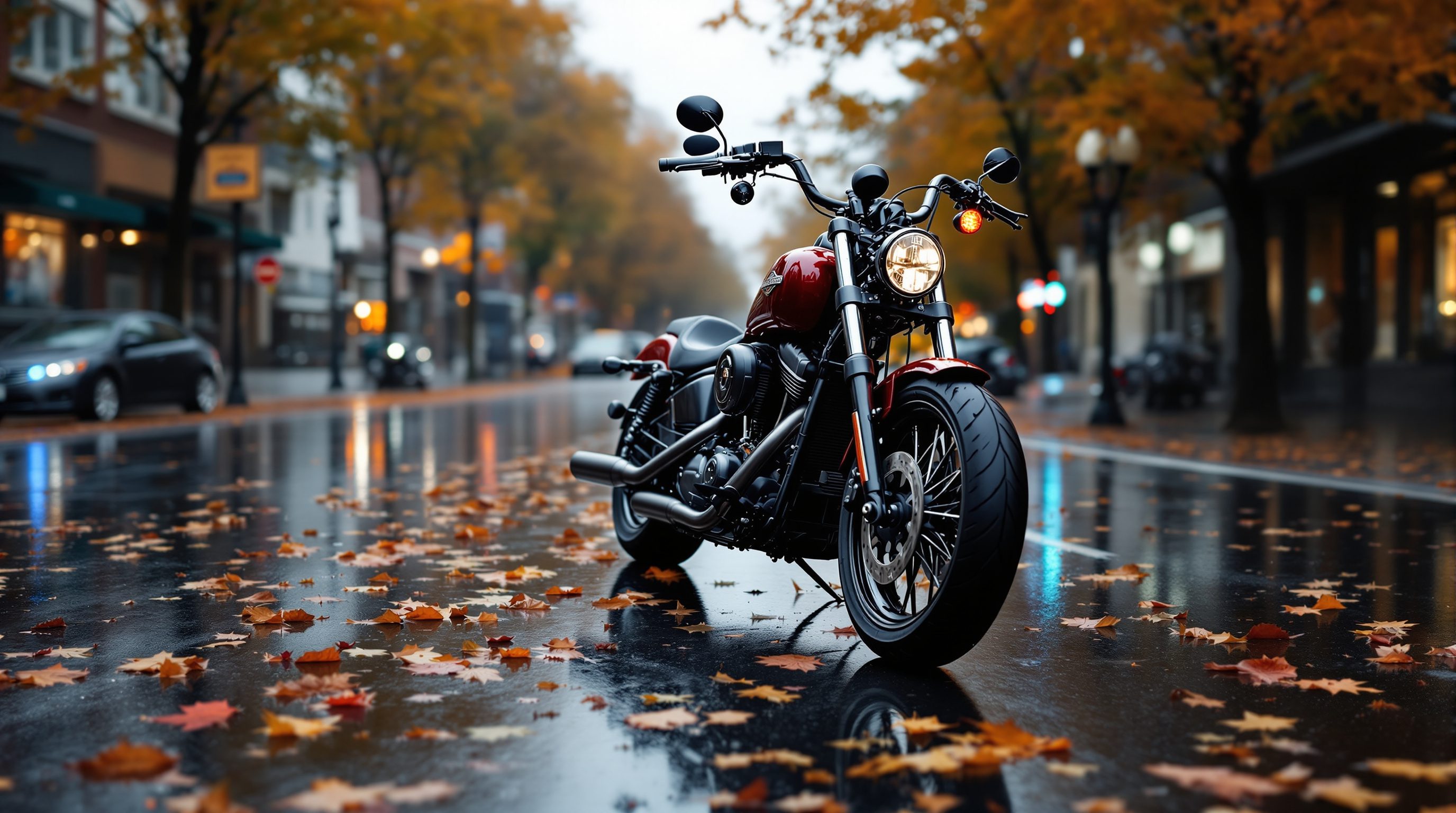
Wet Leaves, Painted Lines, and Slick Traps: A Portland Rider's Winter Survival Guide
Ask any Portland rider who has been down in the winter and the story almost never involves speed or showboating. It involves a surface that looked fine and was not. Wet season here is not one big hazard, it is a scatter of small, specific low-traction traps that hide in plain sight: a mat of soaked maple leaves in the corner of a side street, the glossy white paint of a crosswalk under a red light, the green thermoplastic of a bike box, an oily sheen on the first rain after a dry week, a manhole cover sitting right on your line. Each one is survivable if you see it coming and treat it correctly. The riders who go down are usually the ones who braked or leaned on top of a slick surface without realizing it was there. This is a guide to the exact surfaces that get us in Portland, and how to ride across them upright.
Wet leaves are close to riding on ice
A single dry leaf is nothing. A wet, matted layer of them is one of the most treacherous surfaces you will ever put a tire on, close to black ice, and worse because it hides everything underneath it: the paint, the potholes, the tar snakes, the exact shape of the road. Portland grows a lot of trees, which means leaves pile up in all the wrong places. They collect in the gutter line where you would tuck to avoid a car, in the apex of shaded neighborhood corners in the older parts of town, at the edges of on-ramps, and thick along the tree-canopied sweepers of the Historic Columbia River Highway and the Gorge, where the road never sees enough sun to dry. The rule is simple and unforgiving: do not brake or turn on top of leaves. Get your speed off before you reach them, keep the bike as upright as you can while you are on them, and roll a neutral, steady throttle across. If a corner is carpeted, treat the whole thing as a straight line problem, not a lean problem.
Paint is a trap you ride over a hundred times a day
This is the one riders underestimate the most, because painted road markings are everywhere and we cross them constantly without a thought. Wet, they turn glossy and slick, and Portland's streets are covered in them: lane lines, stop bars, arrows, the fat white bars of a crosswalk, and the bright green thermoplastic of the bike boxes and bike lanes downtown and across the east side. That green paint at an intersection is exactly where you are likely to be stopped, starting, or turning, which is exactly when you least want a slick patch under your contact patch. Crosswalk stripes catch you the same way as you brake for a light. The technique is to see the paint as a surface, not just a marking. Try to place your tires on bare asphalt between the lines when you brake and when you launch, avoid putting a tire down on a big painted arrow or crosswalk bar while you are turning, and if you cannot avoid it, cross it upright and smooth with no sudden brake, throttle, or steering input.
- ✓ Brake early, hard surface first. Get your slowing done on clean, dry-looking asphalt before the leaves, the paint, or the corner, so you are never grabbing brake on top of a slick patch.
- ✓ Cross paint and metal upright and neutral. Manhole covers, grates, and painted lines all grab a leaned or loaded tire. Straighten the bike, ease off the brakes, hold a steady throttle, and glide across.
- ✓ Read the bike box before you commit. That green paint sits right where you stop, start, and turn downtown. Plan your feet-down spot and your line so you are not accelerating hard across wet thermoplastic.
- ✓ Treat the first rain like ice. After a dry stretch, oil and grime float up before the road washes clean, so the first few hours of rain are the slickest of all. Double your following distance and soften every input.
- ✓ Assume shaded corners are wet all day. Canopied curves along the Gorge and the backroads hold water, moss, and leaves long after the open road has dried, so carry less lean and more margin there.
The first rain and the oily film
Every rider here should have the first-rain rule burned in. During a dry stretch, oil, rubber dust, and grime build up on the pavement and bake in. When the rain finally returns, that film lifts to the surface before enough water arrives to wash it away, and for a few hours the whole road wears a slippery slurry that fresh tires cannot cut through. It is worst where cars sit and drip: intersections, the approaches to lights, freeway on-ramps, and any busy stretch that has not seen water in a while. The first rain after any dry break, not just the first storm of fall, deserves the same respect. Give yourself more room, brake sooner and gentler, and stay off aggressive throttle until the road has had a real soaking.
Metal, moss, and the small stuff that hides on your line
Beyond leaves and paint, Portland's wet streets throw a handful of small metal and organic traps that punish a tire in exactly the wrong spot. Manhole covers and utility plates go greasy in the rain and often sit right where your wheel wants to track. Moss and algae creep across the edges of low-traffic lanes and shaded shoulders. Painted or plastic lane dividers and reflectors are slick when wet. None of these will drop you if you spot them and stay upright and neutral as you pass over, but they will absolutely take your front end if you are trailing brake into a corner and clip one mid-lean. Keep your eyes up and scanning the surface, not just the traffic, and build your line to keep leaned, loaded tires off the shiny stuff.
When a slick-surface crash becomes a fight over fault
Here is what too many Portland riders learn the hard way. Oregon follows modified comparative negligence with a 51 percent bar. Your recovery is reduced by your share of fault, and if you are found more than 50 percent at fault you recover nothing at all. So after a wet-road crash, the insurance company's whole play is to shift blame onto the surface and onto you: you were going too fast for conditions, you should have expected the slick paint, you chose to ride in the rain. Do not let "the road was wet" get twisted into "the rider caused it," especially when a careless driver turned across your path or ran the light. If you do go down, get medical care first, then document everything while it is fresh: photograph the leaves, the wet paint, the manhole cover, the standing water, and the exact spot. In a 51 percent state, that evidence is not a formality. It is the difference between a paid claim and nothing.

Led by Dave Eltringham, ELG Injury Lawyers in Portland fights for injured motorcyclists. Reach out to their motorcycle accident lawyers in Portland anytime you need real answers.