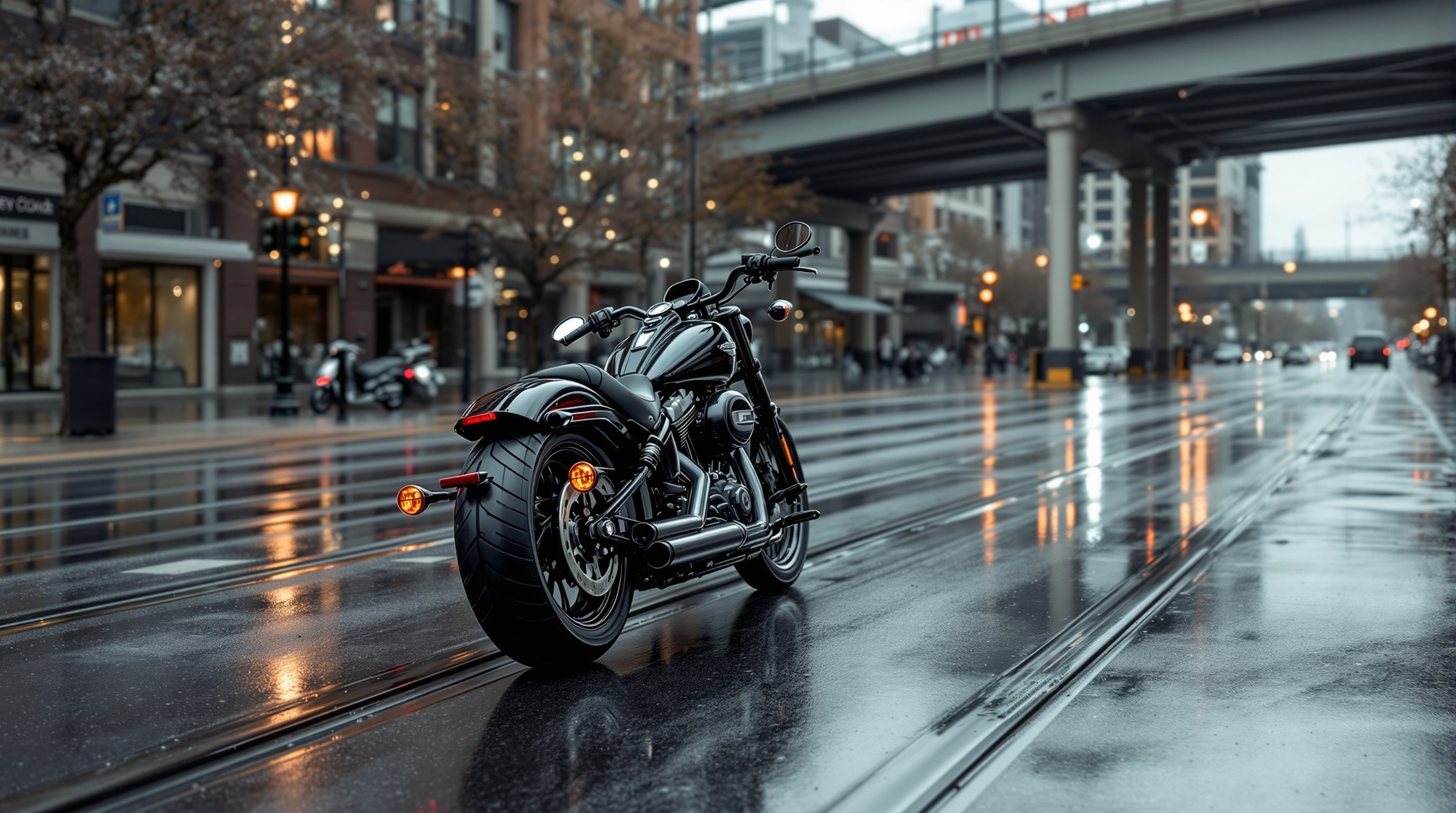
Crossing MAX and Streetcar Tracks on a Motorcycle in Downtown Portland
Downtown Portland is laced with steel. The MAX light-rail lines run through the transit mall and across the bridges, the streetcar loops through the Pearl, the South Waterfront, and the central east side, and the whole grid is stitched with embedded rails, flangeway gaps, switch plates, and the metal-grate decks of the older Willamette River bridges. On a car those tracks are background noise. On a motorcycle they are one of the most under-respected hazards in the city, because a rail can catch your front tire and take it out from under you before you have any chance to react, and it is worst exactly when the tracks are wet, which downtown is most of the year. This is how the tracks actually get riders, how to cross them so they do not, and what your options are when the road surface itself, not another driver, is what put you down.
Why a rail eats a front wheel, especially wet
The danger of a track is not the metal itself, it is geometry. A rail sits in a groove, the flangeway, and it runs in a line. If your front tire drops into that groove or touches the rounded steel while it is angled even slightly along the rail rather than across it, the wheel gets steered by the track instead of by you, and it happens instantly. That is the classic trapped-front-wheel crash: the bike goes out sideways with no warning and no time to save it. Wet makes everything worse, because polished steel under rain is close to frictionless, so a tire that would have skipped across a dry rail slides right along a wet one. Downtown Portland stacks the odds against you here: the rails are polished mirror-smooth by constant train traffic, the tracks curve and switch and cross at odd angles through the transit mall and the streetcar loop, and it rains most of the riding season. The metal-grate decks on the old lift bridges add their own version of the same problem, a slick, grooved steel surface that makes the front end feel like it is wandering.
How to actually cross them
The core rule is angle. You want to cross a rail as close to perpendicular as the situation allows, so the tire steps over the groove instead of running along it. In real downtown traffic you cannot always get a full 90 degrees, but the more square you are the safer you are, and anything shallower than about 45 degrees is where riders start getting caught. Set your angle early, before you reach the track, by adjusting your lane position while you still have room, not by swerving at the last second. As you cross, be upright, be off the brakes, and hold a light steady throttle so the suspension is settled and the front is lightly loaded rather than diving. Never brake or downshift right on top of the rails. The place this bites hardest is a turn where the track curves with you, on the transit mall or a streetcar corner, because then the rail runs parallel to your path for several feet and there is no good angle to take. In those spots, slow down before the turn, keep as upright a line as you can, and treat the whole painted-and-railed intersection as one slick zone.
- ✓ Cross at the steepest angle you can. Aim for close to 90 degrees so the tire steps over the flangeway groove instead of dropping into it. Anything shallower than about 45 degrees is where front wheels get trapped.
- ✓ Set your line early, not at the rail. Adjust lane position while you still have space, so you never have to swerve across a wet track at the last moment.
- ✓ Upright, off the brakes, steady throttle. Do your slowing before the tracks. Crossing with the bike vertical and lightly driving keeps the front from tucking on the steel.
- ✓ Respect the metal-grate bridge decks. The old Willamette lift bridges have grooved steel decks that feel squirmy when wet. Relax on the bars, hold your speed steady, and let the bike wander a little without fighting it.
- ✓ Watch for the track-plus-paint combo. Downtown, rails, bike-box paint, and crosswalk stripes overlap at the same intersections, stacking two slick surfaces at once. Treat the whole zone as low grip.
When the road itself is the defect
Most motorcycle claims are against a careless driver. Track and grate crashes are different, because sometimes the thing that put you down is the road: a rail that has heaved above the pavement, a flangeway gap that is too wide or unfilled, a switch plate sitting proud, a grate with a broken or missing section, a pothole right at the crossing, or a track crossing that was left slick with no warning or treatment. When a dangerous condition of public property causes a crash, Oregon law can allow a claim against the public body responsible for that road, bridge, or transit line. These are hard cases and they are governed by special rules, but they are real, and a rider who assumes "it was just the tracks, nothing I can do" may be walking away from a legitimate claim.
The 180-day clock that catches riders off guard
Here is the part that matters most, and the reason not to sit on it. A claim against a public body in Oregon runs on a much shorter clock than an ordinary crash claim. Under the Oregon Tort Claims Act, you generally must give formal written notice of your claim within 180 days of the injury. That is not the deadline to file a lawsuit, that is just the deadline to put the government on notice, and if you miss it your claim can be barred no matter how strong it is. It is a trap precisely because 180 days feels like plenty of time when you are hurt and healing, and then it is gone. The general statute of limitations to actually file a personal injury lawsuit in Oregon is two years, but that longer deadline does you no good if the 180-day notice window has already closed against the public body. So if you went down on a rail, a grate, or a track crossing and you think the condition of the road played a part, treat the calendar as urgent. Get medical care, photograph the exact spot, the rail height, the gap, the grate, the standing water, and the lack of any warning, and get the claim evaluated quickly while there is still time to send notice.

Dave Eltringham and the Portland motorcycle accident attorneys at ELG Injury Lawyers represent riders hurt by negligent drivers. If you have questions after a crash, their team is here to help.