The Most Dangerous Roads for Orlando Motorcyclists, and How to Ride Them
Ask any Orlando rider and they can name the roads that make them tense up. It is not superstition. Certain corridors around Central Florida concentrate the exact conditions that put motorcyclists down: forced merging, blind lane changes, endless construction, slick storm-soaked pavement, and drivers with far too much to watch. Knowing which roads carry the most risk, and why, is not about avoiding them, because most of them you cannot avoid if you ride here. It is about riding them with a plan. Here is an honest look at the corridors that demand the most from Orlando riders, and how to give yourself the best odds on each one. This is safety education, not a knock on any road. The point is to ride them smarter.
I-4 and the construction zone
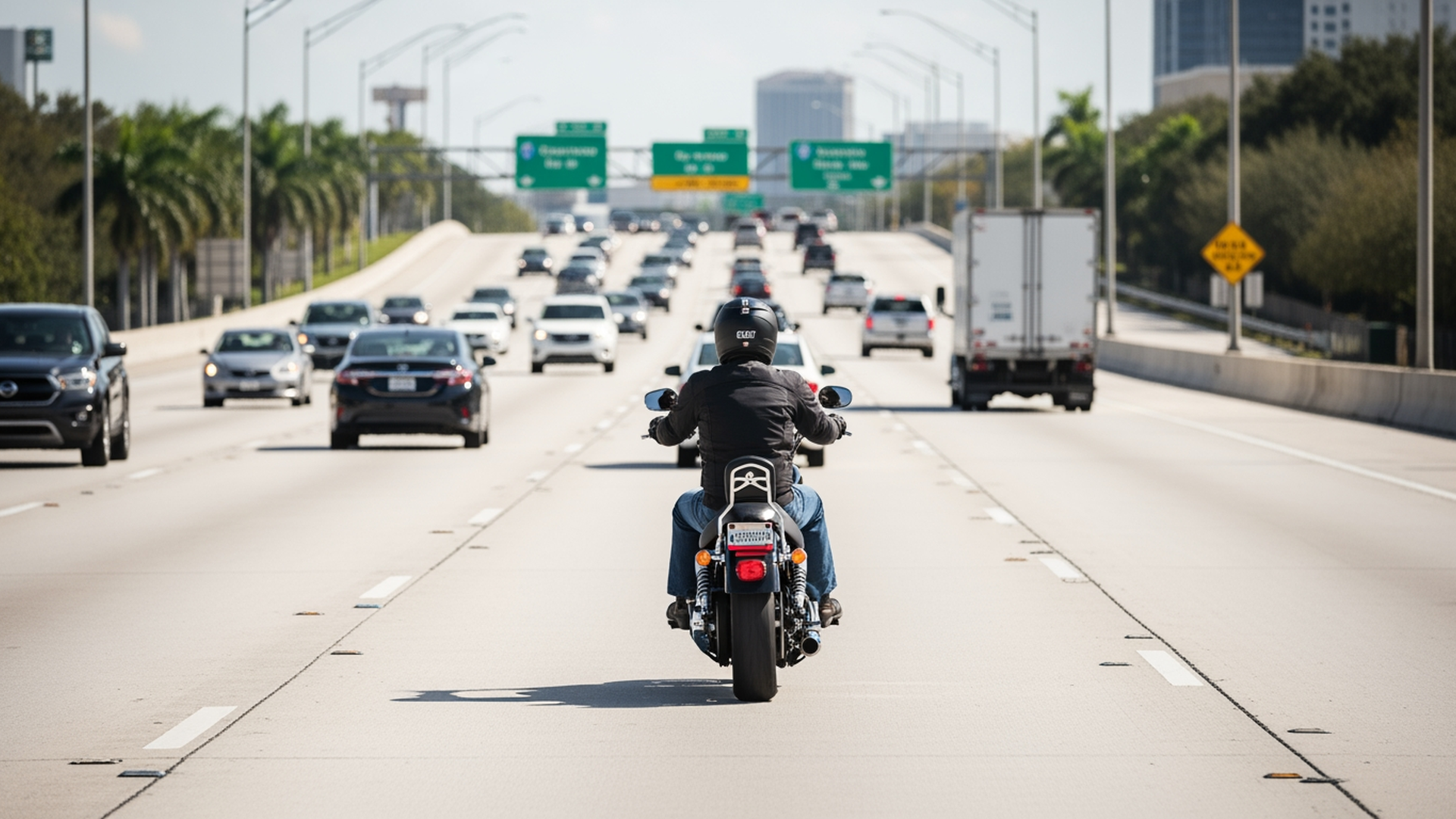
I-4 is the road every Orlando rider has to reckon with, and it has earned its reputation as one of the deadliest stretches of interstate in the country. It cuts straight through the middle of the metro with no real alternative, it carries a brutal mix of local commuters, tourists, and trucks, and for years it has been under construction, with lanes that shift, narrow, and route through concrete barriers with almost no shoulder to escape to. For a rider that is a worst-case stack: heavy stop-and-go that turns into sudden braking, forced merges where on-ramps dump traffic straight into the flow, drivers weaving across lanes to reach an exit, and construction walls that leave you nowhere to go if the traffic ahead stops hard. The crash that gets riders here is the rear-end into stopped traffic and the lane change into a bike the driver never saw. Ride I-4 with a following gap bigger than feels necessary, stay out of the blind-spot pockets beside trucks and cars, cover your brakes, read the traffic two or three cars ahead, and always keep an escape path in mind, even when the barriers make it feel like there is none.
US-192, Orange Blossom Trail, and US-441
The big surface arterials carry a different danger. US-192 through Kissimmee is a long, wide tourist strip lined with hotels, attractions, and constant driveways, where cars slow, turn, and pull out across your lane at hundreds of curb cuts, and where drivers watching for their motel miss the motorcycle in front of them. Orange Blossom Trail and US-441 run for miles through dense commercial stretches with heavy cross traffic, frequent lights, and left-turning cars that misjudge an oncoming bike. On roads like these the hazard is the intersection and the driveway: the left-turn across your path, the car pulling out from a side street or a parking lot, the sudden stop for a turn. Cover your brakes on every approach, watch the front wheels of any car waiting to turn because they move before the car does, back off the throttle so you have options, and pick a lane position that keeps your headlight in the line of sight of the drivers who might turn into you.
The 408 and 417 merges and International Drive
The expressways add speed to the mix. The 408 East-West Expressway and the 417 GreeneWay move fast, and their danger for riders lives at the ramps and merges: closely spaced on-ramps and off-ramps, quick lane changes to reach a toll plaza or an exit, and the speed differential between traffic already flying and traffic merging in. A driver crossing three lanes for an exit, or braking late for a plaza, is a driver not checking for a bike. Then there is International Drive, the tourist heart of Orlando, where the danger is not speed but chaos: rental cars driven by people who have never been here, sudden stops for attractions and parking, pedestrians everywhere, and constant lane changes with no signals. Ride I-Drive slow and defensive, expect the unexpected stop and the car that changes its mind, and treat every rental plate as a driver who does not know where they are going.
- ✓ Live outside the blind spots. On I-4, the 408, and the 417, the crash that gets riders is the lane change into a bike the driver never saw. Position yourself where mirrors can find you and never linger beside a vehicle.
- ✓ Keep a gap you can stop in. Congested merges and the I-4 construction zone turn into sudden stops. A larger following distance is your buffer against the rear-end and gives you room to swerve.
- ✓ Watch the turning wheels on 192, OBT, and 441. The left-turn and the pull-out from a driveway are the arterial rider killers. The front wheels of a waiting car move before the car does, so watch them and cover your brakes.
- ✓ Treat tourist traffic as unpredictable. On I-Drive and US-192, rental cars stop, turn, and change lanes without warning. Give yourself extra room and an escape route through the whole strip.
- ✓ Make yourself seen. Reflective gear, a clean and aimed headlight, and a lane position that keeps you visible all cut down the "I never saw the motorcycle" crash these corridors specialize in.
When a driver puts you down on one of these roads
You can ride every one of these corridors perfectly and still get hit, because most rider crashes come down to another driver merging, turning, or changing lanes into a motorcycle they never looked for. When that happens, Florida law shapes what comes next. Since 2023 the state follows modified comparative negligence with a 51 percent bar: your recovery drops by your share of fault, and if you are found more than 50 percent at fault you recover nothing. Insurers know this, so after a crash on a road with a bad reputation they love to argue the rider chose a dangerous route or was going too fast for it, trying to shift blame off their driver. The road's reputation is not your fault, and it does not excuse a driver who failed to yield or check a blind spot.
- ✓ PIP does not cover the motorcycle. Florida exempts motorcycles from PIP, so an injured rider gets no PIP for their own medical bills. Strong health coverage and UM/UIM are your backstop.
- ✓ Many Florida drivers carry no bodily-injury coverage. The state does not require BI liability for ordinary drivers, only PIP and property damage, so a serious injury on I-4 can leave you facing a driver with nothing behind them. UM/UIM is your real protection.
- ✓ The 51 percent bar makes documentation everything. How the crash is recorded can decide whether you recover in full, in part, or not at all.
- ✓ Two years to file. The statute of limitations on a Florida injury claim is now two years, cut from four in 2023, so act well before the clock runs.
If you go down on one of these corridors, get medical care first, then document everything you can: the lane, the merge or the construction zone, the road surface, the traffic, and the exact spot. The more a road is known for crashes, the harder the insurer will lean on that reputation to blame you, and the more those details matter.
Moe DeWitt and the Orlando motorcycle accident attorneys at DeWitt Law Firm represent riders hurt by negligent drivers. If you have questions after a crash, their team is here to help.