Fall Riding Hazards in Central Florida: What the Wet Season Throws at Orlando Riders
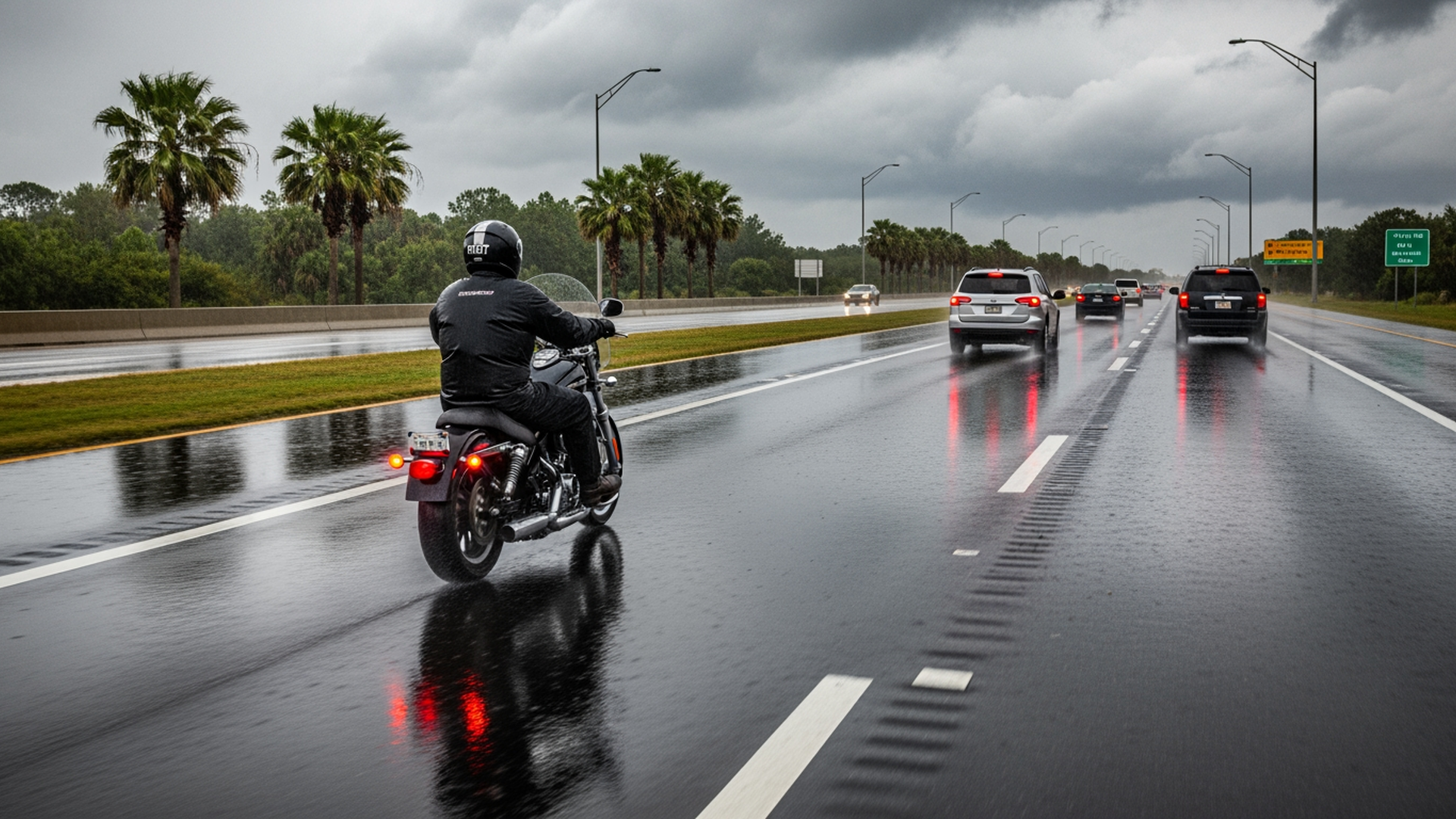
Fall in Central Florida does not look like fall anywhere else. There is no crisp air and no changing leaves. What we get instead is the back half of hurricane and storm season stacked on top of the daily afternoon thunderstorm, and for an Orlando rider that combination is the most demanding stretch of the year. The pavement that felt perfect on a dry morning turns into an oil slick the moment the first drops fall, I-4 and the toll roads pond up with standing water, love bugs smear across your visor, deer step out on the Lake County backroads at dusk, and the snowbirds and tourists come pouring back into every lane. None of it should keep you off the bike. All of it should change how you ride. Here is what the Central Florida wet season really throws at you, and how to handle it.
The first rain is the most dangerous moment of the day
In Central Florida the slickest road is not the one soaked by an hour of steady rain. It is the one that gets its first drops after a hot, dry morning. Oil, rubber, and grime bake into the pavement, and when the daily storm rolls in off the sea breeze that film floats up before enough water arrives to wash it away. For a few minutes the road is coated in a slippery slurry that grip cannot cut through, and it is worst exactly where you need traction most: the intersections along Colonial Drive and Semoran where cars idle and drip, the approaches to lights on Orange Blossom Trail, and the on-ramps to I-4 and the 408. Treat the first rain of any afternoon as if the road were greased. Give yourself extra room, brake sooner and softer, and stay off aggressive throttle until the road has had a real soaking.
Standing water on I-4 and the toll roads
A Central Florida downpour does not sprinkle. It dumps, fast, and the pavement cannot drain quickly enough. Water pools in the ruts and low spots of I-4, sheets across the 408 and the 417, and hides in the lane grooves of the Beachline. Hit a patch of standing water at speed on two wheels and your tire can hydroplane, riding up on a film of water with no grip at all, and there is no good way to recover once it starts. The danger is worse in the wheel ruts where trucks have worn the pavement, because that is where the water collects deepest. When the rain is heavy, slow down well below the posted speed, keep out of the puddled ruts by riding the higher ground of the lane where you can, avoid the temptation to follow directly behind a car through spray you cannot see through, and if a squall turns the road into a river, get off at the next exit and wait it out under cover. A Florida storm cell usually blows through in twenty minutes.
- ✓ Respect standing water on the interstate and tolls. Ponding on I-4, the 408, the 417, and the Beachline can hydroplane a tire in an instant. Slow down, ride the higher part of the lane, and stay out of the worn truck ruts where water sits deepest.
- ✓ Do your braking upright and early. Get your speed off before the corner, the paint, or the puddle, not on top of it, so you are never asking a slick surface for grip mid-lean.
- ✓ Avoid the paint at intersections. Crosswalks, stop bars, arrows, and lane lines turn glossy and slick the instant they are wet, and Orlando's arterials are covered in them. Try not to put a tire down on a painted line while braking or turning.
- ✓ Wait out the squall. A Central Florida storm cell is usually short and violent. Ducking under an overpass or into a lot for twenty minutes beats hydroplaning across three lanes of I-4.
Love bugs, deer, and the roads out in Lake County
Two Central Florida hazards have nothing to do with rain. The first is love bugs. Twice a year, and hard in the early fall, they swarm the highways in clouds thick enough to coat a windshield in minutes, and on a bike they hit your visor and your face. A visor smeared with love bugs in the middle of a merge is a real loss of vision at the worst possible time, so carry a clean rag, keep your shield clear, and consider riding the worst swarm days with the corridors and hours where they are thickest in mind. The second is deer. Out past the theme parks, on the rural two-lanes of Lake and the edges of Orange and Seminole counties, deer move most at dawn and dusk and give a rider almost no warning at the edge of a headlight. Those same backroads toward Mount Dora, Sugarloaf, and the Clermont hills are some of the best riding around Orlando, but they demand a slower pace at first and last light, high beams when no one is oncoming, and a scan of the shoulders for eyes and movement.
The snowbirds and tourists come back
Fall is also when Central Florida's traffic changes character. The snowbirds return for the season, the theme parks fill for the holidays, and International Drive, US-192 through Kissimmee, and the roads around the parks clog with rental cars driven by people who have never seen these interchanges before. A driver reading signs for the parks, missing an exit, or braking late for a toll plaza is a driver not looking for a motorcycle. Ride the tourist corridors expecting the sudden lane change, the last-second exit across three lanes, and the car that stops dead to figure out where it is going. Keep a following gap bigger than feels necessary, stay out of the blind-spot pockets beside cars and rental SUVs, and give yourself an escape route at every merge and plaza.
Why a wet-season crash hits Central Florida riders harder
Here is the part too many Orlando riders learn after a wreck instead of before it. Since the March 2023 reforms, Florida follows modified comparative negligence with a 51 percent bar. Your recovery is reduced by your share of fault, and if you are found more than 50 percent at fault, you are barred from recovering anything at all. That is exactly why the insurance company will fight so hard to pin a slice of blame on the weather and on you after a rainy-day crash, arguing you were going too fast for a wet road or should have expected the standing water. Do not let "it was storming out" get twisted into "the rider caused it." A careless driver who turns across your path does not get a free pass because the pavement was wet.
- ✓ PIP does not cover the motorcycle. Florida is a no-fault PIP state, but motorcycles are exempt, so an injured rider gets no PIP for their own medical bills. Carry strong health coverage and UM/UIM.
- ✓ The 51 percent bar makes documentation everything. Fault below that line only reduces your recovery, so how a rainy-day crash is recorded can decide whether you recover in full, in part, or not at all.
- ✓ The helmet and $10,000 rule. Riders 21 and older may ride without a helmet only if they carry at least $10,000 in medical benefits coverage, and riders under 21 must always wear a DOT helmet.
- ✓ Two years to file. The statute of limitations on a Florida negligence claim is now two years, cut from four in the 2023 reforms, so do not wait.
If a wet-season crash does happen, get medical care first, because hidden injuries have a way of surfacing days later. Then document the conditions while they are fresh: photograph the standing water, the storm, the slick paint or the spot where you hydroplaned, and exactly where it happened. In a state with a 51 percent bar, those details are not a formality, they are the difference between a claim and nothing.
Led by Moe DeWitt, DeWitt Law Firm in Orlando fights for injured motorcyclists. Reach out to their motorcycle accident lawyers in Orlando anytime you need real answers.