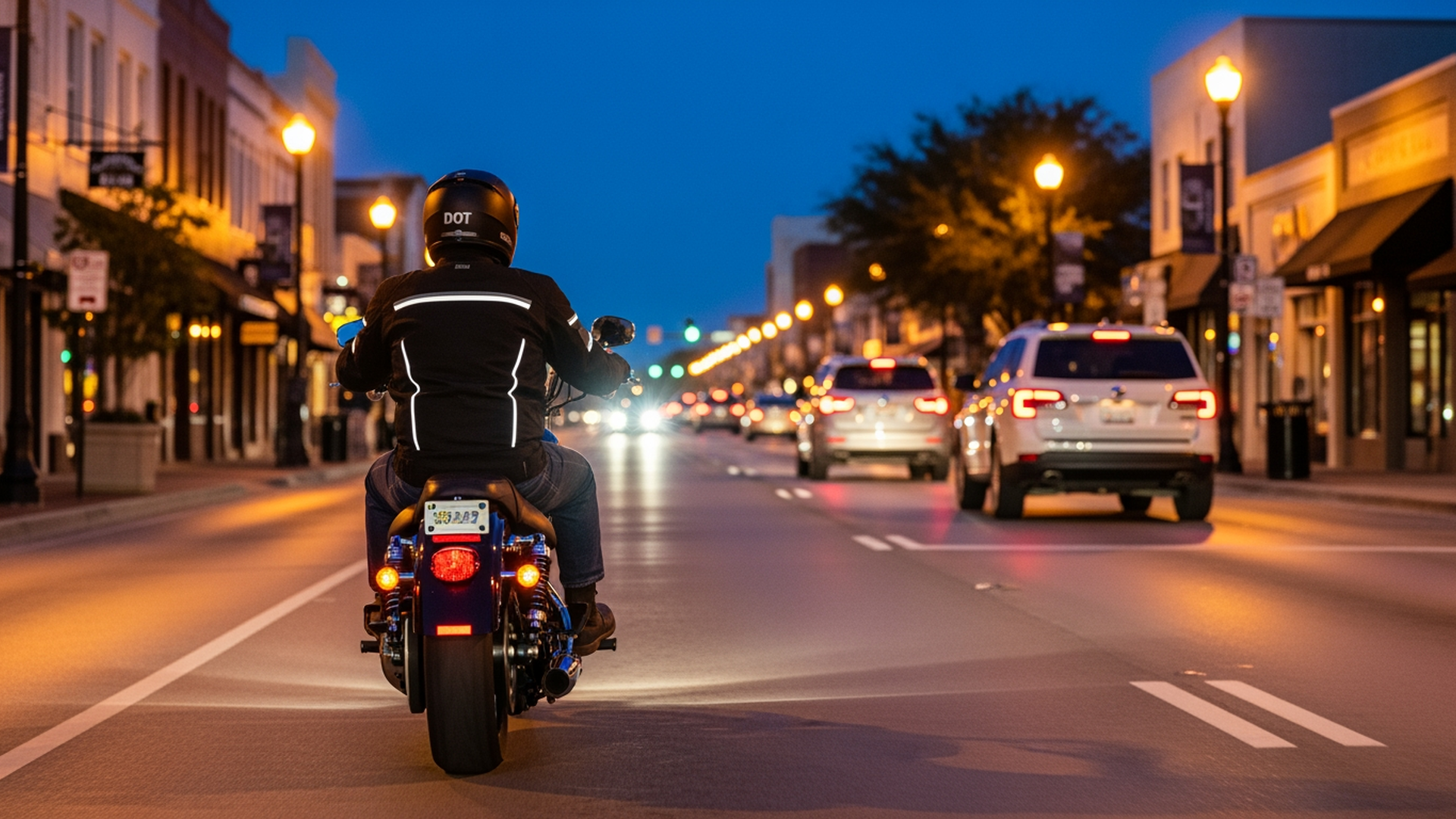
Night Riding in Pensacola: Being Seen When the Sun Goes Down
Ride around Pensacola after dark and the whole equation changes. The heat is gone, the beach roads open up, and a night run down Palafox or out along the water can be the best ride of the week. It is also the most dangerous time to be on two wheels. At night a motorcycle is harder to see, the drivers around you are more likely to be tired or impaired, and the same intersection that is merely busy at noon becomes a guessing game after sunset. The Panhandle adds its own twists: tourists and beach traffic who do not know where the road goes, the weekend windows when downtown and the beach empty out full of drivers who should not be driving, and dark rural stretches up in the Blackwater forest where a deer can be standing in your lane before your headlight finds it. The entire game after dark comes down to one thing, being seen, and giving yourself the room and the light to react. Here is how Pensacola riders stack the odds back in their favor at night.
The left-turn crash is the one that kills
If there is one crash every rider needs to fear after dark, it is the car turning left across your path at an intersection. It is the most common way motorcyclists are killed in traffic, and night makes it far worse. A driver waiting to turn left looks for headlights, sees a gap where a single small headlight sits, misjudges your distance and your speed in the dark, and turns straight into you. It happens at the big signalized intersections along Davis Highway, Nine Mile Road, and Bayou Boulevard, at the turns feeding US-98 and the beach, and at any crossing where a car is sitting in the turn lane facing you. Your defense is to assume every waiting car is about to turn, whether or not it should. Cover your brakes as you approach, watch the front wheel for the first hint of a roll, ease to a lane position that puts your headlight where the driver is looking, and be ready to slow or swerve. Never trust eye contact after dark, because a driver can look right at your headlight and still not register a motorcycle behind it.
Weekend impaired-driver windows downtown and on the beach
Pensacola's nightlife concentrates the risk into predictable windows. Downtown around Palafox and out on Pensacola Beach fill up on Friday and Saturday nights, and when the bars and beach spots let out, the roads carry drivers who are tired, distracted, or flat-out impaired. The late-night and small-hours stretches on the weekend are when the odds of meeting a drunk driver are highest, and a rider is the one who pays for that driver's mistake. The routes home from the beach and downtown, the bridge crossings back to the mainland, and the arterials that feed the interstate are exactly where those drivers travel. If you ride during those windows, ride like the car next to you is impaired, because some of them are. Leave a bigger cushion, stay out of the pack, do not linger beside another vehicle, and give yourself extra room at every intersection and lane change. The best move is often to avoid the peak let-out hours on the busiest weekend routes altogether.
- ✓ Make yourself impossible to miss. Bright and reflective gear, reflective piping and tape, and a light-colored or high-visibility helmet all turn you from a single dim headlight into something a tired driver actually sees.
- ✓ Aim and clean your light. A properly aimed, clean headlight and a working brake and tail light are your whole conversation with the traffic behind and ahead. Add auxiliary lights if your bike runs a single dim beam, and keep your visor clear.
- ✓ Use lane position to be seen. Ride where your headlight lands in the mirrors and eyes of the drivers who matter, and shift position at intersections so a left-turning driver has the best chance of registering you.
- ✓ Ride within your headlight. On dark roads, slow to a speed where your light reaches far enough to stop or swerve for what it finds. Outriding your headlight is how riders meet a stopped car or a deer with no time left.
- ✓ Avoid the weekend let-out windows. The late-night hours downtown and on the beach carry the most impaired drivers. If you can shift your ride earlier or take a quieter route home, do it.
Tourists, unfamiliar roads, and deer on the dark backroads
Two more night hazards are pure Panhandle. The first is the visitor who does not know the road. Even after dark, US-98, the beach roads, and the bridges carry out-of-town drivers hunting for a turn, a hotel, or a parking spot, braking late, stopping in the lane, and turning without warning because they are lost in the dark on a road they have never driven. Give every unfamiliar and out-of-state plate extra space, and expect the sudden, wrong move. The second is wildlife. Head up into the Blackwater River State Forest around Munson and Krul Lake, along Highway 4 and the wooded two-lanes north of Milton, or out toward the Escambia River bottoms after dark and you are in deer country with no streetlights and no margin. Deer move most at dawn, dusk, and through the night, especially in the fall rut, and on those unlit roads a deer can be in your lane before your headlight reaches it. Scan the ditches and the edge of your beam for eyeshine, drop your speed on the rural stretches, and remember that where you see one deer there is usually another. A deer strike on a motorcycle at night is a serious crash, not a scare.
When a night crash still comes down to the details
You can gear up, light up, and ride perfectly and still get hit by a driver who turned left into you, drove home impaired, or never saw the motorcycle in the dark. When that happens, Florida law shapes what comes next. Florida's no-fault PIP does not extend to motorcyclists, so there is no PIP for your own medical bills, and you rely on your health coverage, your UM/UIM, and the at-fault driver's liability, which ordinary Florida drivers are not required to carry. Florida also uses modified comparative negligence with a 51 percent bar, so your recovery is reduced by your share of fault and is barred entirely if you are found more than half at fault. After a night crash the insurer will lean hard on the darkness, arguing you were hard to see, riding too fast for conditions, or should have expected the other driver, trying to shift blame onto you because every point of fault they win comes off your check, and enough of it ends the claim. Being hard to see is not the same as being at fault. A driver who turns left across your path or drives impaired does not get a free pass because it was night.
- ✓ PIP does not cover you on a motorcycle. Florida is a no-fault state, but PIP never reaches motorcyclists, so know what health coverage and UM/UIM you carry before you ride at night.
- ✓ UM/UIM is your real backstop. With impaired and uninsured drivers common on weekend nights, and no bodily-injury liability required of ordinary Florida drivers, uninsured and underinsured motorist coverage is often your only real protection.
- ✓ The helmet and $10,000 rule. Riders 21 and older may ride without a helmet only if they carry at least $10,000 in medical benefits coverage, and every rider under 21 must wear a DOT-approved helmet. Bright, reflective, well-fitted gear is worth wearing after dark regardless.
- ✓ Two years to file. Florida's negligence deadline was cut to two years in the 2023 reforms, so do not sit on a night-crash claim.
If a night crash does happen, get medical care first, because injuries that seem minor in the dark have a way of surfacing days later. Then document everything you can: the lighting, the intersection, the other driver's condition and story, any witnesses, and the exact spot it happened. Florida's 51 percent bar means the details are what keep the darkness from being turned into your fault.

Have questions after a wreck? Dana Brooks and the Pensacola motorcycle injury attorneys at Fasig Brooks (fasigbrooks.com) review rider claims and explain your options.