The Most Dangerous Roads for Pensacola Motorcyclists, and How to Ride Them
Ask any Pensacola rider and they can name the roads that make them tense up. It is not superstition. Certain corridors around Escambia and Santa Rosa counties concentrate the exact conditions that put motorcyclists down: heavy merging traffic, blind lane changes, wind-swept bridge decks, tourists watching the water instead of the road, and a steady stream of left-turn and pull-out conflicts. Knowing which roads carry the most risk, and why, is not about avoiding them, because most of them you cannot avoid. It is about riding them with a plan. Here is an honest look at the corridors that demand the most from Pensacola and Panhandle riders, and how to give yourself the best odds on each one.
I-10 and the I-110 spur
The interstate is where Pensacola riders meet the highest speeds and the least margin. I-10 across the top of the metro carries heavy through-traffic, big rigs running the Gulf Coast freight route, and drivers moving at 70-plus who are not looking for a motorcycle. The interchanges near Davis Highway, Pensacola Boulevard, and the I-110 junction bunch up and stop without warning, and the on-ramps dump traffic straight into the fast flow with short merge room. The I-110 spur down into downtown is worse in its own way: a short, curving, elevated stretch with tight ramps, quick lane drops, and the exits for Cervantes, Garden, and Chase Streets coming up fast one after another, so drivers cut across lanes late and often. On both, the danger to a rider is the lane change into a bike the driver never saw and the rear-end into stop-and-go traffic. Ride these with a following gap bigger than feels necessary, stay out of the blind-spot pockets beside trucks, cover your brakes, and read the traffic two or three cars ahead so a sudden stop never surprises you. Always have an escape lane in mind.
US-98 through the beach and tourist corridor
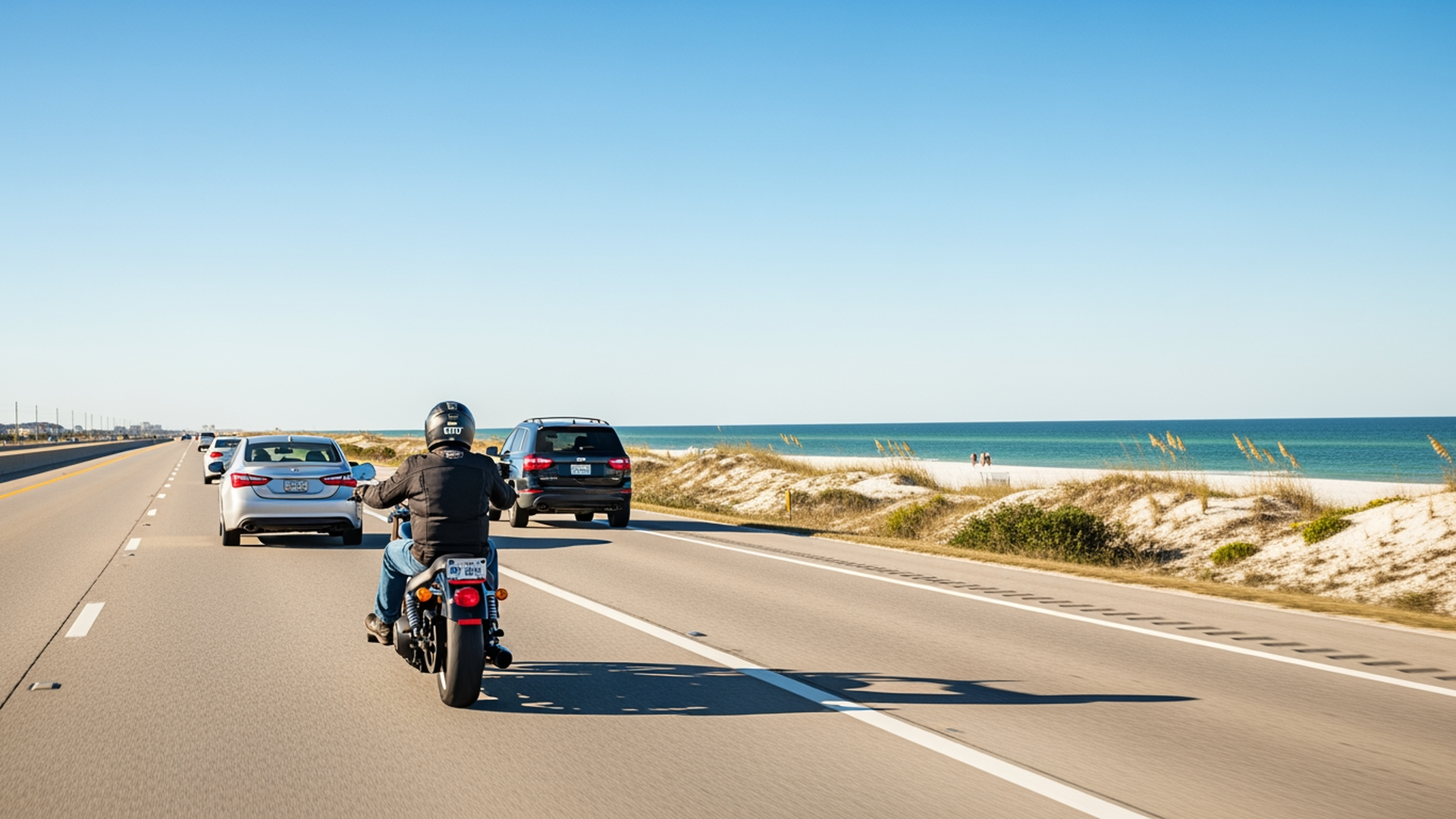
US-98 is the spine of Panhandle riding and one of its most demanding roads, because it changes character mile by mile and it is thick with visitors who do not know it. Through the beach and tourist corridor, out toward Pensacola Beach, Gulf Breeze, Navarre, and Perdido Key, the highway is lined with driveways, resort entrances, cross streets, and left-turn conflicts, and it fills with rental cars and out-of-state plates whose drivers are watching the Gulf, hunting for a parking spot, or slowing without warning to read a sign. Blown sand drifts across the pavement on the exposed coastal stretches, and the road narrows and speeds shift as you move between towns. The theme here is the surprise left turn and the driver pulling out of a side street or resort driveway, the single most common way riders get hit. Keep your speed down in the busy stretches, watch the front wheels of every waiting and turning car for the first hint of movement, stay where mirrors can find you, and treat every out-of-town plate as a driver who does not know what the road is about to do.
US-90, the Scenic Highway, and the bay bridges
Some of the best riding around Pensacola is also some of the most exposed. US-90 as the Scenic Highway rides the bluffs high above Escambia Bay, a beautiful run with a real edge: it curves and rolls, the sight lines drop over crests and around bends, side roads and driveways feed in from the neighborhoods, and the view pulls every eye toward the water instead of the road. The bridges are their own animal. The Pensacola Bay Bridge carrying US-98 over to Gulf Breeze and the Bob Sikes Bridge running out to Pensacola Beach are long, high, and wide open to the wind off the bay and the Gulf, so a gust can shove your bike toward the next lane, and their decks and expansion joints go slick the instant it rains. On the Scenic Highway, slow for the blind crests and curves, expect a car to pull out or drift over the center, and do not let the view take your attention off the road surface. On the bridges, hold a firm relaxed grip, give yourself lane room to absorb a gust, and cross the joints and any wet metal upright and off the brakes.
Davis Highway and Nine Mile Road
The everyday arterials are where a lot of Pensacola riders actually get hurt, because they combine heavy traffic, endless driveways, and drivers in a hurry who are not scanning for bikes. Davis Highway is a wide, busy commercial strip with constant turning movements in and out of shopping centers, closely spaced signals, and cars changing lanes to reach a driveway or a turn. Nine Mile Road on the north side of town is the same problem at higher speed, a growing corridor of big intersections, commercial entrances, and left-turn pockets where a car crossing your path is the crash waiting to happen. On both, the risk is the vehicle that turns left across you or pulls out of a driveway into your lane, and the rear-end when traffic stops short at a light. Keep your following distance long, cover your brakes approaching every intersection and major driveway, position yourself where waiting drivers can see you, and never assume a car stopped to turn has actually seen your headlight.
- ✓ Live outside the blind spots. On I-10, the I-110 spur, and the busy arterials, the crash that gets riders is the lane change into a bike the driver never saw. Position yourself where mirrors can find you and never linger beside a vehicle.
- ✓ Watch the front wheels, not the driver. On US-98, Davis Highway, and Nine Mile Road, the first thing to move in a left turn or a driveway pull-out is the front tire. Watch it, and be ready for the car that starts before it sees you.
- ✓ Keep a gap you can stop in. Congested interstate merges and arterial signals turn into sudden stops. A larger following distance is your buffer against the rear-end and gives you room to swerve.
- ✓ Respect the wind and the wet metal on the bridges. On the Pensacola Bay and Bob Sikes bridges expect gusts off the water to push you, and cross the joints and any wet decking upright and off the brakes.
- ✓ Assume the tourist does not know the road. On US-98 and the Scenic Highway, out-of-town drivers slow, stop, and turn without warning while watching the Gulf. Give them extra space to make a mistake.
When a driver puts you down on one of these roads
You can ride every one of these corridors perfectly and still get hit, because most rider crashes come down to another driver merging, turning, or pulling out into a motorcycle they never looked for. When that happens, Florida law shapes what comes next, and riders need to know how it works. Florida's no-fault PIP does not extend to motorcyclists, so there is no PIP for your own medical bills and you rely on your health coverage, your UM/UIM, and the at-fault driver's liability, which ordinary Florida drivers are not even required to carry. On top of that, Florida uses modified comparative negligence with a 51 percent bar, so your recovery drops by your share of fault and disappears entirely if you are found more than half at fault. Insurers know this, so after a crash on a road with a bad reputation they lean hard on that reputation, arguing the rider chose a dangerous route or was going too fast for it, trying to inflate the rider's fault share and shrink or erase the payout. The road's reputation is not your fault, and it does not excuse a driver who failed to yield, turned left across you, or pulled out of a driveway into your lane.
- ✓ PIP does not cover you on a motorcycle. Florida is a no-fault state, but PIP never reaches motorcyclists, so know what health coverage and UM/UIM you carry before you ride these corridors.
- ✓ UM/UIM is your real backstop. Florida does not require ordinary drivers to carry bodily-injury liability, so uninsured and underinsured motorist coverage is often the only pocket deep enough after a serious interstate or arterial crash.
- ✓ The 51 percent bar makes your fault share the fight. Every point of blame the insurer pins on you comes off your recovery, and more than half ends it, so how the crash is recorded matters enormously.
- ✓ Two years to file. Florida's negligence deadline was cut to two years in the 2023 reforms, so act well before the clock runs.
If you go down on one of these corridors, get medical care first, then document everything you can: the lane, the merge or turn, the driveway, the road surface, the wind, the traffic, and the exact spot. The more a road is known for crashes, the harder the insurer will lean on that reputation to raise your share of blame, and the more those details matter.

Dana Brooks and the Pensacola motorcycle accident attorneys at Fasig Brooks represent riders hurt by negligent drivers. If you have questions after a crash, their team is here to help.