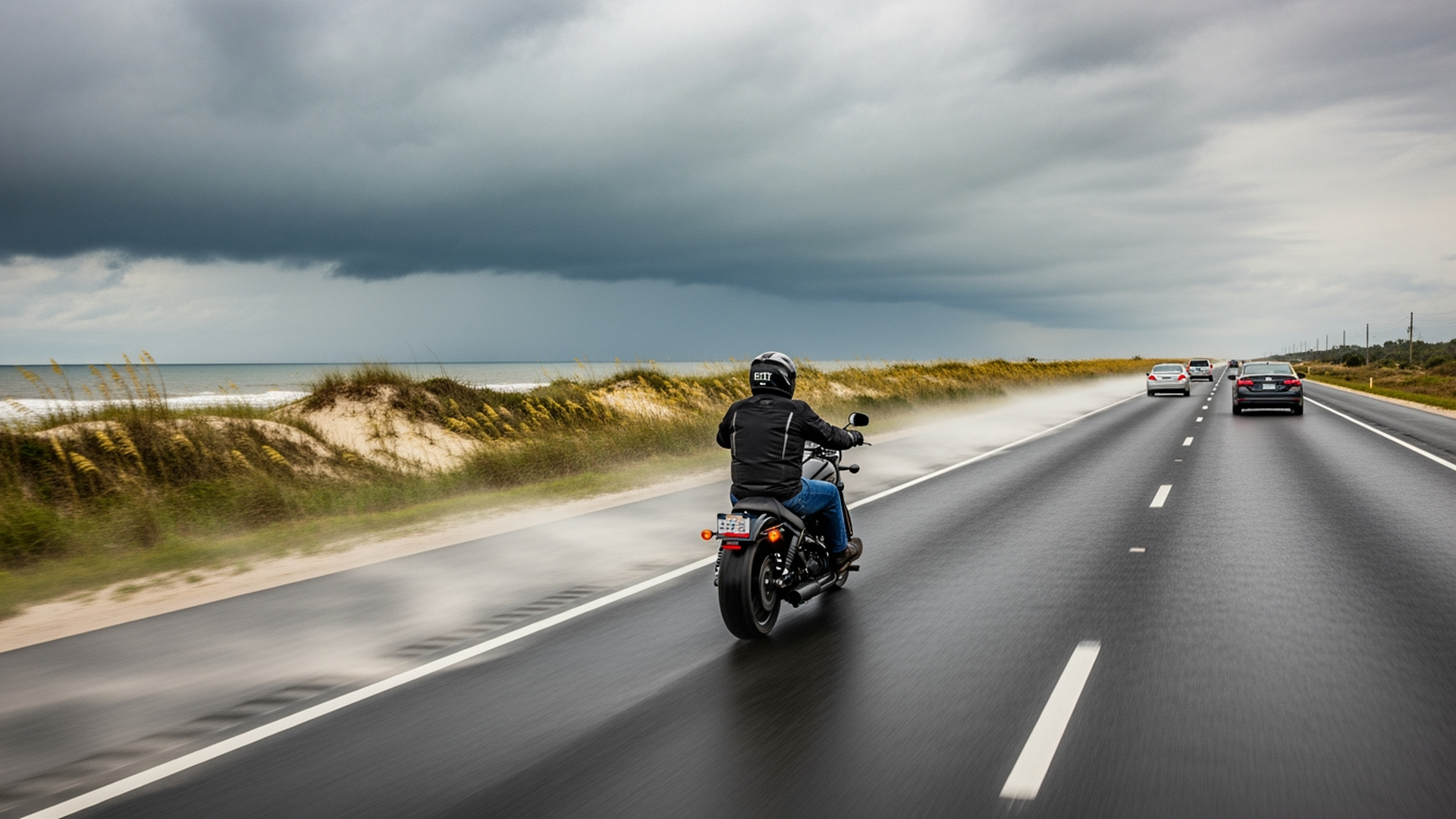
Fall Riding Hazards in the Florida Panhandle: What Bites Pensacola Riders When the Season Turns
Ask any Pensacola rider and they will tell you fall is the payoff for surviving a Gulf Coast summer. The brutal heat and afternoon thunderstorms ease off, the humidity finally breaks, and the runs out to Perdido Key, along the Scenic Highway bluffs, and up into the Blackwater forest come alive. It is also one of the sneakiest seasons to get hurt in the Panhandle. Fall here is not one hazard, it is a stack of them: the peak of hurricane season and the coastal storms that come with it, sand blowing across the beach highways, the oil-slick first rain after a dry stretch, standing water on the low bridges, deer moving on the forest backroads, sunsets that come earlier every week, and the return of snowbird traffic that does not know these roads. None of it should keep you off the bike. All of it should change how you ride. Here is what the turn of the season really throws at Pensacola and Panhandle riders.
Hurricane season is still open, and the coast pays for it
Fall on the Gulf Coast is the back half of hurricane season, and even the storms that never make landfall reshape the roads riders love. A tropical system offshore pushes bands of heavy rain and gusting crosswinds across Escambia and Santa Rosa counties for days, and the open, exposed runs are the worst place to be caught in it. US-98 along the water, the roads out to Pensacola Beach and Perdido Key, and the high, wind-swept spans of the Pensacola Bay Bridge and the Bob Sikes Bridge over to Gulf Breeze all funnel wind straight at a bike, and a gust off the Gulf can shove you toward the next lane before you feel it coming. Even after a storm passes, its mess stays behind: downed limbs, washed-out sand, and grit dragged across the pavement on the low-lying coastal stretches. Watch the tropics before a fall ride, respect a wind advisory the same way you would a storm warning, and give yourself lane room on the bridges and the open coast highway so a gust has somewhere to push you that is not into traffic.
Blowing sand, the first rain, and standing water
Three surfaces turn on Panhandle riders in the fall. The first is sand. Wind off the Gulf carries a steady drift of it across the beach highways, and a patch of dry sand on pavement acts like ball bearings under a tire, especially mid-corner or under braking. It collects worst exactly where you least want it: the curves and driveways along Via de Luna and Fort Pickens Road on Pensacola Beach, the approaches on Perdido Key Drive, and any low coastal stretch of US-98 after a blustery day. The second is the first rain. After a dry spell, oil and rubber bake into the road all summer, and when the first real shower hits, that film floats up before enough water arrives to wash it away, coating intersections and ramps in a slick slurry for the first hour or two. Treat the first rain of a dry break like ice. The third is standing water. The Panhandle drains slowly, and a hard fall downpour leaves sheets of water pooling on the low bridges, the causeway approaches, and the underpasses along I-10 and the I-110 spur, where a bike can hydroplane or hide a pothole you never see. Slow down, avoid the deepest lanes, and never assume a puddle is shallow.
- ✓ Read the sand before you lean. On the beach roads and coastal US-98, scan the pavement for the pale drift of blown sand and get your braking and cornering done on clean, dark asphalt, not on top of a patch you spotted too late.
- ✓ Treat the first rain as the slickest ride of the season. The oil-slick film that floats up on the first shower after a dry stretch is worst at intersections and on the I-10 and I-110 ramps. Brake sooner and softer and stay off aggressive throttle until the road has had a real soaking.
- ✓ Respect standing water on the low spans. Sheeting water on the bridge decks, the causeway approaches, and the interstate underpasses can hydroplane a tire or hide a hazard. Ease off the throttle, keep it upright, and avoid the deepest lane.
- ✓ Give the bridges and open coast extra room in the wind. The Pensacola Bay and Bob Sikes bridges and the exposed stretches of US-98 catch the Gulf wind, so hold a firm relaxed grip and leave lane space to absorb a gust.
Deer on the backroads, earlier dark, and the snowbird return
Fall also changes the light and the traffic, and it puts more wildlife on the rural roads riders chase. Deer move most in the fall rut, and they are on their feet right at dawn and dusk, exactly when a lot of us are riding the two-lanes through the Blackwater River State Forest around Munson and Krul Lake, up Highway 4 and the wooded backroads north of Milton, and out toward the Escambia River bottoms. Where you see one deer, expect another, and a deer strike on a motorcycle is a serious crash, not a dented fender. At the same time the clocks fall back in early November and sunset slides into the late afternoon, so the ride home becomes a low-light or night ride whether you planned it or not, and low sun blasts straight down the east-west arterials at rush hour, blinding the drivers around you. Layer on the return of the snowbirds, seasonal residents and tourists who do not know that US-98 narrows, where the sand drifts, or how the bridges wind, and are often watching the water instead of the road, and fall traffic gets less predictable just as the days get shorter. Run your headlight, wear reflective and bright gear, back off your speed on the wooded backroads at dawn and dusk, and give the out-of-town plates extra space to make a mistake.
Why a fall-condition crash still comes down to how it is documented
You can do everything right and still go down when a storm, a patch of sand, a deer, or a driver who does not know the road makes the decision for you. When that happens, Florida law shapes what comes next, and riders need to understand two things about it. First, Florida's no-fault PIP system does not extend to motorcyclists, so there is no PIP to lean on for your own medical bills, and you rely instead on your health coverage, your UM/UIM, and the at-fault driver's liability. Second, Florida uses modified comparative negligence with a 51 percent bar, so your recovery is reduced by your share of fault and is wiped out entirely if you are found more than half at fault. That is exactly why the insurance company fights so hard to blame the weather and the road on you after a fall crash, arguing you rode too fast for a wet corner or should have expected the sand, because every point of fault they can hang on you comes straight off your check, and enough of it ends the claim. Do not let "it was storming out" get twisted into "the rider caused it." A careless driver who turns across your path does not get a free pass because the pavement was wet or the wind was up.
- ✓ PIP does not cover you on a motorcycle. Florida is a no-fault state, but that no-fault PIP never reaches motorcyclists, so know what health coverage and UM/UIM you actually carry before you need it.
- ✓ UM/UIM is your real backstop. Florida does not require ordinary drivers to carry bodily-injury liability at all, so uninsured and underinsured motorist coverage is often the only pocket deep enough after a serious crash.
- ✓ The helmet and $10,000 rule. Riders 21 and older may ride without a helmet only if they carry at least $10,000 in medical benefits coverage, and every rider under 21 must wear a DOT-approved helmet.
- ✓ Two years to file. Florida's deadline for a negligence claim was cut from four years to two in the March 2023 reforms, so a fall crash gives you far less time than riders used to have.
If a fall-condition crash does happen, get medical care first, because hidden injuries have a way of surfacing days later. Then document the conditions while they are fresh: photograph the sand, the standing water, the storm debris, the deer sign, the low sun, and the exact spot it happened. Florida's 51 percent bar means the details are what keep the blame off you, and off your recovery.

Led by Dana Brooks, Fasig Brooks in Pensacola fights for injured motorcyclists. Reach out to their motorcycle accident lawyers in Pensacola anytime you need real answers.