Night Riding in Las Vegas: Staying Visible in a 24-Hour City
Las Vegas never really goes dark, but that does not make it safe to ride at night. The valley glows around the clock, and that glow cuts both ways. The same neon and headlights that light your way also drown out a single motorcycle, while the late hours fill the roads with tired drivers, distracted tourists, and the impaired. In a 24-hour city the danger does not clock out, and after dark the rider who is not deliberately making himself seen is gambling with the one thing that keeps him alive: being noticed.
Why the City That Never Sleeps Is Harder to Ride at Night
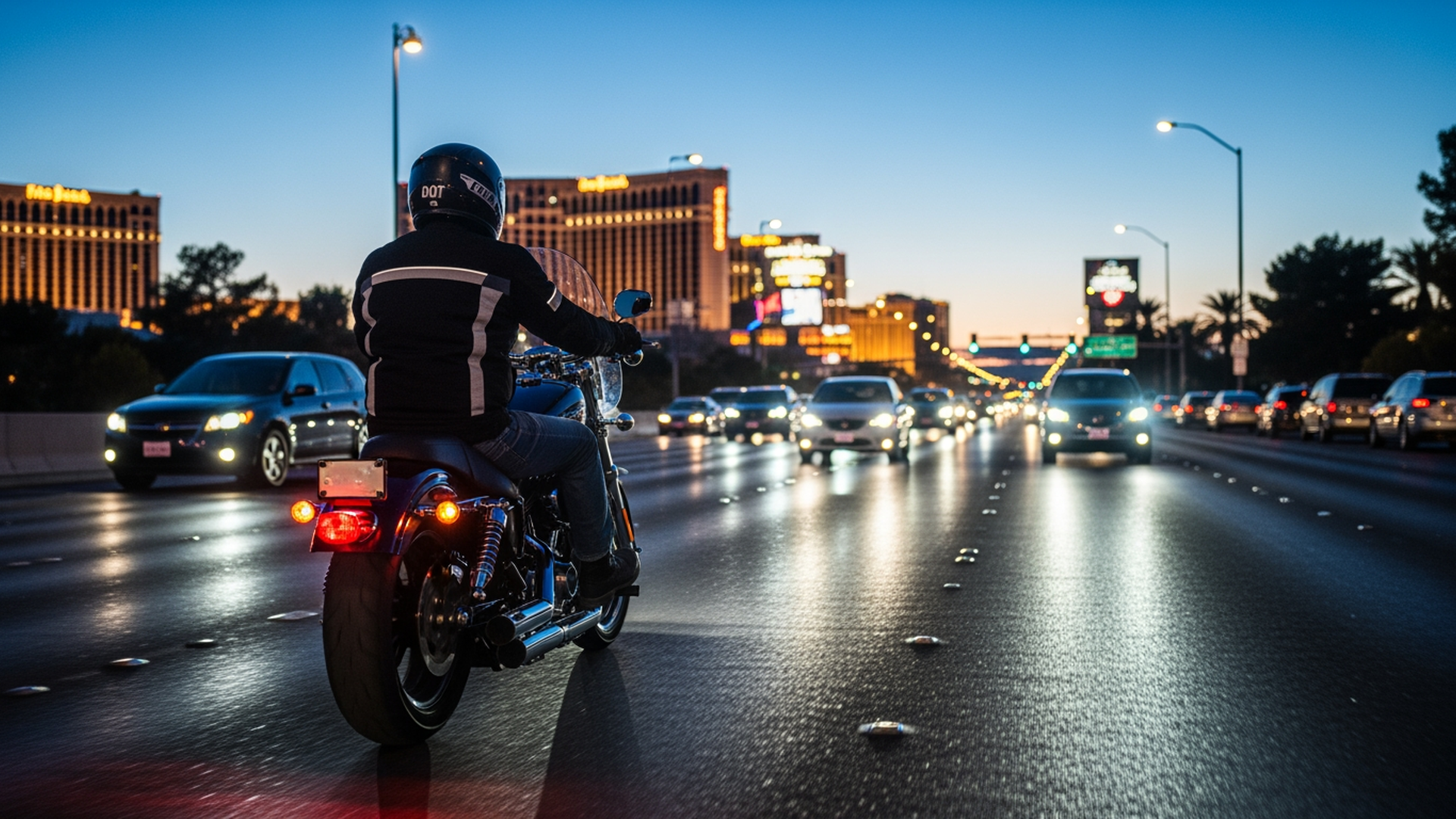
Most drivers assume darkness is dangerous because you cannot see the road. For a motorcyclist the bigger problem is the reverse: other drivers cannot see you. A car has two wide-set headlights and a big lit silhouette. A bike shows a single headlight and a narrow profile that is easy to misjudge for distance and speed, and easy to lose entirely against a wall of other lights. In Las Vegas that wall is everywhere. Neon, marquees, casino floodlights, and streams of headlights blend a lone motorcycle into the background. A driver glancing your way sees a sea of light and never picks your headlight out of it. That is the core of night riding here, and everything else builds on it.
The Strip's Light Pollution and Distraction
Nowhere is that harder than on and around Las Vegas Boulevard. The Strip is engineered to pull eyes upward, off the road and onto the lights, and it works on drivers as well as tourists on foot. Bright signs and reflections wash out a headlight, pedestrians step off curbs mid-block, and rideshare drivers stop and turn wherever a fare is standing. A driver craning to read a marquee is not scanning for an oncoming motorcycle. Through the resort district, slow down, keep extra space, and assume that every driver around you is looking at something other than you. The glow that makes the Strip famous is the same glow that hides you in it.
Late Nights and Impaired Drivers
Las Vegas runs on a 24-hour clock, and that fills the late-night and early-morning roads with the kind of drivers riders most need to avoid. Bars and casinos never close, shifts let out at all hours, and the window from midnight to the early morning is when impaired and drowsy driving peaks. An impaired driver brakes late, drifts across lanes, and blows through the exact left turn that already kills more riders than anything else. You cannot control who else is on the road at 2 a.m., but you can control how exposed you are to them. If you ride the late hours, ride them expecting the worst driving of the day, keep your distance from anyone weaving or drifting, and give yourself room to get out of the way.
Being Seen at Intersections
The single most dangerous moment for any motorcyclist is a car turning left across the rider's path, and after dark that danger climbs. A driver waiting to turn left has to judge your distance and speed from one small headlight, and at night that judgment fails constantly. The driver sees a gap that is not there, turns, and the rider has nowhere to go. Intersections are where night riding is won or lost. Position yourself in your lane where an oncoming driver has the clearest view of your headlight, cover your brakes as you approach, slow enough to react, and never assume the stopped car has seen you just because you can see it. Make eye contact if you can, and if you cannot, treat the driver as blind.
Gear and Lighting That Make You Impossible to Miss
You cannot force other drivers to pay attention, but you can make yourself far harder to overlook. Conspicuity is the whole game after dark, and small changes to your gear and your bike stack the odds back in your favor.
- ✓ Wear reflective, not just dark. A reflective vest, jacket trim, or helmet strips light up in headlights from a long way off. Black leather looks great and disappears at night. Give a driver something to catch.
- ✓ Keep your lighting bright, aimed, and clean. Check that your headlight is properly aimed and your taillight and signals work. A dusty desert lens cuts your output. Auxiliary lights that widen your light footprint help drivers judge that you are a vehicle, not a distant point of light.
- ✓ Use your high beam where it is legal and safe. On darker stretches away from oncoming traffic, more light means you are seen sooner. Drop it for oncoming cars, but do not ride blacked-out where you do not have to.
- ✓ Add motion drivers can read. A modulating headlight or a flashing brake light draws the eye far better than a steady glow lost in the city lights, and helps a driver pick you out of the background.
- ✓ Protect your own vision too. A clean, clear visor and a properly aimed light let you spot road hazards, sand, and debris in time. Being seen is half the job; seeing clearly is the other half.
The Dark Desert Highways Outside Town
Ride past the glow of the valley and the problem flips completely. On the open desert highways heading out toward Pahrump, Lake Mead, or the mountains, there is no ambient light at all. Once the city falls behind you the road goes truly black, and a new set of hazards takes over. Wildlife crosses without warning, there are few lights and long gaps between them, and the temperature drops fast. Help is far away and cell service is thin. Impaired drivers run these routes too, with far less room for error and nobody around to see a crash. If you ride the desert at night, slow down to a distance you can actually stop within, watch the edges of your headlight for animals, dress warmer than the valley demands, and tell someone your route before you leave.
Why Visibility Protects More Than Your Body
Being seen keeps you alive, and it also protects your claim if the worst happens. Nevada follows modified comparative negligence with a 51 percent bar. Your recovery is reduced by your share of the fault, and if the insurance company can pin more than 50 percent of the blame on you, you are barred from recovering anything at all. After a night crash, adjusters love to argue the rider was hard to see, running dark, or riding too fast for conditions, shifting the blame onto you to trigger that bar. Reflective gear, proper lighting, and honest speed are not just safety habits, they are the facts that answer that argument. Nevada also requires drivers to carry only minimum liability coverage of 25/50/20, which can vanish after a serious crash, so in a tourist-heavy, uninsured-heavy state your own uninsured and underinsured motorist coverage is a rider's real backstop. Every rider and passenger in Nevada must wear a DOT helmet, no exceptions, and if you are hurt you have two years from the date of the crash to file an injury claim.
Have questions after a wreck? Eric Blank and the Las Vegas motorcycle injury attorneys at Eric Blank Injury Attorneys (ericblanklaw.com) review rider claims and explain your options.