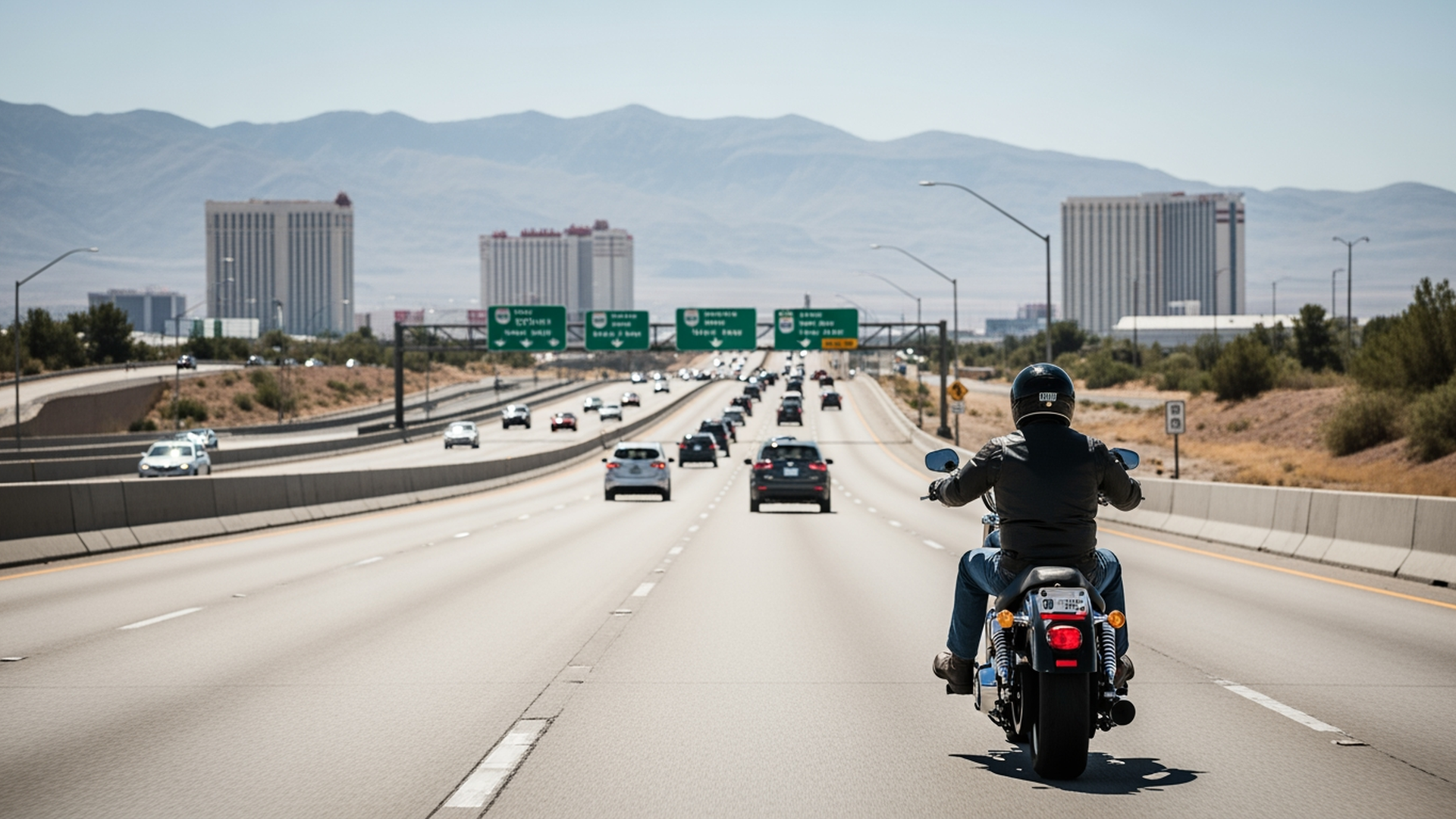
The Most Dangerous Roads for Motorcyclists in Las Vegas
Every Las Vegas rider has a road that raises the hair on the back of their neck. The valley packs tourist traffic, rental cars, distracted drivers, and some of the busiest interchanges in the Southwest into a grid you cross every day. A few corridors stand out as the ones that hurt riders again and again, not because riders are careless on them, but because of how they are built and who is driving them. Knowing which roads carry the most risk, and why, is how you ride them like the target you unfortunately are on a bike.
I-15 Through the Resort Corridor
The stretch of I-15 that runs past the Strip is the busiest freeway in Nevada, and for a rider it is a gauntlet. Out-of-state drivers who do not know the exits brake late and swerve across three lanes for the Sahara or Tropicana ramps. Traffic stacks up and breaks free without warning, rental cars drift between lanes while the driver reads a sign, and the low desert sun washes a motorcycle right out of a mirror. Speeds swing from a dead stop to freeway pace in seconds. Ride the resort corridor with a big cushion in front of you, stay out of blind spots instead of hanging beside a car, and treat every brake light as the start of a chain reaction, because on I-15 it usually is.
The Spaghetti Bowl (I-15 and US-95)
Where I-15 crosses US-95 just north of downtown, the Spaghetti Bowl tangles two interstates into a maze of stacked ramps, short merges, and lanes that appear and vanish. It is one of the highest-volume interchanges in the state and one of the most unforgiving for a bike. Merging traffic converges from several directions at once, drivers cut across lanes to catch a connector at the last second, and there is little room to recover when someone misses their exit. A rider caught in the wrong lane here has cars closing from two sides. Pick your route through the interchange before you reach it, commit to your lane early, and never assume the driver merging beside you has seen you.
US-95 Across the Valley
US-95 carries commuters clear across the valley, from the northwest down through downtown and out toward Henderson and Boulder City. It moves fast, it is heavily traveled, and its interchanges and lane drops give distracted drivers constant chances to make a mistake at speed. Construction zones shift lanes and shoulders without much warning, and the sun sits low across the road at both ends of the day. On a corridor like this the danger is speed differential, the car that closes on you far faster than you expect. Keep your following distance honest, watch the mirrors as much as the road ahead, and give yourself an escape lane whenever traffic bunches up.
The I-215 Beltway
The Beltway rings the south and west of the valley and feels like the easy way around town, which is exactly why riders relax on it. Traffic runs fast, the curves are long and open, and drivers treat it like open highway even where it is thick with cars merging on and off. High speeds meet frequent on-ramps, and a driver flowing onto the Beltway while looking left for a gap will never see a bike already in the lane. Crosswinds sweep across the open desert stretches and shove a motorcycle sideways. Stay visible near every on-ramp, cover your brakes through the merges, and do not let the open feel of the Beltway lull you into a driver's blind spot.
Boulder Highway
Boulder Highway has a hard reputation among Southern Nevada riders and pedestrians alike, and it is earned. This long, wide arterial running southeast toward Henderson has for years ranked among the most dangerous roads in the valley for serious and fatal crashes. Wide lanes invite speed, the many driveways, bus stops, and cross streets create constant conflict points, and lighting and pedestrian traffic vary block to block. For a rider it stacks every urban hazard together: cars pulling out of lots, drivers turning left across your path, and vehicles changing lanes without a look. Slow down below the flow if you have to, stay out of the far lanes near driveways, and treat every gap in traffic as a car about to pull into it.
The Strip and Its Left-Turn Chaos
Las Vegas Boulevard through the resort district is a different animal. Traffic crawls, pedestrians pour off the curbs, rideshares stop wherever they please, and tourists who have never driven the road make sudden turns while looking up at the lights instead of at the lane. The single deadliest crash for any motorcyclist is a car turning left across the rider's path, and the Strip and its side streets serve that up constantly. A driver watching for a parking garage or a hotel entrance simply does not register an oncoming bike. Ride the Strip slow and deliberate, assume every waiting car will turn in front of you, and position yourself where a left-turning driver has the best possible chance of seeing you coming.
How to Ride Any of Them Defensively
The corridors change but the survival habits do not. On every one of these roads, the goal is the same: be seen, buy yourself space, and never bet your safety on a driver doing the right thing.
- ✓ Own a space cushion. Following distance is time to react. On fast corridors like I-15 and US-95, more space in front of you is the single biggest thing standing between a close call and a crash.
- ✓ Live outside the blind spots. Do not ride alongside a car through a merge or interchange. Get ahead of it or drop back, so a driver drifting into your lane has somewhere to see you.
- ✓ Cover your brakes at every conflict point. On-ramps on the Beltway, driveways on Boulder Highway, and intersections on the Strip are where cars appear. A finger already on the lever saves the fraction of a second that counts.
- ✓ Assume the left-turn driver never saw you. The number one motorcycle killer is a car turning left across your path. Slow, position for visibility, and be ready for it at every intersection.
- ✓ Respect the tourist factor. Rental cars and out-of-state drivers brake late, turn wide, and change lanes blind. On the resort corridor and the Strip, ride like the driver next to you has no idea where they are, because often they do not.
Why the Road You Crash On Can Decide Your Claim
Here is what most riders never think about until they are already hurt. Nevada follows modified comparative negligence with a 51 percent bar. Your recovery is reduced by your share of the fault, and if the insurance company can pin more than 50 percent of the blame on you, you are barred from recovering anything at all. On a chaotic corridor like the Spaghetti Bowl or the Strip, where fault is genuinely tangled, that rule is exactly the opening an adjuster looks for, and they lean hard on the old bias that the rider must have been going too fast or weaving through traffic. On top of that, Nevada requires drivers to carry only minimum liability coverage of 25/50/20, which can run dry fast after a serious motorcycle crash, and this is a state thick with tourist and uninsured drivers. That makes your own uninsured and underinsured motorist coverage a Las Vegas rider's real backstop. Every rider and passenger in Nevada must also wear a DOT helmet, no exceptions. And if you do go down, Nevada gives you two years from the date of the crash to file an injury claim. Where and how the crash is documented can matter as much as how it actually happened.
Eric Blank and the Las Vegas motorcycle accident attorneys at Eric Blank Injury Attorneys represent riders hurt by negligent drivers. If you have questions after a crash, their team is here to help.