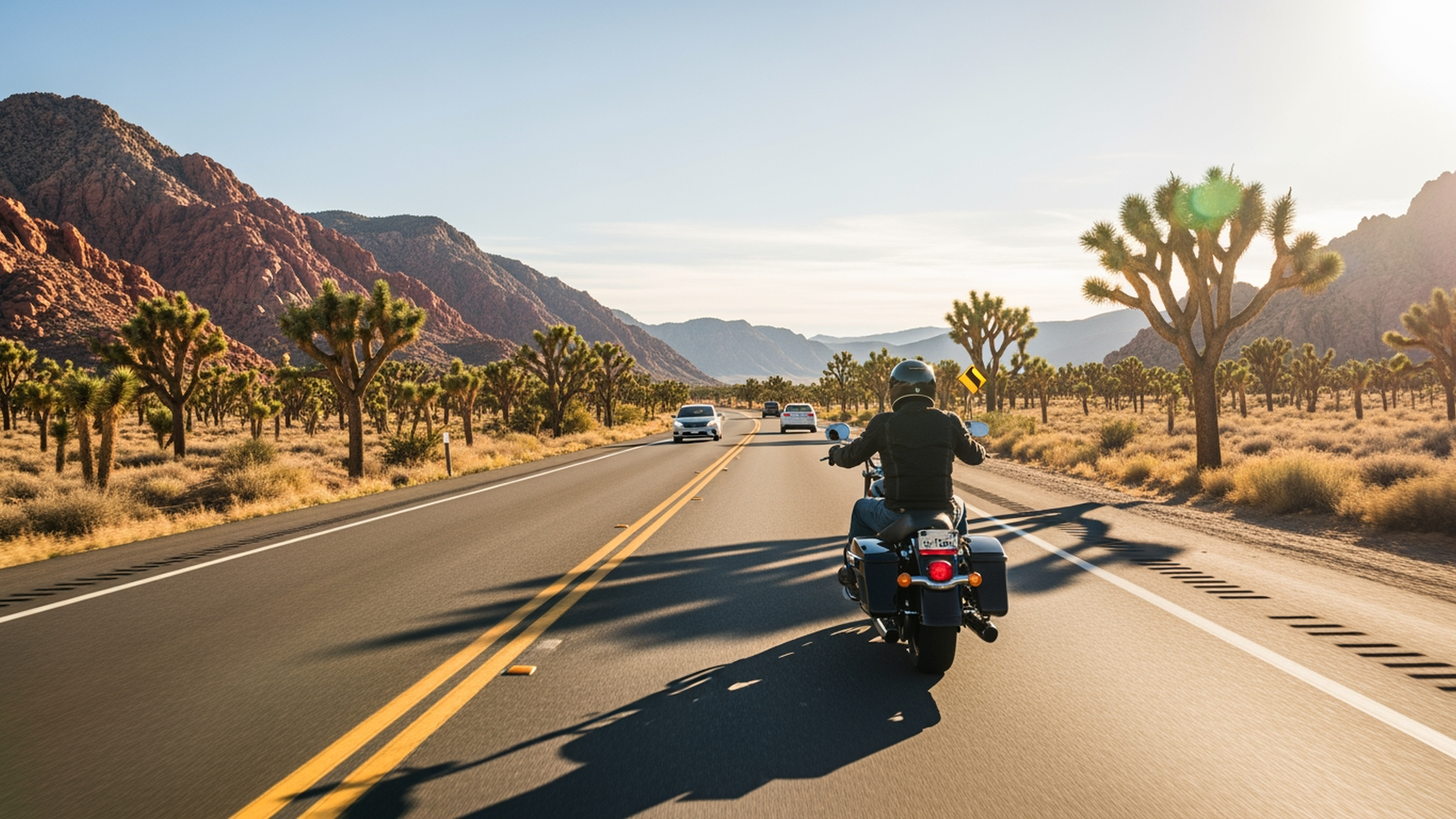
Fall Desert Riding Hazards in Nevada: What Bites Las Vegas Riders When the Heat Finally Breaks
Ask any Las Vegas rider and they will tell you fall is the payoff. You spent June, July, and August dodging 110-degree pavement, and now the heat finally breaks, the light goes golden, and a run out the Red Rock Canyon Scenic Loop or up SR-160 toward Pahrump is the reason you own the bike. It is also the season that quietly puts good riders on the ground. The Mojave does not stop being the desert just because the temperature dropped. Cooler air brings its own hazards, from flash-flood washes and blowing sand to wildlife on the move and thin cold air up the mountain, and in Nevada the fault rules make a fall crash even more punishing than it looks. Knowing what October and November throw at you is half the fight.
Flash-flood season and the water across the wash
People picture the desert as bone dry, and most of the year it is. But fall is still monsoon and storm season around Southern Nevada, and the Mojave does not soak up a downpour, it sheds it. Rain that falls miles away in the mountains funnels down into the washes and low crossings, and a road that was dry when you left the house can have moving water, mud, and gravel across it an hour later. The dips where desert roads cross a wash out toward Red Rock, along the routes to Pahrump and Mount Charleston, and on the back roads near Lake Mead are exactly the spots that fill first. Standing water hides how deep it is and what the storm dragged onto the pavement underneath, and even after the water drains the road is left slick with mud and loose rock.
The rule out here is simple and it saves lives. Do not ride into water running across the road, no matter how shallow it looks. Slow hard for any dip or wash after a storm, watch for the mud and gravel fan that a flash flood leaves behind, and if a crossing is flooded, turn around. No ride is worth guessing wrong about how deep that water is.
Blowing sand and high desert wind
Wind is the hazard Las Vegas riders underestimate most. The open stretches of I-15 north and south of the valley, the wide runs out to Red Rock and Pahrump, and the exposed high desert can turn a calm morning into a hard crosswind by afternoon. A gust that a car never feels can shove a motorcycle across a lane, and when that wind is carrying sand it does two things at once. It cuts your visibility to almost nothing in a blowing sheet, and it lays a slick, marble-like layer of sand across the pavement right where you need grip.
- ✓ Loosen up and ride the wind. A relaxed grip and gentle counter-pressure handle a crosswind far better than a death grip on the bars. Expect the gust before the overpass, the gap between hills, and the open desert flats.
- ✓ Treat blown sand like ice. A fan of sand across a corner or a lane on the roads to Red Rock and Pahrump gives up grip the instant you lean or brake on it, so get your speed off upright and early.
- ✓ Back off the semis and box trucks. On I-15 a big rig throws a wall of turbulence, and stacked with a natural crosswind it can move you around hard. Do not linger alongside one.
- ✓ Respect a real sandstorm. If blowing sand drops your visibility, get off the road and wait it out. You cannot ride what you cannot see.
Big temperature swings and thin mountain air
The fall desert giveth and taketh away. A morning that starts in the 40s can climb into the 70s or 80s by afternoon, and that swing matters on a bike. Cold rubber does not grip, so your tires are stiff and down on traction for the first several miles of a cool morning, right when a cold-tire lowside is most likely. Tire pressure drops about a pound for every ten-degree fall in temperature, so what was set right in the summer heat can be low on a cold morning. And if your ride climbs, the air gets colder and thinner fast. Head up Kyle Canyon or Lee Canyon toward Mount Charleston on SR-157 or SR-156 and you can leave a warm valley and arrive twenty or thirty degrees colder at elevation, with the first frost, damp shade that never dries, and even early snow up top well before the valley sees it.
- ✓ Dress in layers you can shed. A 45-degree desert dawn becomes an 80-degree afternoon, and a warm valley becomes a cold mountain. Pack for both ends of the day.
- ✓ Warm the tires before you push. Take the first few miles easy, no hard braking or aggressive lean, until cold rubber comes up to temperature.
- ✓ Check your pressures more often. Colder air means lower pressure, and an underinflated tire handles worst right when the roads are least forgiving.
- ✓ Respect the mountain. Up Mount Charleston the shaded switchbacks stay cold and damp, and a stiff, chilled rider reacts slower. Ride it warm and ride it awake.
Low sun glare and wildlife on the move
Fall changes the light as much as the temperature. The sun sits low right at the times most people are driving, blasting straight down east-west streets like Charleston, Sahara, and the arterials feeding the valley during the morning and evening rush. A driver squinting into that wall of light may never register a single headlight coming at them. Assume at sunrise and sunset that half the drivers around you are blinded, and buy yourself space and an escape route at every intersection. Fall is also when the desert wildlife moves. Wild burros wander the roads around Red Rock and out toward Lake Mead, bighorn sheep come down to lower ground near the Red Rock loop and the Lake Mead shorelines, and a burro standing in a dark lane at dusk is a serious threat to a rider. Scan the shoulders and the treeless flats, not just the pavement, and back your speed down on those roads at first and last light so you actually have room to react.
Why a fall crash hits Nevada riders harder
Here is the part too many Las Vegas riders learn after the crash instead of before it. Nevada follows modified comparative negligence with a 51 percent bar. Your recovery is reduced by your share of fault, and if you are found more than 50 percent at fault you are barred from recovering anything at all. That is exactly why the insurance company fights so hard to hang blame on the rider after a fall crash, arguing you were going too fast for a wet wash, should have seen the sand, or had no business out in the wind. Do not let "it was slick out" get twisted into "the rider caused it." Standing water, blown sand, and low sun do not hand a careless driver a free pass, and how the crash is documented drives that fault number.
- ✓ Modified comparative negligence, 51 percent bar. Nevada reduces your recovery by your share of fault and bars it entirely above 50 percent, so documenting the crash matters enormously.
- ✓ Universal helmet law. Every rider and passenger in Nevada must wear a DOT-approved helmet, no exceptions, so keep yours on and make it work for you.
- ✓ Minimum liability is 25/50/20. That is often not enough for a serious injury, which is why UM/UIM coverage is a rider's real backstop in a tourist-heavy, uninsured-driver-heavy town.
- ✓ Two years to file. The statute of limitations on a Nevada injury claim is generally two years, and waiting can quietly end a valid case.
If a fall-condition crash does happen, protect yourself and get medical care first, because hidden injuries have a way of surfacing days later. Then document the conditions while they are fresh: photograph the water, the sand, the mud, the low sun, and the exact spot it happened. In a comparative fault state those details are not a formality, they are the difference between a full claim and a slashed one.
Led by Eric Blank, Eric Blank Injury Attorneys in Las Vegas fights for injured motorcyclists. Reach out to their motorcycle accident lawyers in Las Vegas anytime you need real answers.