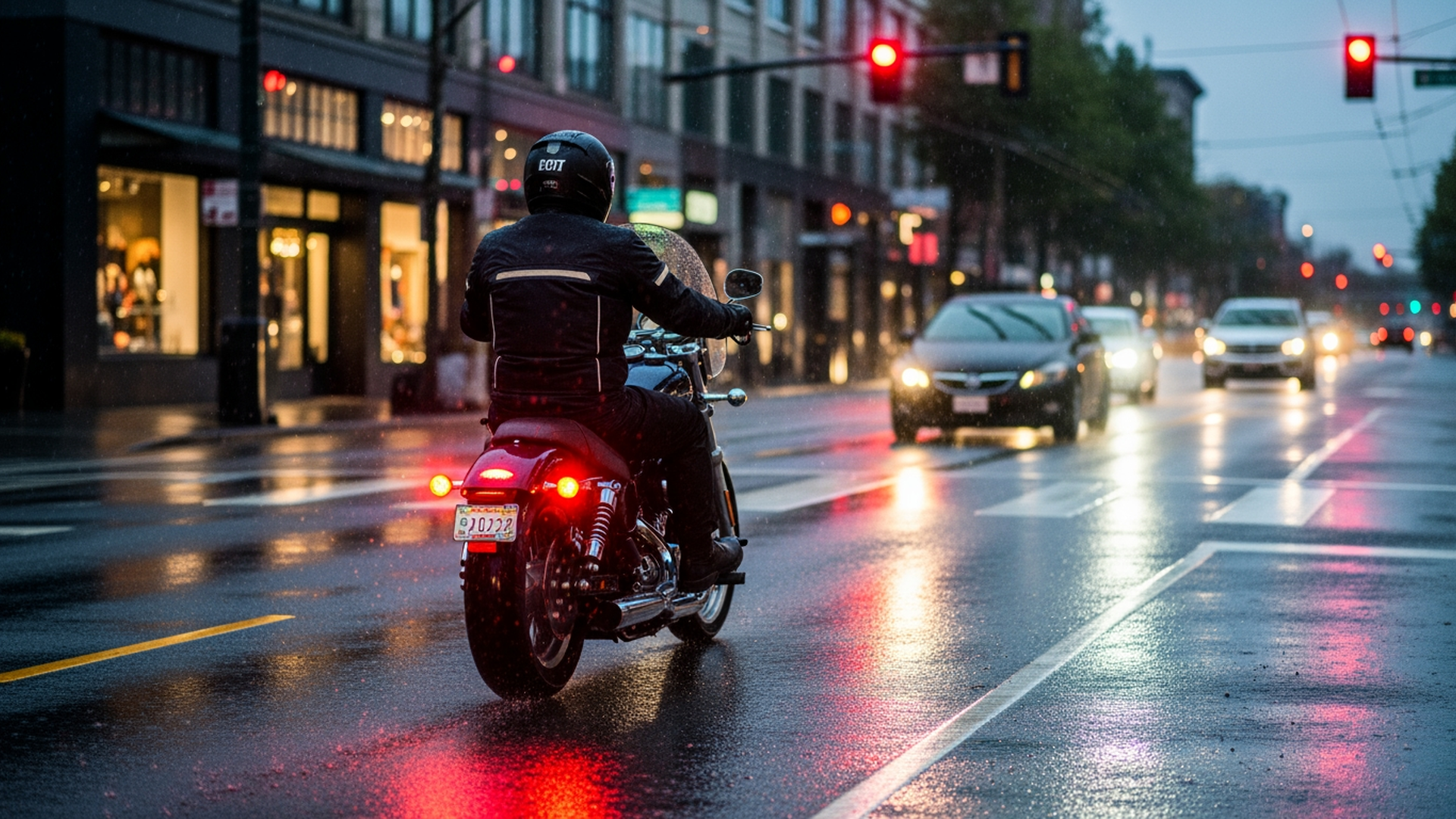
Night Riding in Seattle: Staying Seen in the Rain, the Glare, and the Dark
By the first week of November the clocks have fallen back and sunset lands in the late afternoon, and in Seattle the dark only stretches longer from here into the deep winter. That means a big share of Puget Sound riding shifts into the dark. Night riding is not reckless on its own, but it strips away your single biggest advantage on the road, which is being seen. Do it in Seattle and you stack another problem on top: the rain almost never quits, and wet pavement turns every headlight into a smear of glare. On a motorcycle, visibility is survival, and after dark in the wet you have to fight for it. Here is how to stay lit and stay upright once the sun goes down.
Why the dark is harder on a motorcycle
A car at night reads as a wide, obvious pair of headlights and a set of taillights. A motorcycle reads as a single light that a tired or distracted driver can mistake for something far away, or miss entirely. Depth perception fails in the dark, and a driver judging the gap before a left turn can badly misjudge how close and how fast you are coming. In Seattle the rain makes it worse. Wet pavement throws headlight glare back in every direction, smearing your one small light into the wash of reflections off the street, and rain on a windshield or your own visor scatters the light even more. The result is the crash Seattle riders should fear most: the left-turning driver who looks right at your headlight and still pulls across your path, because they never registered it as a fast-moving motorcycle.
The intersection is where it happens
Left-turn crashes are the number one killer of riders, and they happen at intersections. A driver waiting to turn left across your lane sees a gap that is not really there, because they misjudged your speed or never picked your headlight out of the background of city lights. After dark and in the rain, that misjudgment gets far more likely. Every lit intersection on Aurora, Rainier, Denny, Mercer, or a downtown grid corner is a place where an oncoming car might turn into you, or a cross-street driver might pull out. Treat each one as a live threat. Cover your brakes on the approach, watch the front wheels of any car waiting to turn because they move before the car does, back off the throttle so you have options, and pick a lane position that keeps your headlight in the driver's line of sight and gives you an escape route.
Own your visibility, do not assume it
You cannot control whether a driver is paying attention, but you can control how hard you are to miss. The riders who make it home are the ones who stack the deck with gear and lighting, not the ones who trust drivers to look twice.
- ✓ Reflective gear on the parts that move. Reflective strips on your jacket, helmet, and boots catch headlights and read as a human, not a road sign. Movement draws the eye through the rain and glare.
- ✓ A clean, aimed headlight. A grimy or misaligned headlight throws away half its output, and road spray coats a lens fast in a Seattle winter. Wipe it and check the aim.
- ✓ A clear, clean face shield. Scratches, haze, and rain beads turn oncoming headlights into starbursts and cost you the detail you need. An anti-fog treatment and a fresh shield are worth it in the wet season.
- ✓ Auxiliary lights that widen your footprint. A pair of lights spreads your signature so you stop looking like a single distant point that a left-turning driver can misjudge.
- ✓ A bright, working brake light. In stop-and-go on a wet arterial, the driver behind you needs the clearest possible warning the moment you slow.
Impaired-driver hours and the roads past the city lights
Two more things change after dark. The late-evening and overnight hours, especially on weekends, are when impaired drivers are most likely to be on the road, and an impaired driver is exactly the one who will drift a lane, miss a signal, or turn across your path without ever seeing you. Give yourself extra space late at night and read every car around you as if the driver might not be all there. And when you leave the city lights behind, the problem flips. Head out past the metro onto the two-lanes toward the Cascade foothills, the Kitsap Peninsula, or the farm country of the river valleys and the streetlights simply disappear. Your headlight becomes the whole show, a curve you can read easily by day becomes a guess, and those unlit roads are prime territory and prime hours for deer and elk, which move most at dawn and dusk and give you almost no warning at the edge of your beam. Ride these roads slower at night than in daylight, use your high beam when no one is oncoming, and treat the edge of your light as the edge of what you can safely handle. If you cannot stop within the distance your headlight reaches, you are riding too fast for the dark.
When a driver never saw you
You can do everything right and a driver can still turn left across your path or pull out from a side street because they registered your headlight too late or not at all. When that happens, "I never saw the motorcycle" is not a defense, it is an admission that the driver failed to look for you. Washington follows pure comparative negligence: your recovery is reduced by your share of fault, but it is never barred outright, so even a partly at-fault rider still recovers. That is more rider-friendly than most of the country, but it does not stop insurers from fighting. After a night crash they love to argue the rider was hard to see, as if that shifts the blame off their driver and inflates your fault share. Whether your lights and gear met the moment, and how the crash actually unfolded, become central questions, which is exactly why the details matter.
- ✓ PIP is optional in Washington. Washington is an at-fault state and Personal Injury Protection is coverage you can add or reject, so many riders rely on health insurance and UM/UIM for their own medical bills. Know what you carry.
- ✓ Minimum liability is only 25/50/10. Often not enough for a serious injury, which is why UM/UIM coverage is your real backstop against an impaired or underinsured driver.
- ✓ Universal helmet law. Every rider and passenger in Washington must wear a DOT-approved helmet, so keep yours on and add reflective detail to it.
- ✓ Three years to file. The statute of limitations on a Washington injury claim is generally three years, with separate steps for claims involving a government entity, so do not let the clock run.
If a driver hits you after dark, get medical care first, then document the scene while it is fresh: the intersection, the lighting, the rain, your gear and lights, and the exact spot it happened. Washington's pure comparative rule means you can still recover even if you carry part of the blame, but the details are what keep that blame off you in the first place.

Have questions after a wreck? Janelle Bailey and the Seattle-Tacoma motorcycle injury attorneys at Washington Injury Law (washingtoninjurylaw.com) review rider claims and explain your options.